
Things
Golf
Golf is a club-and-ball game played over a course of holes in as few strokes as possible - and where it began is a genuine historical debate. Stick-and-ball games existed earlier in the Netherlands and China, but the first written record of golf itself is Scottish: an act of 1457 banning the game for stealing men from archery practice. Scotland gave it written rules in 1744, the 18-hole round in 1764, and its oldest championship in 1860.
At a Glance
- What it is
- A cross-country club-and-ball game: players hole a ball in a series of holes on a course, in as few strokes as possible
- Earliest written record
- An act of the Scottish Parliament of 6 March 1457 banning golf and football for distracting men from archery practice
- The origin question
- Dutch colf and Chinese chuiwan are earlier stick-and-ball games; the codified game played today was developed in Scotland - the debate is genuine and set out on this page
- First written rules
- Thirteen articles drawn up by the Gentlemen Golfers of Leith, Edinburgh, in 1744
- The 18-hole round
- Set at St Andrews in 1764, when its course was shortened from 22 holes to 18
- Governing bodies
- The R&A, descended from the Society of St Andrews Golfers (1754), writes the rules jointly with the USGA
- Oldest championship
- The Open, first played at Prestwick on 17 October 1860 and won by Willie Park Sr
Introduction
Golf is a cross-country game in which a player strikes a small ball with various clubs from a series of teeing grounds into a series of holes, in as few strokes as possible. A standard round is 18 holes, and the same basic game - codified in Scotland - is now played worldwide, from village courses to the four major championships.
Golf is unusual among major sports in having no single inventor and a genuinely contested birthplace. Stick-and-ball games were played in the Netherlands and China centuries before the word golf appears anywhere; but the game that survived, acquired written rules and spread worldwide was assembled in Scotland between the 15th and 18th centuries.
The Origin Debate: Netherlands, China, Rome
Several older games compete for the title of golf's ancestor. In the Netherlands, colf (later kolf) was played from at least the 13th century, players striking a ball with a club towards a target, sometimes on frozen canals; the word golf may itself derive from the Dutch kolf, meaning a club. In Song-dynasty China, chuiwan - striking a ball - was played with clubs and balls centuries before Scotland's first record. Rome had paganica, a leather ball stuffed with feathers, hit with a bent stick.
Britannica's assessment is blunt: the evidence now suggests early forms of golf were played in the Netherlands first and then in Scotland, and its history heads one section "Scots as inventors: a popular fallacy". What the Dutch and Chinese games lacked, so far as the record shows, was the defining feature of the Scottish game: the hole in the ground as the target, played over a course of holes in sequence. Scotland did not invent the stick-and-ball idea - but the game the world plays descends from the Scottish version, not from colf or chuiwan.
Scotland: Banned, Then Royal
Golf's first appearance in any written record is a prohibition. On 6 March 1457 the Scottish Parliament under James II decreed that football and golf - "futbawe and ye golf" - be "utterly cryit doune" and not used, because they drew men away from the archery practice on which the kingdom's defence depended. The ban was repeated in 1471 and again, angrily, in 1491. A game does not get banned three times unless it is popular.
The ban lapsed with the peace of 1502, and James IV - the king who had renewed the prohibition in 1491 - became the first authenticated royal player, with the first recorded purchase of golf equipment that year. The game was played on the common coastal land called links, above all at St Andrews, where a charter of 1552 confirmed the townspeople's right to play golf on the links. Golf was never only royal: it was a game of the links and the towns, one reason it survived its bans.
Timeline
- 13th century
Colf is played in the Netherlands - golf's closest documented relative among stick-and-ball games.
- 6 March 1457
The Scottish Parliament bans golf and football for distracting men from archery - the game's first written record.
- 1491
A third Scottish ban names golf among "unprofitable sports"; within a decade the ban lapses.
- 1502
James IV makes the first recorded purchase of golf equipment and becomes the game's first authenticated royal player.
- 1552
A charter confirms the right of St Andrews townspeople to play golf on the links.
- 1744
The Gentlemen Golfers of Leith draw up the first known written rules - thirteen articles - at Leith Links, Edinburgh.
- 1754
Twenty-two golfers form the Society of St Andrews Golfers, ancestor of the Royal and Ancient Golf Club.
- 1764
St Andrews shortens its course from 22 holes to 18, setting the standard length of a round.
- 1834
William IV becomes patron of the St Andrews society, which takes the name Royal and Ancient Golf Club.
- 17 October 1860
The first Open Championship is played at Prestwick; Willie Park Sr beats Old Tom Morris by two strokes.
- 1897
The Royal and Ancient publishes the first unified Rules of Golf, recognised across most of the world.
Rules, St Andrews and the R&A
The modern game's machinery is Scottish and 18th-century. The first written rules were drawn up not at St Andrews but at Leith in Edinburgh, where in 1744 the Gentlemen Golfers - later the Honourable Company of Edinburgh Golfers - wrote thirteen articles for a silver club competition. Ten years later the Society of St Andrews Golfers adopted a similar code, and in 1764 St Andrews reduced its course from 22 holes to 18 - an economy measure that became, by imitation, the worldwide standard.
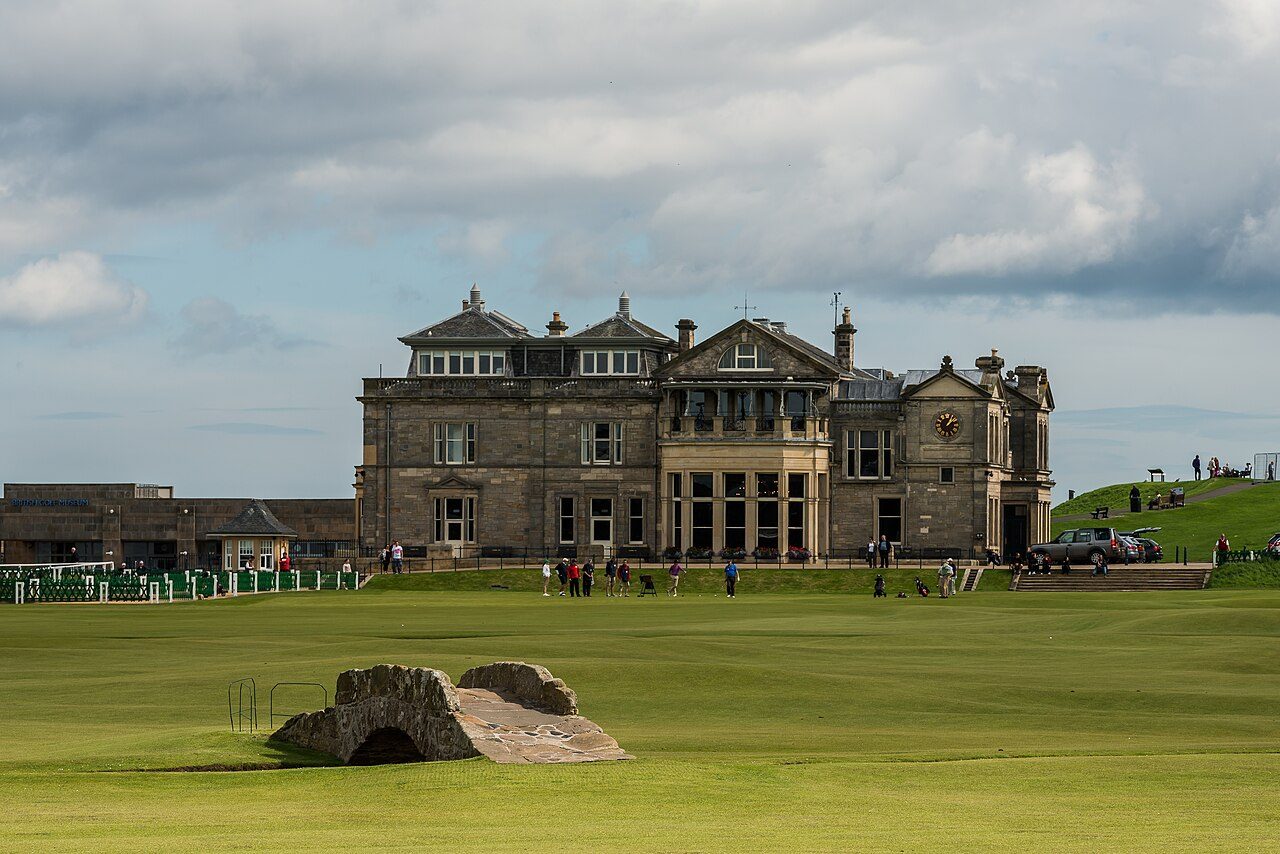
The St Andrews society, renamed the Royal and Ancient Golf Club in 1834, became the game's legislator: it published the first unified Rules of Golf in 1897 and ran the game everywhere except the United States and Mexico, where the USGA governed. Since 2004 its governing functions have sat with a separate body, The R&A, which still writes the rules jointly with the USGA and runs The Open. The Old Course - public links owned by the town's Links Trust - remains the game's symbolic home.
The Open and the Professional Game
Golf's oldest championship was born from a vacancy. When Allan Robertson of St Andrews, the finest player of his day, died in 1859, the members of Prestwick Golf Club organised a competition to find his successor as Champion Golfer. On 17 October 1860 eight professionals played three rounds of Prestwick's twelve-hole course in one day for a red leather Challenge Belt; Willie Park Sr of Musselburgh scored 174 and beat the local favourite, Old Tom Morris, by two strokes.
The Open grew from that field of eight into a championship played before vast crowds on the great links, and professional golf grew with it - to the Masters, the PGA Championship and the US Open alongside The Open, to the Ryder Cup, and to a global tour game. Yet it still returns regularly to the links where the written game began, and the Claret Jug is still presented within sight of ground where golf was played before it was ever banned.
Significance
Golf's significance lies in how completely a local pastime became a world standard without a founding moment. No committee invented it; a banned game on Scottish common land acquired rules, clubs, a governing body and a championship by accretion over four centuries, and the result - 18 holes, a shared rulebook, stroke play - proved exportable everywhere. It is also one of few sports whose highest level is still played on its original ground: the Old Course is both museum and working championship venue.
Myths and disputes
Did Mary, Queen of Scots play golf? The claim is repeated everywhere, and the evidence is thin: the 1911 Encyclopaedia Britannica found only "some scrap of evidence" connecting her to the game, while her father James V's and grandfather James IV's golfing are properly documented. She may have played; the record does not prove it, and this page treats the story as tradition, not fact.
The shepherds' origin story - herdsmen knocking stones into rabbit holes with crooked sticks - is likewise a picturesque legend without a document behind it. And the claim that golf is an acronym of "Gentlemen Only, Ladies Forbidden" is a modern invention: the word is centuries older, most plausibly from the Dutch word for a club. The genuine dispute is the scholarly one above - whether the game's roots are Dutch or Scottish - and on that the evidence supports a Dutch ancestor and a Scottish invention of the game as played.
Legacy
Golf's legacy is a game that carries its history in its geography. Its oldest championship dates to 1860, its rulebook descends from thirteen articles written at Leith in 1744, its standard round was fixed by a course-shortening at St Andrews in 1764, and its governing body still sits beside the Old Course's first tee. Few sports can point to the ground where they became themselves; golf can - even if hitting a ball with a stick arrived, as the Dutch evidence suggests, from across the North Sea.
Sources
- Encyclopaedia Britannica - Golf
- 1911 Encyclopaedia Britannica - Golf (Wikisource)
- The Open (The R&A) - The 1st Open
- The Open (The R&A) - Previous Opens: 1st Open, Prestwick 1860
The facts on this page were checked against these sources on 19 November 2026. The History Trail's permanent pages are researched and written for this site; the live profiles elsewhere on The History Trail are assembled automatically from Wikipedia and Wikidata.
About the Author
Researched and written by the The History Trail Editorial Team — the accountable editorial function behind this site's permanent story pages. The team works from the published sources cited on each page; it does not invent historians, reviewers or credentials, and it corrects errors openly.
Fact Check
Every load-bearing fact on this page traces to one of the sources listed above, and significant claims link to their source in the text. Our checking method is described on the methodology page; errors can be reported via the corrections page.
Sources & Citations
Cite this page as: The History Trail Editorial Team, The History Trail — this article's title, publication and update dates are shown beneath its headline. The full source list appears under Sources above; the site's source standards are on the sources page.