
Things
Sequoiadendron giganteum
The giant sequoia (Sequoiadendron giganteum) is the largest tree on Earth by volume, growing naturally only in scattered groves on the western slopes of California's Sierra Nevada. Indigenous peoples lived alongside it for millennia, but its 1852 debut before Euro-American audiences - and the felling and bark-stripping of its most famous trees - helped provoke the conservation movement that created America's protected parks.
At a Glance
- What it is
- A coniferous evergreen of the cypress family (Cupressaceae), the only species of the genus Sequoiadendron and, in Britannica's words, the largest of all trees in bulk
- Where it grows
- Only in scattered groves on the western slopes of the Sierra Nevada, California, at elevations between 900 and 2,600 metres (Britannica)
- The largest
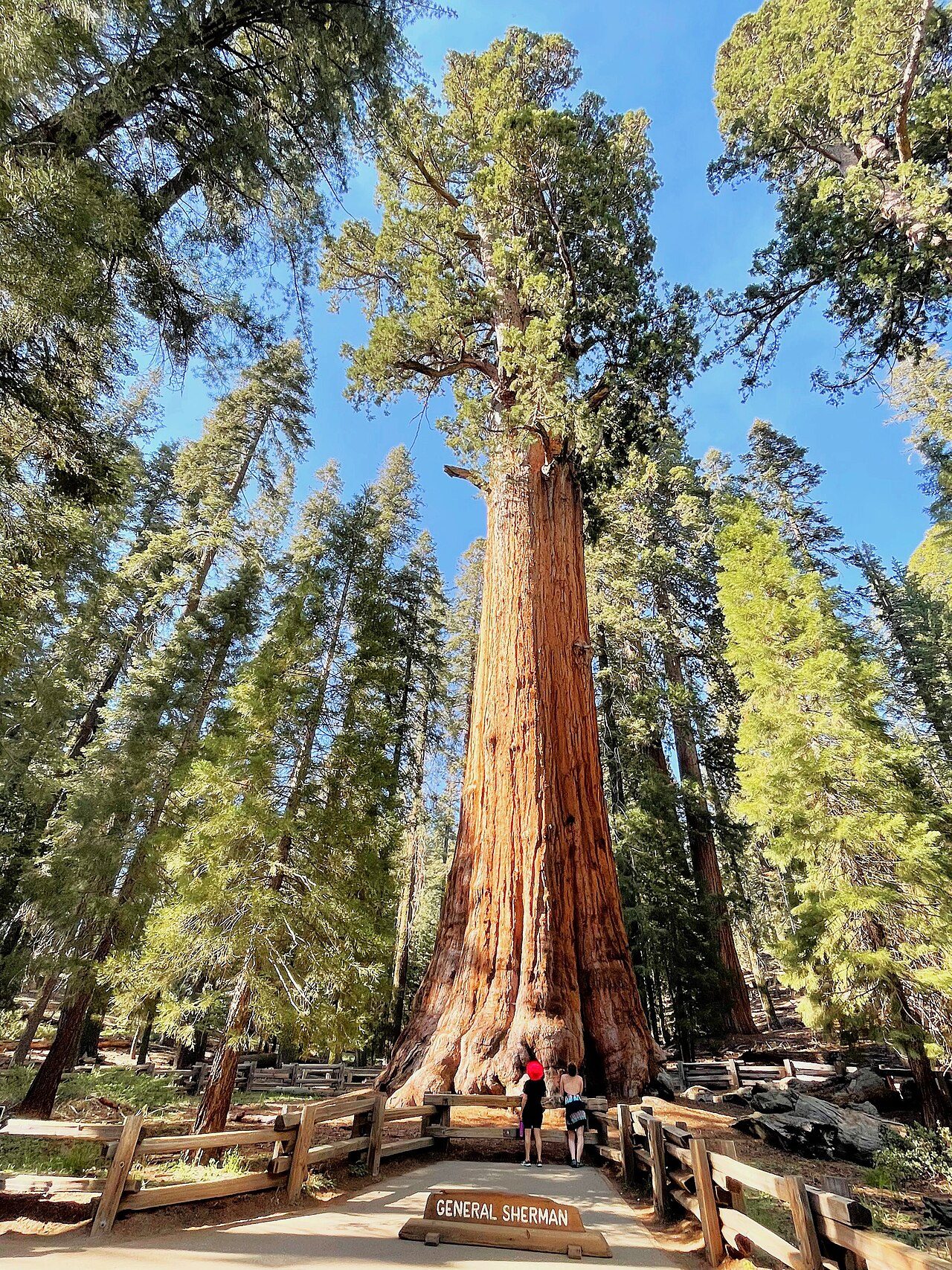
- The General Sherman Tree in Sequoia National Park: 274.9 feet (83.8 m) tall, 102.6 feet in circumference at the ground, and an estimated volume of 52,500 cubic feet, according to the National Park Service
- The 1852 debut
- Hunter Augustus T. Dowd's 1852 report of the Calaveras grove brought the species to Euro-American attention; the Discovery Tree was felled in 1853
- The cost
- The Discovery Tree was cut down and its stump used as a dance floor; the Mother of the Forest was stripped of bark in 1854 for exhibition and died
- Protection
- The Yosemite Grant followed in 1864; Sequoia and Yosemite national parks were created in 1890; most of the roughly 70 groves are now protected, though the species is listed as endangered on the IUCN Red List (Britannica)
Introduction
No living thing better measures the gap between knowing a place and merely hearing about it. The giant sequoia grows in about 70 groves in a narrow band of the Sierra Nevada, and the people of those mountains knew the trees for thousands of years before any newspaper did. Then, in one gold-rush decade, the species was announced to the world, exhibited as a freak of nature, cut down for proof, and mourned in print - in that order. Its history is two histories: the long, quiet one of a tree in its homeland, and the loud, short one of what happened when the wider world arrived.
Britannica describes the giant sequoia as the largest of all trees in bulk and the most massive non-clonal organism by volume, distinct from the coast redwoods, which grow taller but slimmer. A mature sequoia can live for more than 3,000 years. Yet the species now survives only where people decided, in time, to protect it.
The First Inhabitants: Indigenous Knowledge of the Groves
The earliest human encounters with the giant sequoia came shortly after the first Native Americans reached the Sierra Nevada, and for millennia the relationship was, in a US Forest Service history's word, benign. The Miwok, whose seasonal villages stood along the foothill rivers below the groves, had a name for the tree recorded in 1877 as woh-woh-nau, said to imitate the hoot of the owl, the guardian spirit of the great trees. Calaveras Big Trees State Park's account notes that some Native groups held the trees sacred and untouchable, while the Miwok respected them and made careful use of the country around them.
1852: Calaveras and the Price of Proof
A European sighting had been noted as early as 1833, when the Walker Party crossed the Sierra, but it made little impression. The effective debut came in spring 1852, when Augustus T. Dowd, a hunter supplying a water company near the mining town of Murphys, followed a wounded grizzly into a grove of enormous trees in Calaveras County. The National Park Service's scientific history records that his workmates treated the report as a tall tale; the Sonora Herald printed the news in June 1852 and it travelled fast.
What followed was exploitation dressed as wonder. The tree Dowd had described, remembered as the Discovery Tree, was felled in 1853 after weeks of work, and its stump - wide enough to serve as a dance floor - became a tourist attraction. In 1854 another giant, the Mother of the Forest, was stripped of its bark to about 120 feet; the sections were shipped away and reassembled for exhibition, including at the Crystal Palace in London, while the tree died standing. A hotel rose beside the grove, and dances were held on the stump. John Muir later wrote of the felling with contempt, in an essay remembered for its charge that the vandals then danced upon the stump.
From Spectacle to Sanctuary
The spectacle also produced its opposite. Outrage at Calaveras fed a new idea: that some landscapes should be held in trust rather than sold. In 1864 the federal government granted Yosemite Valley and the Mariposa Grove to California as a protected park - a decision in which, historians of the grove note, the felling of the Discovery Tree was directly cited in congressional debate. Yellowstone became the first national park in 1872, and in 1890 Sequoia and Yosemite were made national parks, with John Muir among the sequoia's most effective advocates. Britannica credits Muir's advocacy with helping bring most groves under the protection of state or national forests and parks.
Protection did not end the cutting: logging of groves outside the parks continued into the twentieth century, the brittle wood shattering so badly on falling that felling often wasted much of the tree. Nor did protection end the threats. The National Park Service records that in September 2021 firefighters wrapped the base of the General Sherman Tree in protective foil as the KNP Complex Fire approached Giant Forest - a sign that hotter drought and severe wildfire now endanger trees that survived three thousand years of ordinary fire.
Timeline
- For millennia
Indigenous peoples, including the Miwok, live alongside the Sierra Nevada groves; the Miwok name for the tree is recorded in 1877 as woh-woh-nau.
- 1833
Members of the Walker Party sight giant sequoias crossing the Sierra Nevada - the first European notice, little reported.
- Spring 1852
Augustus T. Dowd, tracking a wounded grizzly, enters the Calaveras grove; the Sonora Herald prints the news in June 1852.
- 1853
The Discovery Tree at Calaveras is felled; its stump is used as a dance floor and bowling alley for tourists.
- 1854
The Mother of the Forest is stripped of its bark for exhibition; the reassembled bark is displayed as far away as London's Crystal Palace, and the tree dies.
- 1864
The Yosemite Grant protects Yosemite Valley and the Mariposa Grove under California - an early fruit of the Calaveras outcry.
- 1872
Yellowstone becomes the world's first national park, extending the preservation idea the sequoia debate helped start.
- 1890
Sequoia National Park and Yosemite National Park are established, protecting the greatest groves.
- 1931
The Calaveras groves, where the story began, finally gain protection as a California state park.
- September 2021
Firefighters wrap General Sherman's base in foil as the KNP Complex Fire threatens Giant Forest; the tree survives.
Significance
The giant sequoia's significance is out of proportion even to its size, because it changed how a young nation thought about nature. Before Calaveras, the American landscape was widely treated as inventory. The sequoias made that attitude visible: a tree older than Rome, cut down so its stump could hold a dance, was an image critics could use. The line from the Calaveras outcry to the Yosemite Grant, to Yellowstone, and to the national park idea that spread worldwide is not a straight one, but contemporaries drew it, and park historians have traced it ever since.
The tree also remains a scientific benchmark. The National Park Service gives the General Sherman Tree a height of 274.9 feet (83.8 metres), a ground circumference of 102.6 feet and an estimated trunk volume of 52,500 cubic feet (about 1,487 cubic metres) - the largest known living single-stem tree. The Park Service estimates it to be around 2,200 years old: a giant, but by sequoia standards only middle-aged.
Myths and disputes
Was the sequoia discovered in 1852? Only in a narrow sense, and this page uses the word with that caution. Indigenous peoples knew the groves for millennia, and a European party had noted the trees in 1833. Several men later claimed to have seen the Calaveras grove before Dowd - claims the National Park Service's history treats as suspect, because none was published until after his report. What happened in 1852 was not the finding of unknown trees but the moment the news became impossible for the outside world to ignore.
Is General Sherman the largest living thing on Earth? It is the largest known single-stem tree by trunk volume, which is the claim the National Park Service actually makes. It is not the tallest tree - coast redwoods grow taller - nor the oldest, and clonal organisms such as aspen colonies cover far more ground. The honest superlative is bulk: no other single tree holds as much wood.
Legacy
The sequoia's legacy stands in two places at once. In the Sierra Nevada, the groves endure - protected, studied, and now defended tree by tree against a changing climate, with the species listed as endangered on the IUCN Red List. And in the idea of the national park itself, exported to almost every country on Earth, the Calaveras story is part of the founding argument: that the world's wonders can be destroyed in a season for a season's profit, and that law, not sentiment, is what stops it.
The stump of the Discovery Tree still lies in the North Grove at Calaveras, where visitors walk past it on the grove trail. It may be the most eloquent exhibit in any American park: the tree that had to be destroyed, and danced on, before the country learned to keep the rest.
Sources
- National Park Service - The General Sherman Tree
- National Park Service - The Largest Trees in the World
- Encyclopaedia Britannica - Giant sequoia
- National Park Service - The Giant Sequoia of the Sierra Nevada (Hartesveldt et al.)
- USDA Forest Service - Discovery and History of Giant Sequoia (Harvey)
- Environmental History - Mother of the Forest (Neuzil and Kovarik)
The facts on this page were checked against these sources on 19 November 2026. The History Trail's permanent pages are researched and written for this site; the live profiles elsewhere on The History Trail are assembled automatically from Wikipedia and Wikidata.
About the Author
Researched and written by the The History Trail Editorial Team — the accountable editorial function behind this site's permanent story pages. The team works from the published sources cited on each page; it does not invent historians, reviewers or credentials, and it corrects errors openly.
Fact Check
Every load-bearing fact on this page traces to one of the sources listed above, and significant claims link to their source in the text. Our checking method is described on the methodology page; errors can be reported via the corrections page.
Sources & Citations
Cite this page as: The History Trail Editorial Team, The History Trail — this article's title, publication and update dates are shown beneath its headline. The full source list appears under Sources above; the site's source standards are on the sources page.