
Things
Wildfire
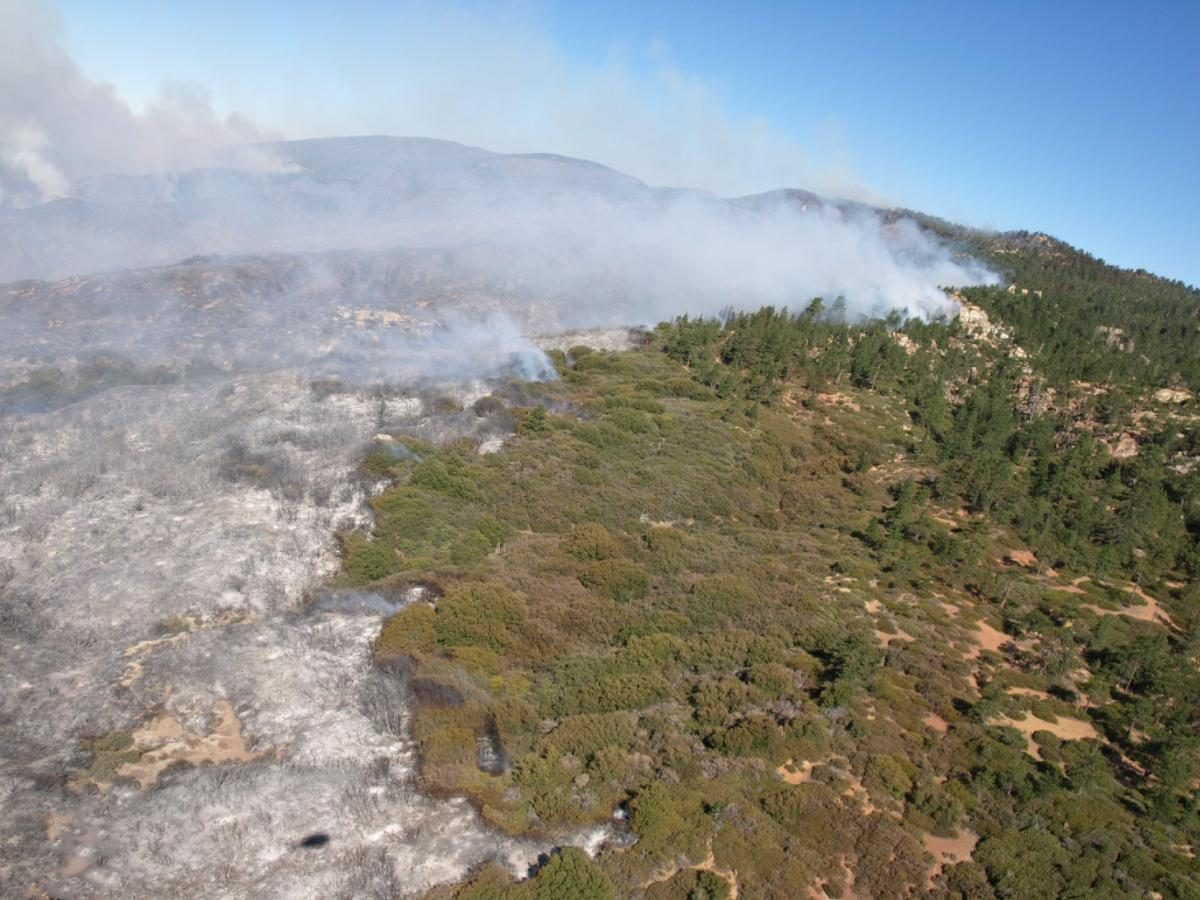
A wildfire is an unplanned fire burning in wildland vegetation - forest, grassland or shrubland - ignited by lightning or by people. It is both a natural ecological process, to which many plants and whole ecosystems are adapted, and, where it meets homes and towns, a disaster. For thousands of years Indigenous peoples used deliberate, frequent, low-intensity burning to manage landscapes; a century of total suppression after 1910 in the United States then loaded many forests with fuel. Modern fire science works between those two facts: restoring good fire, and fighting the bad.
At a Glance
- What it is
- An unplanned fire in wildland vegetation, ignited by lightning or human activity, distinct from prescribed (planned) fire
- Fire ecology
- Many species are fire-adapted: lodgepole pine's serotinous cones stay sealed with resin until fire's heat melts it and releases the seed (National Park Service)
- Indigenous burning
- Frequent low-intensity cultural burning managed grasslands and open forests for millennia; tree-ring records in British Columbia show surface fires every 5-10 years in dry forests before suppression
- Peshtigo, 1871
- The deadliest wildfire in US history: estimates of the dead range from about 1,200 to 2,500, across roughly 1.5 million acres in Wisconsin and Michigan
- The Big Blowup, 1910
- Fires burned about 3 million acres in Montana, Idaho and Washington in two days and killed 86 people; they locked in a policy of total suppression (Forest History Society)
- Suppression era
- The US Forest Service's 1935 '10 a.m. policy' required every fire to be controlled by 10 a.m. the day after it was reported; Smokey Bear followed in 1944
- Yellowstone, 1988
- Fires burned 793,880 acres, 36 percent of Yellowstone National Park (USGS/NPS figures), and the lodgepole forest regenerated rapidly from serotinous cones
Introduction
Wildfire has two reputations, and both are earned. To a town in its path it is an emergency measured in evacuations and lost homes. To a fire-adapted forest it is a recycling system older than the forest itself: charcoal in lake sediments records fire in western North America for at least 11,000 years, and many landscapes burn, in their natural rhythm, every few years or every few centuries. Fire science begins by holding both truths at once - its central distinction is not fire versus no fire, but the right fire, in the right place, at the right intensity, against the wrong one.
Three things decide a wildfire's behaviour: fuel, weather and topography. Dry, continuous fuel, hot windy weather and steep slopes produce the fast, high-intensity crown fires that make headlines. Burned frequently and gently, as Indigenous managers burned it, the same landscape carries fire along the ground instead. Fire policy is the history of learning that difference the hard way.
Fire Ecology: Landscapes That Need Burning
Many plants do not merely tolerate fire; they require it. The National Park Service's account of lodgepole pine, Yellowstone's dominant tree, describes its serotinous cones: sealed tight with resin that melts in a fire's heat, releasing seed stored for years onto a cleared, sunlit forest floor - exactly the conditions its seedlings need. The parent trees usually die in a severe fire; the species' strategy is not to survive the fire but to be reborn from it, in stands that burn again at intervals the Park Service puts at 150 to 400 years.
Elsewhere the rhythm is faster. In the dry ponderosa pine and Douglas-fir forests of the interior Pacific Northwest, fire-scarred trees record surface fires every 5 to 14 years over centuries - frequent, low flames that kept the understorey open. Giant sequoias and many grasslands show their own versions. Remove fire for a century and shade-tolerant trees crowd in and fuels accumulate, so fire returns at an intensity the old system never produced. Ecologists call the missing burning a fire deficit.
Indigenous Burning
Much of that frequent historical fire was set by people. Across North America, Australia and other continents, Indigenous peoples burned deliberately and skilfully - to renew grazing for game, to encourage food plants, to clear travel routes and to protect settlements. In the Pacific Northwest, tree-ring researchers find surface fires recurring every five to ten years in dry forests, with fire scars clustering near culturally important sites and in spring, outside the lightning season - signatures of cultural burning, as forest ecologist Lori Daniels and her colleagues describe.
Colonisation ended the practice, by law as well as by displacement. British Columbia's Bush Fire Act of 1874 made intentional burning in forests punishable by jail or worse. The fire scars stop, across study after study, in the late 1800s and early 1900s - exactly when Indigenous burning was suppressed. Modern agencies now formally learn from Indigenous practitioners, and cultural burning is being restored in several jurisdictions.
Catastrophe and the Suppression Century
The fires that shaped policy were the catastrophic ones. On 8 October 1871 - the same night as the Great Chicago Fire, which overshadowed it - the Peshtigo Fire swept Wisconsin and Michigan, burning roughly 1.5 million acres. It remains the deadliest wildfire in American history; estimates of the dead range from about 1,200 to 2,500 - reported here as a range, because the records of 1871 cannot support a single figure. In August 1910 the Big Blowup burned about 3 million acres in Montana, Idaho and Washington in two days and killed 86 people.
The Forest History Society's account is blunt: the men who fought the 1910 fires ran the US Forest Service for the next two decades and instituted total suppression as doctrine. The agency opposed even the light burning ranchers practised, built lookout towers and a national cooperative firefighting system, and in 1935 adopted the 10 a.m. policy - every fire controlled by ten the morning after it was reported. In 1944 Smokey Bear began teaching that all forest fire was bad. In fire-adapted forests the policy quietly manufactured the fuel loads later fires would burn in.
Timeline
- For millennia
Indigenous peoples use frequent cultural burning to manage grasslands and forests across North America, Australia and elsewhere.
- 8 October 1871
The Peshtigo Fire burns about 1.5 million acres in Wisconsin and Michigan; an estimated 1,200 to 2,500 people die - the deadliest US wildfire.
- 1874
British Columbia's Bush Fire Act criminalises intentional burning in forests, part of the colonial suppression of Indigenous fire use.
- 1905
The US Forest Service is established and takes charge of the national forests - and of fire protection on them.
- 20-21 August 1910
The Big Blowup burns about 3 million acres in Montana, Idaho and Washington and kills 86 people; total suppression becomes doctrine.
- 1935
The Forest Service adopts the 10 a.m. policy: every fire to be suppressed by 10 a.m. the day after it is reported.
- 1944
Smokey Bear is introduced to teach fire prevention - the public face of the suppression era.
- Summer 1988
Yellowstone's fires burn 793,880 acres, 36 percent of the park; the expected devastation instead shows rapid regeneration.
Significance
The Yellowstone fires of 1988 were the turning point the public saw. In an exceptionally dry summer, fires started by lightning and by people burned 793,880 acres - 36 percent of the park, on USGS and National Park Service figures - and they ended only with autumn snow. Commentators predicted a moonscape. Instead, lodgepole pine seedlings rose in their millions from serotinous cones the heat had opened, and the mosaic of burned and unburned patches became a textbook case of a fire-adapted ecosystem doing what it evolved to do. A revised park fire plan followed in 1992.
The wider significance is the policy reversal those fires symbolised. Fire management now works with prescribed burning, mechanical thinning and managed wildfire, while suppression concentrates on protecting homes in flammable country. Climate change presses on the whole system: hotter, drier seasons mean the area burned has grown even as the science has improved.
Myths and disputes
Did a cow start the Peshtigo Fire? The famous cow belongs to Chicago's fire the same night - Mrs O'Leary's cow is itself an unproven Chicago legend - and no such cause is documented for Peshtigo. What is documented is a drought-parched landscape of logging slash and land-clearing fires, where small fires were already burning for weeks before the firestorm of 8 October.
Were the Yellowstone fires a disaster that destroyed the park? The contemporary coverage often said so; the ecological record says otherwise. The fires killed stands of lodgepole pine that were themselves the product of earlier fires, opened their cones, and produced one of the best-documented regenerations in ecology. The genuine losses were real - two fire-related deaths outside the park and a firefighting bill the National Park Service put above $120 million in 1988 dollars - but 'destroyed' is the wrong word for a landscape that regrew from its own seed bank.
Legacy
Wildfire's legacy is a changed idea of what a healthy forest is. The suppression century treated every flame as an enemy and produced, in many dry forests, the conditions for worse fire. That science - fire ecology, tree-ring histories, satellite burn mapping and prescribed and cultural burning - treats fire as a process to be governed rather than abolished, and has restored Indigenous knowledge to the centre of practice.
The work is unfinished. Fire agencies now spend much of their budgets on suppression near homes, prescribed burning struggles for funding and for public tolerance of its smoke, and each severe season tests the new doctrine. But the direction set after 1988 has held: restore the fire a landscape needs where it is missing, and reserve the full weight of firefighting for the fires where fire does not belong.
Sources
- Forest History Society - U.S. Forest Service Fire Suppression
- National Park Service - Wildland Fire in Lodgepole Pine
- Yale Environment 360 - On Controlling Fire, New Lessons from a Deep Indigenous Past
- US Geological Survey Earthshots - Yellowstone National Park, USA 1987-1988
The facts on this page were checked against these sources on 19 November 2026. The History Trail's permanent pages are researched and written for this site; the live profiles elsewhere on The History Trail are assembled automatically from Wikipedia and Wikidata.
About the Author
Researched and written by the The History Trail Editorial Team — the accountable editorial function behind this site's permanent story pages. The team works from the published sources cited on each page; it does not invent historians, reviewers or credentials, and it corrects errors openly.
Fact Check
Every load-bearing fact on this page traces to one of the sources listed above, and significant claims link to their source in the text. Our checking method is described on the methodology page; errors can be reported via the corrections page.
Sources & Citations
Cite this page as: The History Trail Editorial Team, The History Trail — this article's title, publication and update dates are shown beneath its headline. The full source list appears under Sources above; the site's source standards are on the sources page.