
Things
Climate change
That human activity is warming the planet is now stated by the IPCC as unequivocal. The road to that word ran through two centuries of physics, an engineer working alone in 1938, and a measuring station on a Hawaiian volcano that has recorded carbon dioxide rising, without pause, since 1958.
At a Glance
- Core finding (IPCC AR6)
- Human activities have unequivocally caused global warming
- Warming so far
- 1.1 degrees Celsius above 1850-1900, measured for 2011-2020
- Main driver
- Greenhouse gas emissions, principally carbon dioxide from fossil fuels
- Carbon dioxide level
- 410 parts per million in 2019, highest in at least 2 million years
- Longest direct record
- Keeling Curve, Mauna Loa, continuous since 1958
- Assessing body
- Intergovernmental Panel on Climate Change, founded 1988
- Global framework
- UNFCCC (1992); Kyoto Protocol (1997); Paris Agreement (2015)
Introduction
Climate change, in the sense used by scientists and the Intergovernmental Panel on Climate Change, is the long-term warming of the Earth's climate system driven principally by human activities, above all the burning of fossil fuels and the clearing of land. The IPCC's Sixth Assessment Report states the core finding without qualification: human activities, principally through emissions of greenhouse gases, have unequivocally caused global warming, with the global surface temperature in 2011-2020 reaching 1.1 degrees Celsius above the 1850-1900 average.
The mechanism has been understood in outline for well over a century. Carbon dioxide, methane and other greenhouse gases let sunlight in and slow the escape of heat to space; raise their concentration and the surface warms. What changed across the twentieth century was the quality of the proof: from calculation, to measurement of the gases themselves rising year by year, to attribution studies separating the human contribution from natural drivers.
Background
The science began with the atmosphere's basic physics. In 1824 Joseph Fourier reasoned that the atmosphere keeps Earth warmer than bare rock would be, and in 1859 John Tyndall measured which gases trap heat, finding water vapour and carbon dioxide chief among them. In 1896 the Swedish scientist Svante Arrhenius calculated that doubling atmospheric carbon dioxide could raise global temperature by several degrees, work he framed around explaining ice ages, and noted that burning fossil fuels adds the gas to the air.
For decades the idea rested on arithmetic. In 1938 the English engineer Guy Callendar assembled temperature and fuel records and argued that warming from fossil-fuel carbon dioxide was already under way, a claim mostly set aside at the time. The decisive instrument arrived in 1958, when Charles David Keeling began precise, continuous measurement of carbon dioxide atop Mauna Loa in Hawaii. His record, the Keeling Curve, showed the concentration climbing steadily, season by season and year by year, converting a theoretical argument into a measured fact that has now run for more than six decades.
Timeline
- 1824
Joseph Fourier describes how the atmosphere raises Earth's temperature above what an airless planet would have.
- 1859
John Tyndall measures the heat-trapping properties of gases and identifies water vapour and carbon dioxide as the key absorbers.
- 1896
Svante Arrhenius calculates that changes in atmospheric carbon dioxide can change global temperature, and that fossil-fuel burning adds carbon dioxide to the air.
- 1938
Guy Callendar publishes evidence linking rising carbon dioxide from fossil fuels to the warming he finds in temperature records.
- 1958
Charles David Keeling begins continuous carbon dioxide measurement at Mauna Loa, producing the Keeling Curve's record of steady increase.
- 1979
A United States National Academy of Sciences committee (the Charney report) estimates that doubling carbon dioxide would warm the planet by about 3 degrees Celsius, within a range later assessments have kept.
- 1988
NASA scientist James Hansen tells a United States Senate hearing that greenhouse warming is under way; the IPCC is founded the same year by the World Meteorological Organization and the UN Environment Programme.
- 1992
Governments adopt the UN Framework Convention on Climate Change at the Rio Earth Summit, committing to prevent dangerous human interference with the climate system.
- 1997
The Kyoto Protocol sets binding emission-reduction targets for industrialised countries; it enters into force in 2005.
- 2015
The Paris Agreement commits nearly all countries to hold warming well below 2 degrees Celsius and to pursue efforts toward 1.5 degrees.
- 2023
The IPCC's Sixth Assessment synthesis reports warming of 1.1 degrees Celsius above 1850-1900 in 2011-2020, with carbon dioxide concentrations in 2019 higher than at any time in at least two million years.
Significance
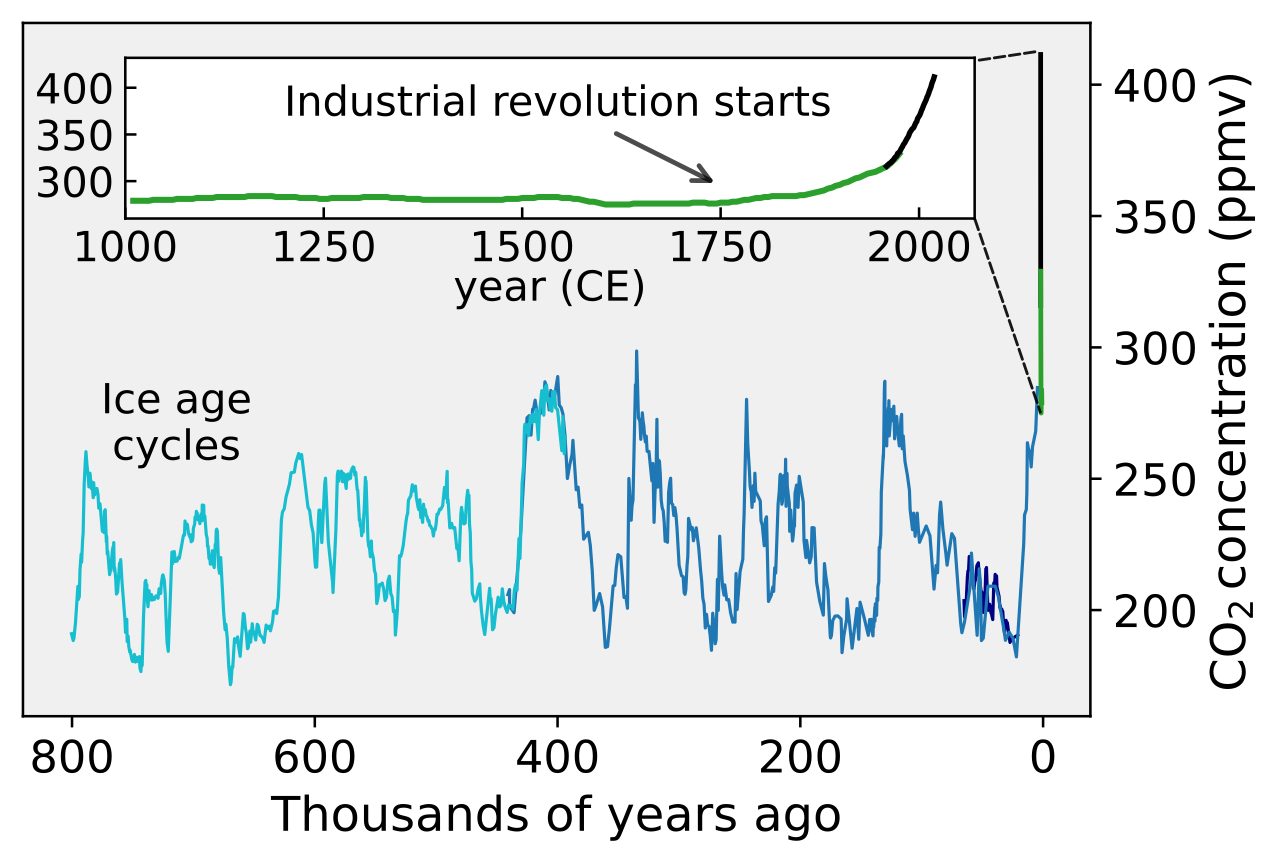
The measured changes extend well beyond the thermometer. The IPCC and agencies such as NASA and NOAA document rising global sea level, shrinking ice sheets and glaciers, warming and acidifying oceans, and shifts in rainfall and extreme weather. Carbon dioxide concentrations, 410 parts per million in 2019, exceed anything in the ice-core record covering 800,000 years, and the isotopic signature of the added carbon identifies fossil fuels as its source.
Climate change is therefore simultaneously a settled measurement and an open policy problem. The assessment literature is explicit about both halves: the warming and its human cause are established to the standard the IPCC calls unequivocal, while the scale of future warming depends on emissions choices, which is why the Paris Agreement is written in terms of temperature limits rather than certainties. The same reports set out the impacts that scale with each additional increment of warming, from heat extremes and heavy rainfall to sea-level rise that continues for centuries.
Legacy
Climate science's legacy includes a new kind of institution. The IPCC, founded in 1988, assesses the published literature through thousands of volunteer scientists and issues reports whose summaries governments approve line by line, an arrangement designed to make the science usable by every country at once. Its assessment cycles, from the first report in 1990 to the sixth synthesis in 2023, trace the tightening of the evidence: from detection, to attribution, to quantified impacts at each level of warming.
The subject's second legacy is the record itself. Between Mauna Loa's curve, the satellite era and the ocean float networks, humanity now watches its own effect on the planet in something close to real time. Whatever course emissions take, the measurements will continue to arbitrate the argument.
Sources
- IPCC — Climate Change 2023: Synthesis Report, Summary for Policymakers (AR6)
- NASA — Climate Change: Evidence
- American Institute of Physics — The Discovery of Global Warming (historical summary)
- Scripps Institution of Oceanography — The Keeling Curve
The facts on this page were checked against these sources on 19 November 2026. The History Trail's permanent pages are researched and written for this site; the live profiles elsewhere on The History Trail are assembled automatically from Wikipedia and Wikidata.
About the Author
Researched and written by the The History Trail Editorial Team — the accountable editorial function behind this site's permanent story pages. The team works from the published sources cited on each page; it does not invent historians, reviewers or credentials, and it corrects errors openly.
Fact Check
Every load-bearing fact on this page traces to one of the sources listed above, and significant claims link to their source in the text. Our checking method is described on the methodology page; errors can be reported via the corrections page.
Sources & Citations
Cite this page as: The History Trail Editorial Team, The History Trail — this article's title, publication and update dates are shown beneath its headline. The full source list appears under Sources above; the site's source standards are on the sources page.