
Animals
Lion
Every other big cat hunts alone. The lion built a society instead — related lionesses, a coalition of males, a defended territory and a roar that carries across the savanna. It once ruled three continents; now its kingdom has shrunk to fragments of Africa and one Indian forest.
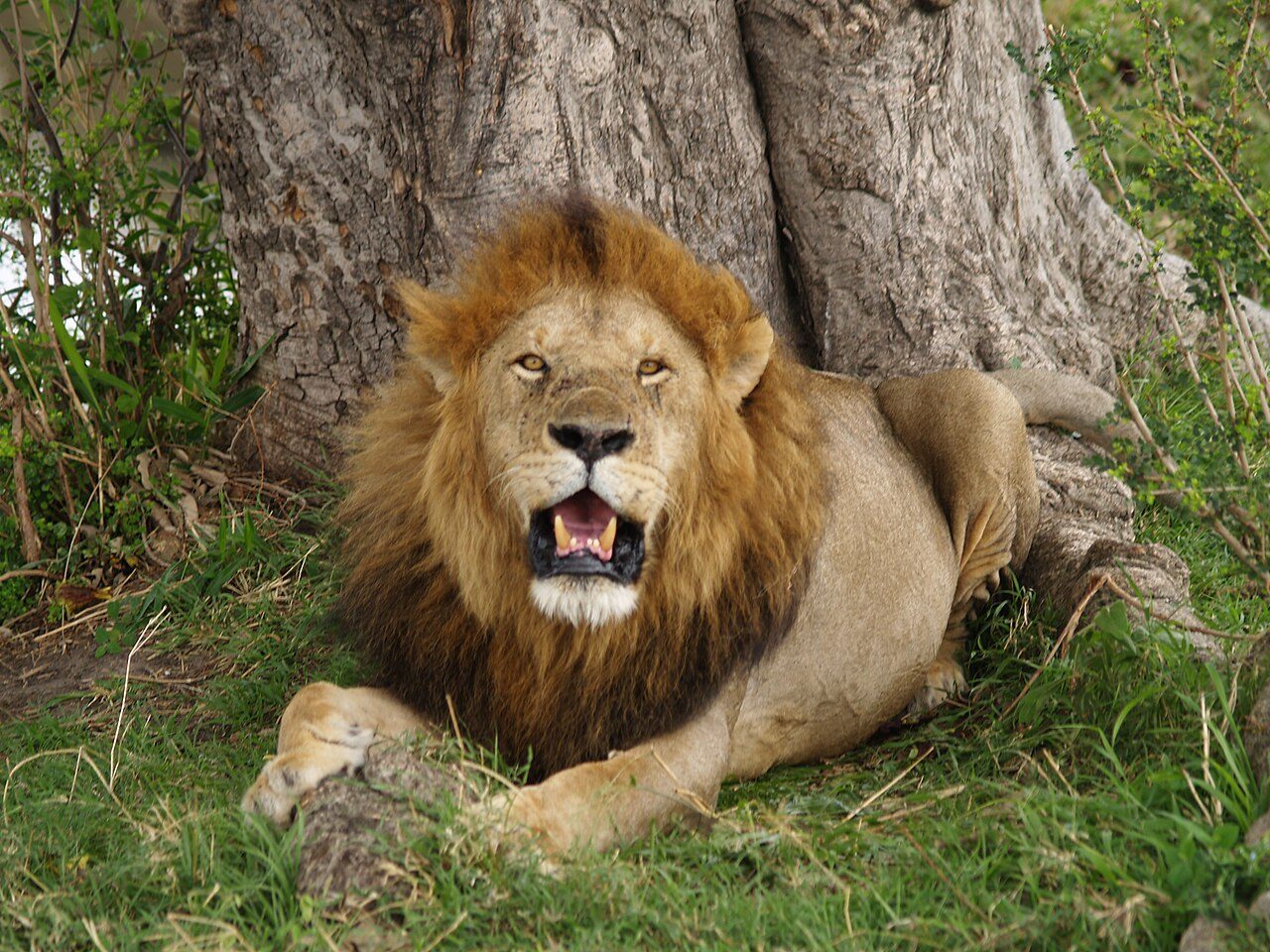
At a Glance
- Scientific name
- Panthera leo (Linnaeus, 1758)
- Size
- Males 1.8–2.1 m body length plus a 1 m tail; 170–230 kg. Second-largest cat, after the tiger
- Social unit
- The pride — the only social cat; about 15 members on average (range 4–37)
- Territory
- 20 square km where prey is abundant, up to 400 square km where it is sparse
- Diet
- Mainly wildebeest, zebras and antelopes; also buffalo, hippos and scavenged kills
- Population
- An estimated 22,000–25,000 in Africa; just under 700 Asiatic lions in India
- Wild lifespan
- Usually 8–10 years; over 25 years in captivity
- Conservation status
- Vulnerable (IUCN Red List), population decreasing
Introduction
The lion, Panthera leo, is a large, powerfully built cat of the family Felidae, second in size only to the tiger, and a famous apex predator with no natural enemy. The proverbial king of beasts has been among the best-known wild animals since earliest times — the Swahili word for lion, simba, also means king, strong and aggressive. A full-grown male runs 1.8 to 2.1 metres in body length, plus a metre of tail, stands about 1.2 metres at the shoulder and weighs 170 to 230 kilograms; the lioness is smaller, at 120 to 180 kilograms.
What makes the lion unique among cats is not its size or even the male's mane, but its social life. Lions are the only cats that live in a group — the pride — and everything about the species, from how it hunts to how it raises its young and holds its ground, is organised around that group.
Background
Lions are most active at night and prefer grassland, savanna, dense scrub and open woodland. Historically they ranged across much of Europe, Asia and Africa; today they are found mainly in Africa south of the Sahara, plus one isolated population of Asiatic lions — between 500 and 700 animals — under strict protection in India's Gir National Park and Wildlife Sanctuary. The male's mane, his outstanding characteristic, varies from a fringe around the face to a full shaggy mantle, sometimes almost black; it makes him look larger, and may intimidate rivals and impress prospective mates, as well as shielding his neck in fights.
A pride consists of several generations of related lionesses, a smaller number of breeding males, and their cubs — as few as four members or as many as 37, with about fifteen the average. Each pride defends a territory that may be as small as 20 square kilometres where prey is abundant or up to 400 where game is sparse, and some prides pass the same territory down between females for decades. Lions proclaim ownership by roaring — usually in the evening before hunting and again at dawn — and by scent-marking with urine, dung and rubbing.
Timeline
- 1758
Linnaeus formally describes the lion as Panthera leo, the name it still carries.
- 1915
A male lion named Rex and two females, Rena and Cleopatra, arrive in San Diego with the Panama-California International Exposition; Rex's roar inspires the founding of the San Diego Zoo the following year.
- 1923
An open-air lion grotto opens at the San Diego Zoo — lions have been emblematic of the zoo ever since, commemorated by a 27-foot bronze of Rex at its entrance.
- 1996
The lion is listed as Vulnerable on the IUCN Red List, as African populations fall — a decline of about 43 percent since the early 1990s is recorded in the listing's history.
- 2017
The IUCN Cat Classification Task Force recognises two living subspecies: Panthera leo leo of West and Central Africa and India, and Panthera leo melanochaita of eastern and southern Africa.
- 2025
The latest IUCN assessment keeps the lion Vulnerable with a decreasing trend, while conservation scientists estimate 22,000 to 25,000 lions in Africa and just under 700 in India.
Significance
Pride life is an energy strategy. Groups of females hunt more effectively and can defend cubs against infanticidal males and territory against rival females; lionesses in open savanna do most of the hunting, stalking and rushing prey in a short burst, while males typically appropriate shares of the kill — though males are adept hunters too, and pride males in scrub hunt most of their own meals. The diet runs from rodents and baboons to Cape buffalo and hippopotamus, but centres on wildebeest, zebras and antelopes. A hunting pride is potentially nature's most formidable predatory force on land — yet a high proportion of hunts fail, and an adult male may gorge more than 34 kilograms of meat at a sitting, then rest for days.
The lion's ecological significance is matched by its cultural weight. No wild animal is more deeply embedded in human symbolism — in heraldry, scripture, place names and the vocabulary of courage, from 'lionhearted' to 'lionise'. That fame is now a conservation tool: lions are flagship animals whose protection shelters entire savanna ecosystems, and programmes such as the San Diego Zoo Wildlife Alliance's work in Kenya rest on coexistence between people, livestock and lions.
Legacy
In the wild, lions usually live no more than eight to ten years — ended by rival lions, by humans, or by the kicks and gorings of their prey — though in captivity they may pass twenty-five. Their numbers tell the modern story: a species that once ranged from Greece to India now occupies a fraction of its historic range, with habitat loss the largest threat, prey depletion behind it, and retaliation for livestock killing a constant pressure where lions and herders meet. Trophy hunting remains permitted in some countries even where lion hunting is banned in others.
The lion's legacy is therefore still being decided. The Gir population shows what strict protection can hold; southern Africa shows that well-managed populations can stabilise; West and Central Africa show how quickly small, isolated groups can slip away. Whether the most famous animal in the world remains a living presence across its savannas — rather than a symbol surviving mainly in bronze — depends on the coexistence work now under way.
Sources
- Encyclopaedia Britannica — Lion
- San Diego Zoo Animals & Plants — Lion
- San Diego Zoo Wildlife Alliance Library — African and Asian Lions Fact Sheet: Population & Conservation Status
- Wikipedia — Lion
The facts on this page were checked against these sources on 19 November 2026. The History Trail's permanent pages are researched and written for this site; the live profiles elsewhere on The History Trail are assembled automatically from Wikipedia and Wikidata.
About the Author
Researched and written by the The History Trail Editorial Team — the accountable editorial function behind this site's permanent story pages. The team works from the published sources cited on each page; it does not invent historians, reviewers or credentials, and it corrects errors openly.
Fact Check
Every load-bearing fact on this page traces to one of the sources listed above, and significant claims link to their source in the text. Our checking method is described on the methodology page; errors can be reported via the corrections page.
Sources & Citations
Cite this page as: The History Trail Editorial Team, The History Trail — this article's title, publication and update dates are shown beneath its headline. The full source list appears under Sources above; the site's source standards are on the sources page.