
Animals
Bengal tiger
The Bengal tiger is the tiger most people picture: orange, black-striped, solitary, and big enough to kill prey several times its weight. It survives in the forests and mangrove swamps of India, Bangladesh, Nepal and Bhutan — the stronghold of a species reduced to a few thousand animals.
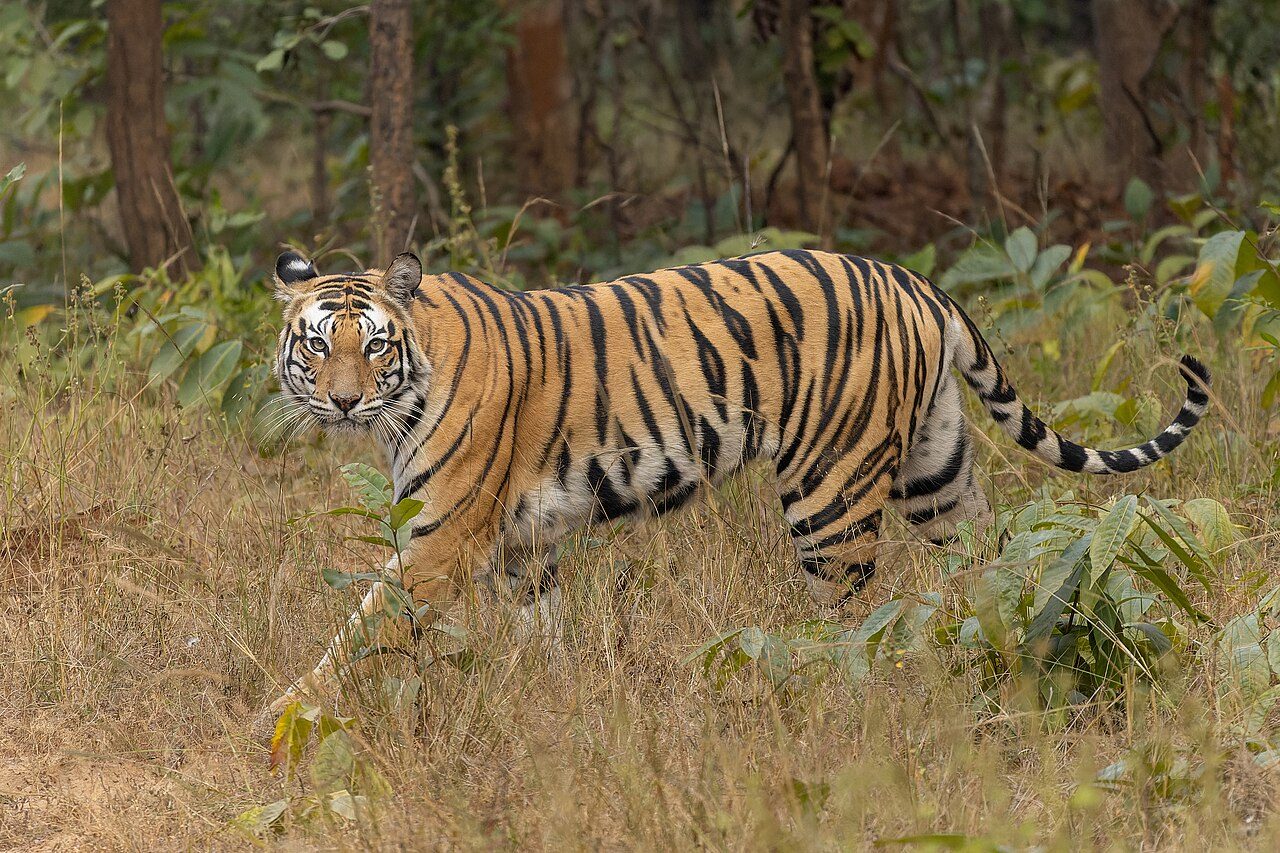
At a Glance
- Scientific name
- Panthera tigris tigris
- Size
- Males up to 10.5 feet (3.2 m) long and up to 650 pounds (295 kg); females smaller
- Range
- Forests and wetlands of India, Bangladesh, Bhutan and Nepal
- Prey
- Ungulates, chiefly deer and wild pigs, stalked and ambushed
- Family life
- Solitary; a female may raise up to seven cubs, though usually only two survive
- Species status
- Tiger listed as Endangered on the IUCN Red List (2022): 3,726 to 5,578 wild tigers worldwide
- Distinguishing habits
- Excellent, powerful swimmer with partially webbed toes; seldom far from water
Introduction
The Bengal tiger, Panthera tigris tigris, is the second-largest of the tiger subspecies: males can reach ten and a half feet in length and weigh up to 650 pounds, with orange coats marked in brown or black stripes. Tigers are stalk-and-ambush hunters, armed with canine teeth one to two inches long and claws of three to four inches that retract as the animal walks, keeping them sharp; the same claws mark territory by scratching trees. A tiger stalks prey — usually ungulates such as deer and pigs — slowly and quietly for twenty or thirty minutes, then grabs it by the neck with powerful jaws and suffocates it.
Bengal tigers live in the forests and wetlands of India, Bangladesh, Bhutan and Nepal, one population of a species whose six surviving subspecies occupy flooded mangrove forests, arid forests, tropical forests and taiga across Asia. Unlike most cats, tigers are seldom far from water: they are excellent and powerful swimmers with partially webbed toes, often found relaxing or waiting in ambush in ponds, streams and rivers, and not discouraged by a river if there is prey on the other side.
Origins
The tiger's design is a compromise between power and patience. A tiger makes a kill once or twice a week and eats as much as it can — as much as seventy-five pounds of meat in a night — then drags or carries the remains into cover, hides them under grass and dirt against vultures and scavengers, and returns over the following days for smaller meals. In some parts of Asia a tiger may bring down prey far beyond deer and pigs, up to a young rhino or an elephant calf. Tigers are generally solitary, maintaining home ranges of several square miles depending on habitat and prey; some defend their territory fiercely while others share their range.
Family life is the exception to solitude. A female leaves scent messages on trees to signal her breeding condition; a pair may stay together a few days before parting. Cubs are born small and helpless — about two pounds — and the mother must leave them alone while she hunts. A litter can hold up to seven cubs, but she typically cannot kill enough prey to feed so many, and usually only two survive; up to half of all tiger cubs die in their first year from starvation, disease, accidents or injuries.
Timeline
- 1972
The Smithsonian-Nepal Tiger Ecology Project begins — the Smithsonian's first great field effort to understand tiger behaviour well enough to protect it.
- 1970s
The South China tiger is last reliably observed in the wild in this decade; scientists now believe that subspecies may be extinct in the wild.
- 2008
The Smithsonian Institution joins the World Bank Group and the Global Environment Facility to launch the Global Tiger Initiative, to stabilise and restore wild tiger populations.
- 2010
At the Tiger Summit in St. Petersburg, leaders of thirteen tiger-range countries adopt the first Global Tiger Recovery Program, a comprehensive strategy to save the species.
- 2022
The IUCN Red List assessment counts between 3,726 and 5,578 wild tigers worldwide, excluding cubs, and keeps the species listed as Endangered.
- Today
Only six of the nine tiger subspecies that once existed remain; all tigers are protected under CITES Appendix I, and India holds most of the world's wild tigers.
Significance
Globally, tigers are an endangered species, and the threats stack up from every side. Poaching is the largest: tigers have been hunted for their fur and for body parts used in traditional medicines, a demand that persists in an illegal market despite education efforts, and despite the compounds being unproven. Human-animal conflict follows from two directions — agriculture and overgrazing drive away the tiger's prey and force it onto livestock, while urban sprawl and the encroachment of towns into tiger territory displace the cats and provoke killings born of fear. Habitat destruction and fragmentation shrink the forests into isolated patches where food and mates run short.
Yet the tiger also shows what organised protection can hold. The 2010 St. Petersburg summit did something never done before: thirteen range countries agreed a single recovery programme, with national priorities country by country. The Bengal remains the most numerous tiger population on earth — which makes its fate the hinge of the whole species' future. Lose the Bengal's forests and prey, and the tiger as a wild animal contracts to scattered remnants; hold them, and the largest cat on land keeps a working kingdom.
Legacy
The Bengal tiger's legacy in human culture is out of all proportion to its numbers: it is the tiger of story, emblem and nightmare across Asia and, through literature, the world — a reverence mixed with a measure of fear that the San Diego Zoo calls an appropriate reaction to so large and swift a hunter.
The honest summary is the one the conservationists themselves give: there is still much to be done, and the tiger's future relies heavily on protecting habitat in a range that overlaps areas of significant and continuing human population growth. Partnerships between governments, conservation organisations and the communities who actually live beside tigers will decide it.
Sources
- San Diego Zoo Wildlife Alliance — Tiger
- Smithsonian's National Zoo and Conservation Biology Institute — Tiger
- IUCN Red List — Panthera tigris (2022 assessment)
The facts on this page were checked against these sources on 19 November 2026. The History Trail's permanent pages are researched and written for this site; the live profiles elsewhere on The History Trail are assembled automatically from Wikipedia and Wikidata.
About the Author
Researched and written by the The History Trail Editorial Team — the accountable editorial function behind this site's permanent story pages. The team works from the published sources cited on each page; it does not invent historians, reviewers or credentials, and it corrects errors openly.
Fact Check
Every load-bearing fact on this page traces to one of the sources listed above, and significant claims link to their source in the text. Our checking method is described on the methodology page; errors can be reported via the corrections page.
Sources & Citations
Cite this page as: The History Trail Editorial Team, The History Trail — this article's title, publication and update dates are shown beneath its headline. The full source list appears under Sources above; the site's source standards are on the sources page.