
Animals
Wolf
The gray wolf is the largest wild member of the dog family, a family animal that hunts in packs and sings to hold its territory. Erased from most of the United States by the early 1900s, it was brought back to Yellowstone in 1995 — and the park has been re-arranging itself around the wolf ever since.
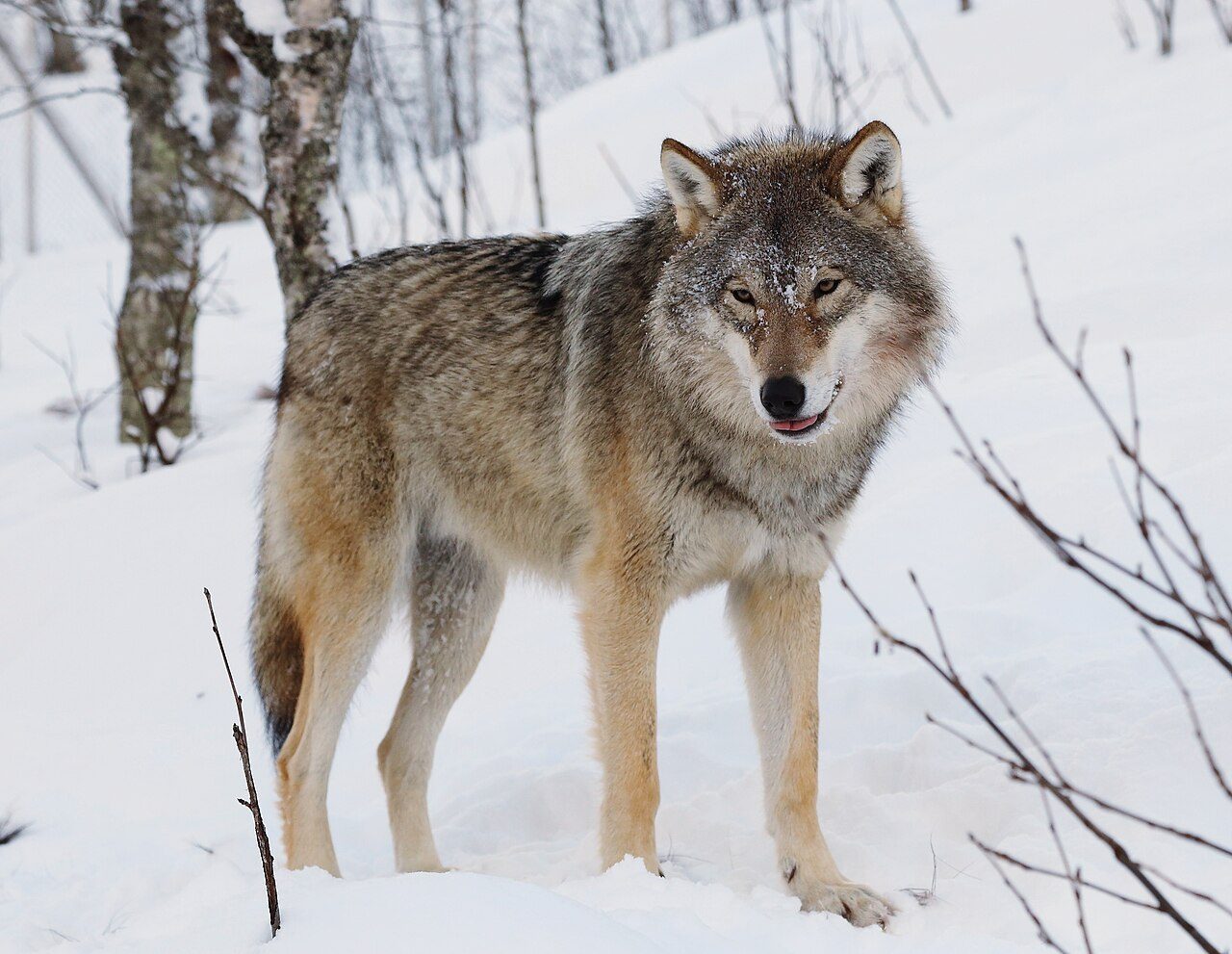
At a Glance
- Scientific name
- Canis lupus
- Distinction
- Largest wild member of the dog family (Canidae)
- Size
- A typical northern male is about 2 metres long including the tail, 76 cm at the shoulder, and about 45 kg; weights range from 14 to 65 kg
- Speed
- Can pursue prey at up to 60 km (37 miles) per hour
- Pack
- A family group — a breeding pair and their offspring; commonly 6 to 10, averaging 11.8 in Yellowstone
- Territory
- 80 to 3,000 square kilometres, defended by howling and scent-marking
- Diet
- Large herbivores — deer, elk, moose, bison; in Yellowstone, 90 percent of winter prey is elk
- Historic range
- Once across most of the Northern Hemisphere — wider than any land mammal except humans and lions
Introduction
Everything about the gray wolf is scaled for the chase: keen senses, large canine teeth, powerful jaws and legs that can carry it after prey at 60 kilometres an hour. A typical northern male measures about two metres from nose to tail-tip and weighs around 45 kilograms. Yet the wolf's real weapon is not its body but its family. Wolves live in packs — a breeding pair and their offspring of several years — and it is the pack that hunts moose and bison, defends a territory that may span thousands of square kilometres, and raises each spring's pups as a collective enterprise.
This is also the animal from which all dogs descend: wolves were domesticated several thousand years ago, and selective breeding did the rest. The wild original once ranged over more of the Earth than any land mammal except humans and lions — across North America from Arctic Canada to central Mexico, and throughout Europe and Asia. Then, in the space of a few generations, people with traps, poison and bounties removed it from most of that map.
Background
The persecution was deliberate policy. Wolves killed livestock, and governments paid to be rid of them; by the early 1900s, loss of habitat and extermination programmes had ended the wolf across most of the United States, and by the late 1920s even Yellowstone National Park — set aside as a protected refuge — had none left. The predator-free park that resulted was an ecological experiment nobody had intended: elk multiplied without their main hunter, and the valleys changed under their grazing.
The legal reversal came with the endangered species era. In 1973 the US Fish and Wildlife Service listed the northern Rocky Mountain wolf as endangered and named the Greater Yellowstone Ecosystem one of three recovery areas. Two decades of argument followed — ranchers against biologists, states against the federal government — before the decision was taken to do what nature was doing too slowly: bring wolves back by truck and release pen.
Timeline
- Thousands of years ago
Wolves are domesticated; selective breeding over the generations produces the dog — while the wild wolf keeps the northern world.
- Early 1900s
Extermination programmes and habitat loss erase the wolf from most of the United States.
- Late 1920s
No wolves remain in Yellowstone National Park, the place that will later define their return.
- 1973
The northern Rocky Mountain wolf is listed as an endangered species, and Greater Yellowstone is designated one of three recovery areas.
- 1995–1997
Forty-one wild wolves from Canada and northwest Montana are released in Yellowstone; the new packs spread and breed.
- 2002
Wolves in the Northern Rocky Mountains meet the federal criteria for a recovered population.
- 2011
The gray wolf is removed from the endangered species list in Idaho and Montana.
- 2016
Wyoming's wolves are delisted as well; the decision is upheld on appeal in April 2017, and the states manage hunting.
- 12 January 2025
Yellowstone marks the 30th anniversary of the wolf's return — three decades of research into what a restored predator does to a landscape.
Significance
Yellowstone's wolves became the most watched predator-restoration experiment in history. The National Park Service notes what the pack structure buys: cooperative care of pups, group hunting of prey too large for a lone wolf, defence of territory and carcasses, and even survival support for injured members. Around the kills, an economy reassembles — ravens and magpies arrive within moments, coyotes wait their turn, bears muscle in, and eagles and invertebrates finish what the wolves began. In Yellowstone, 90 percent of the wolves' winter prey is elk, and the park's researchers have tracked for 25 years how wolf predation interacts with weather, forage and other predators.
The wolf also remains a live argument. Wolves that leave the park are hunted under state rules in Montana, Idaho and Wyoming; livestock losses, though small in number, are compensated by several states; and biologists still debate how much of Yellowstone's vegetation recovery belongs to wolves and how much to climate and other causes. No other animal carries so much symbolic weight in the politics of wild land.
Legacy
The wolf's recovery is real but patchwork. Northern Rocky Mountain wolves have met federal recovery criteria since 2002, Eurasian populations probably exceed 100,000 and are stable or rising in most countries, and an estimated 65,000 to 78,000 wolves inhabited North America at the start of this century. Against that stand the empty maps: most of the species' former range in the contiguous United States and western Europe is still wolf-less, and where wolves do return, their fate is renegotiated election by election.
What Yellowstone proved is narrower and more valuable than the slogans on either side: a missing apex predator can be put back, a wild population will organise itself, and a landscape will answer. The wolf that fairy tales made a villain and eradication made a ghost is, again, simply an animal doing its work — in full view of the scientists, ranchers and visitors still arguing about what that work is worth.
Sources
- US National Park Service — Wolf Ecology, Yellowstone National Park
- Encyclopaedia Britannica — Gray wolf
- Encyclopedia.com — Wolf, Gray
The facts on this page were checked against these sources on 19 November 2026. The History Trail's permanent pages are researched and written for this site; the live profiles elsewhere on The History Trail are assembled automatically from Wikipedia and Wikidata.
About the Author
Researched and written by the The History Trail Editorial Team — the accountable editorial function behind this site's permanent story pages. The team works from the published sources cited on each page; it does not invent historians, reviewers or credentials, and it corrects errors openly.
Fact Check
Every load-bearing fact on this page traces to one of the sources listed above, and significant claims link to their source in the text. Our checking method is described on the methodology page; errors can be reported via the corrections page.
Sources & Citations
Cite this page as: The History Trail Editorial Team, The History Trail — this article's title, publication and update dates are shown beneath its headline. The full source list appears under Sources above; the site's source standards are on the sources page.