
Things
Chinese New Year
Chinese New Year, also known as the Spring Festival, opens the year in the traditional Chinese lunisolar calendar with fifteen days of feasting, red decorations, fireworks and family reunion. It is China's most important festival, celebrated across East and Southeast Asia and by Chinese communities throughout the world.
At a Glance
- Also called
- Spring Festival (Chunjie)
- Calendar
- Traditional Chinese lunisolar calendar
- Date
- The new moon between 21 January and 20 February
- Length
- 15 days, ending with the Lantern Festival
- Zodiac
- A 12-year cycle of animals; 2026 is the Year of the Horse
- Travel season
- Chunyun, the roughly 40-day Spring Festival travel rush
- UNESCO
- Spring Festival social practices inscribed on the Intangible Cultural Heritage list in 2024
Introduction
Chinese New Year is the festival that marks the beginning of a new year on the traditional lunisolar Chinese calendar. It falls on the new moon that appears between 21 January and 20 February, and the celebrations run for fifteen days, from New Year's Eve to the Lantern Festival at the following full moon. In China the holiday is officially called the Spring Festival, and since the mid-1990s it has brought seven consecutive days off work.
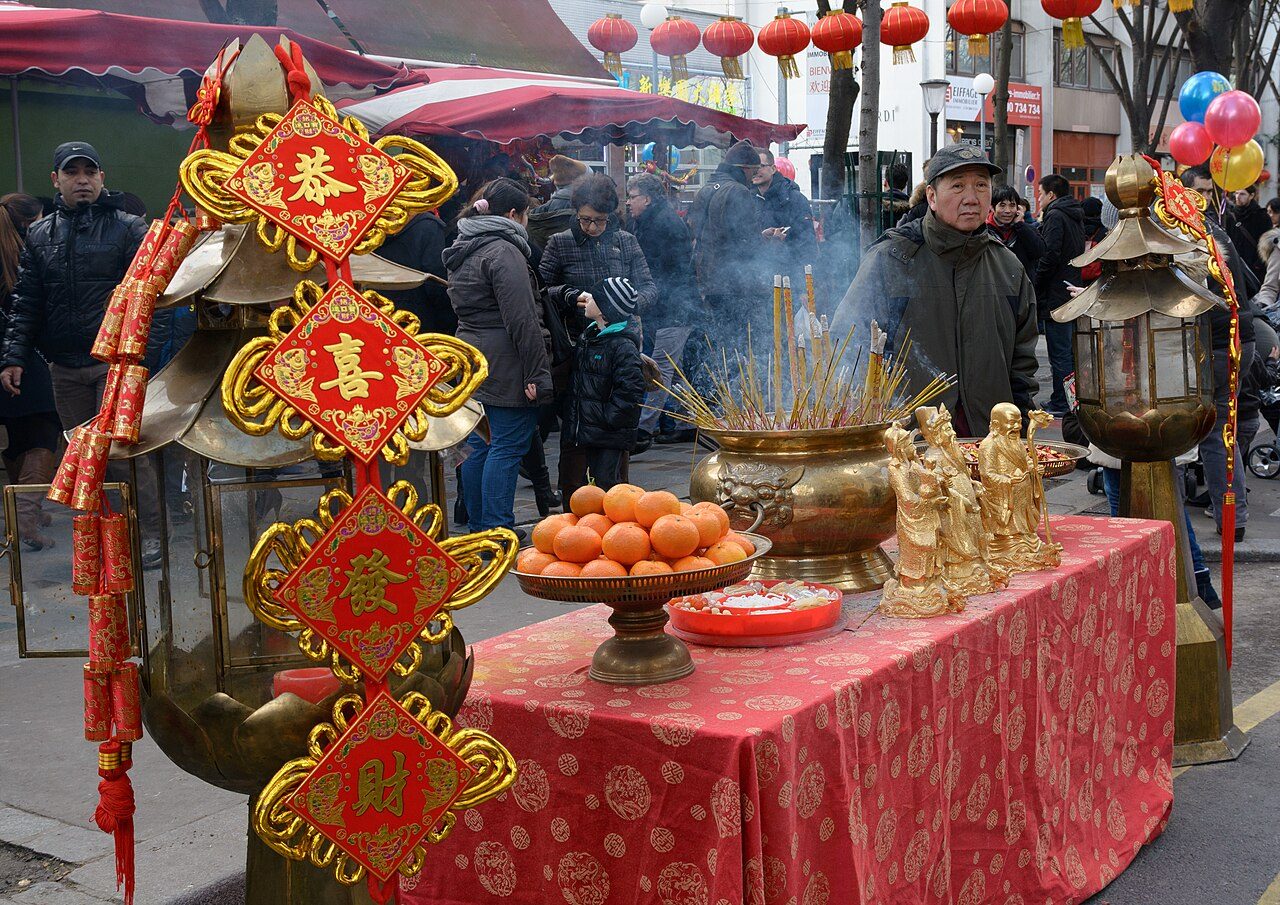
The festival's centrepiece comes first: on New Year's Eve, families gather for the annual reunion dinner, the most important meal of the year. Around it cluster the customs the world recognises — houses thoroughly cleaned and hung with red paper-cuts and couplets, firecrackers and fireworks, dragon and lion dances, symbolic foods chosen for the lucky meanings of their names, and money given to the young in bright red envelopes.
Origins
The festival's best-known origin story is a legend, and is told as one. Long ago, the story runs, a monster called Nian — the word also means 'year' — would attack villagers at the beginning of each new year. The monster was afraid of loud noises, bright lights and the colour red, so those things were used to chase the beast away. The tale is folklore rather than history, but it is still told to explain why the New Year arrives dressed in red and noise.
The documented roots are agricultural and ritual. Ancient Chinese communities gathered to celebrate the end of the harvest, and a text of the Warring States period records a year-end exorcism rite, the 'Big Nuo', performed to expel illness — a forerunner of the thorough house-cleaning still done before the festival. By the Han dynasty, the first day of the first month was being marked with worship of ancestors and toasts to parents' health, and honouring ancestors remains part of the festival today. The name 'Spring Festival' was proposed in 1914 by Yuan Shikai, then interim president of the Republic of China.
Timeline
- 475–221 BC
In the Warring States period, the Lüshi Chunqiu records a year-end exorcism ritual, the 'Big Nuo', held to expel illness on the last day of the year.
- 202 BC – AD 220
During the Han dynasty, written accounts describe celebrations at the start of the first month, including worship of ancestors and children toasting their parents' health.
- In legend
The beast Nian is driven from a village by red paper, bright lights and firecrackers — the story still told to explain the festival's colours and noise.
- 1914
Yuan Shikai proposes the name 'Spring Festival' for the New Year holiday; it becomes the festival's official name in China.
- New Year's Eve
Families gather for the reunion dinner, the year's most important meal, with dishes chosen for their auspicious meanings — whole fish for abundance, dumplings shaped like ancient gold ingots for wealth.
- Day 1
The new year begins at the new moon. Homes display red couplets, the young receive money in red envelopes, and sweeping is avoided lest good fortune be brushed away.
- Days 1–15
Visits to relatives, temple fairs, fireworks and dragon and lion dances fill the festival days; each new year also brings a new animal of the twelve-year zodiac cycle.
- Day 15
The Lantern Festival closes the celebrations at the full moon, with glowing lanterns hung in temples and carried in night-time parades, and riddles written on lanterns for revellers to solve.
- Around the festival
Chunyun, the Spring Festival travel rush, runs for about forty days as hundreds of millions of people travel home — a movement often called the largest annual human migration in the world.
- 2024
UNESCO inscribes 'Spring Festival, social practices of the Chinese people in celebration of traditional new year' on its Representative List of the Intangible Cultural Heritage of Humanity.
Significance
At its heart the festival is about reunion and renewal. The reunion dinner gathers families scattered by work and study; ancestors are honoured alongside the living; houses are cleaned to sweep away the old year's ill fortune and make room for the luck and prosperity of the new. Foods, greetings and decorations are chosen to speak of abundance, wealth and longevity — the festival is a collective act of hope, performed with the people who matter most.
Its scale is unmatched. The travel season around the festival, chunyun, lasts about forty days and is often described as the largest annual human migration on Earth, as migrant workers and students cross China to reach home in time for New Year's Eve. The twelve-year zodiac cycle gives each year an animal and a character — 2026 is the Year of the Horse — and a person's birth-year animal remains a shared reference point for identity and fortune across the Chinese-speaking world.
Legacy
Chinese New Year is now a global festival. It is an official holiday in countries across Southeast Asia, including Singapore, Malaysia, Indonesia and the Philippines, and is prominent far beyond Asia, in Australia, Canada, France, the United Kingdom and the United States, where Chinatown parades fill city streets. Its imagery — red lanterns, dancing dragons, envelopes of lucky money — has become one of the most recognisable festival vocabularies in the world.
Kindred new year festivals flourish alongside it: Vietnam's Tet, Korea's Seollal and Tibet's Losar share the season and many of its customs, shaped by centuries of exchange with Chinese practice. UNESCO's inscription of the Spring Festival in 2024 recognised the social practices at its core — ushering in the new year, praying for good fortune, celebrating family reunion and promoting community harmony — as heritage of humanity as a whole.
Sources
- Encyclopaedia Britannica — Chinese New Year
- Wikipedia — Chinese New Year
- Wikipedia — Chunyun
- Wikipedia — Lantern Festival
The facts on this page were checked against these sources on 19 November 2026. The History Trail's permanent pages are researched and written for this site; the live profiles elsewhere on The History Trail are assembled automatically from Wikipedia and Wikidata.
About the Author
Researched and written by the The History Trail Editorial Team — the accountable editorial function behind this site's permanent story pages. The team works from the published sources cited on each page; it does not invent historians, reviewers or credentials, and it corrects errors openly.
Fact Check
Every load-bearing fact on this page traces to one of the sources listed above, and significant claims link to their source in the text. Our checking method is described on the methodology page; errors can be reported via the corrections page.
Sources & Citations
Cite this page as: The History Trail Editorial Team, The History Trail — this article's title, publication and update dates are shown beneath its headline. The full source list appears under Sources above; the site's source standards are on the sources page.