
Things
Oak
The oak is not one tree but a genus, Quercus, of about 450 species in the beech family, spread across the north temperate zone. For thousands of years it was also a material civilisation ran on: its timber framed houses and warships, its bark tanned leather, its charcoal smelted iron, and its acorns fed pigs and, in hard times, people.
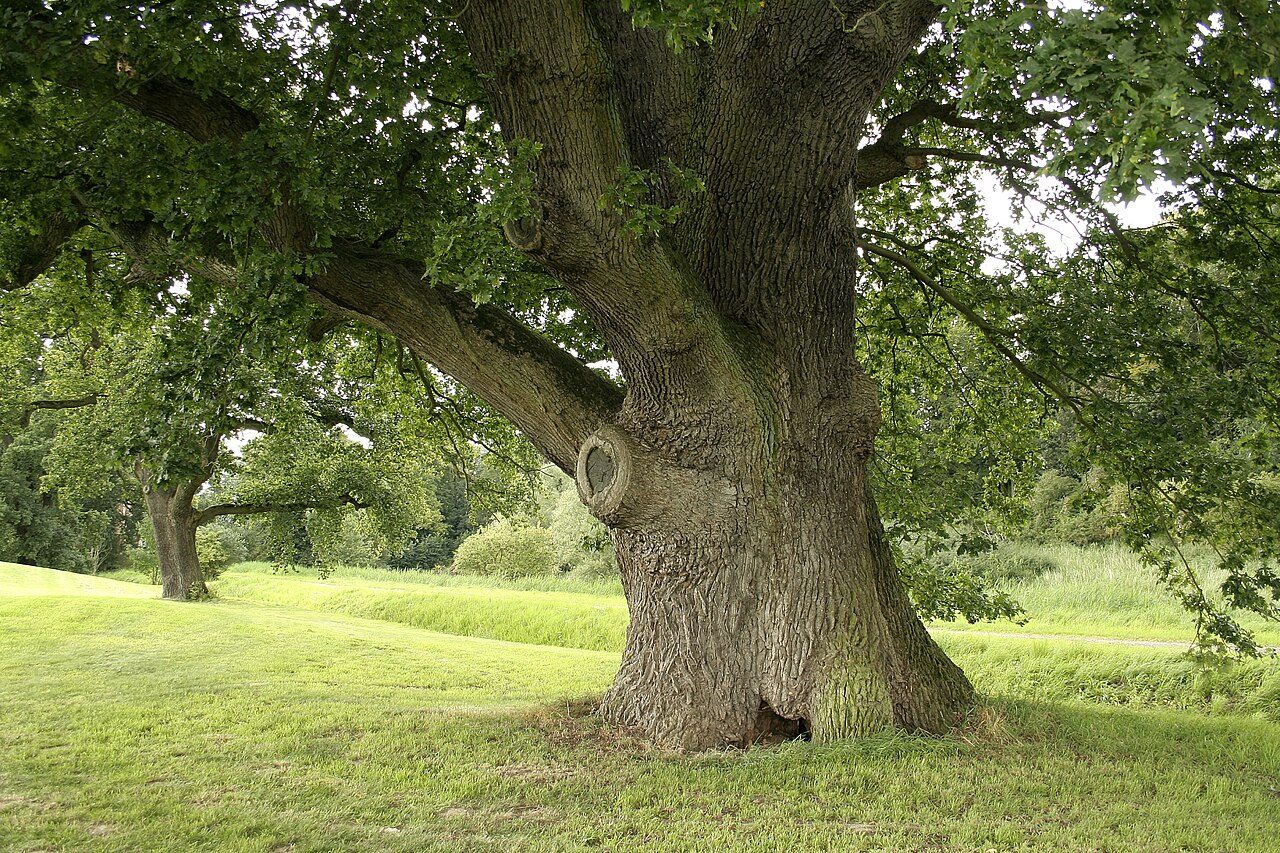
At a Glance
- What it is
- Genus Quercus, about 450 species of trees and shrubs in the beech family (Fagaceae), according to Britannica
- Where it grows
- Throughout the north temperate zone and at high altitudes in the tropics; the fruit is the acorn, held in a woody cup
- Timber
- Red- and white-oak lumber has been used in construction, flooring, furniture and cooperage; English oak heartwood was once used extensively in Britain for shipbuilding
- One warship
- About 6,000 trees were used to build HMS Victory, launched in 1765, according to the National Museum of the Royal Navy
- Sacred associations
- The oak was linked in classical writing to Zeus and Jupiter, and in Irish tradition it ranked among the seven Nobles of the Wood
- Longevity
- Kew notes the Bowthorpe Oak in Lincolnshire is thought to be over 1,000 years old; common oak can grow to about 40 metres
- Threats today
- Acute oak decline and other diseases now threaten Britain's oaks; Kew is using genome sequencing to study their health
Introduction
Few plants have carried as much human history as the oak. Britannica counts about 450 species in the genus Quercus, from stately timber trees to shrubs, all bearing the same unmistakable fruit: an acorn seated in a cup. Oaks grow across Europe, Asia, North Africa and the Americas, and wherever they grew large, people built with them. The tree supplied the beams of houses and cathedrals, the planks of ships, the barrels that carried wine and water, and the fuel that made metalworking possible.
It also supplied meaning. Oaks were sacred in Greek, Roman, Celtic and Norse traditions, stood for strength and endurance in heraldry, and gave their name to places, surnames and laws. This page traces that double history: the oak as a working material, and the oak as a symbol powerful enough that cutting one down could once be a serious offence.
Food, Law and Sacred Groves
Before the oak was timber, it was food. Acorns fattened swine and poultry for centuries, Britannica notes, and the acorns of some species can be ground into flour for people. In early Ireland the tree's value was written into law. University College Cork's tree guide records that a ninth-century Irish law text counted the oak, called dair, among the seven Nobles of the Wood in early Irish society, valued for acorns to fatten pigs, timber for fencing and building, and bark to tan leather. One letter of the early Irish Ogham alphabet, dair, took the oak's name for the letter D.
The sacred reputation was older still. The oak was the tree of Zeus in Greece, where the oracle at Dodona stood in an oak grove, and of Jupiter in Rome. The Roman writer Pliny described the druids of Gaul and Britain honouring oak groves and cutting mistletoe that grew on oak with ceremony. How much of Pliny's account was observation and how much was Roman storytelling is debated, and this page treats the druid connection as tradition reported by classical writers rather than proven ritual. What is certain is that across unconnected cultures the same long-lived, lightning-struck tree kept being chosen as the tree of sky gods and kings.
Timber, Ships and Charcoal
Oak timber earned its place because it is hard, durable and resistant to rot in wet conditions. University College Cork records oak dugout canoes in Bronze Age Ireland, oak trackways across Iron Age bogs, and oak used extensively in Viking Dublin, including shipbuilding: timbers from a Viking longship wreck in Roskilde Fjord, Denmark, were traced back to oaks grown near Dublin. Through the Middle Ages oak framed Anglo-Norman buildings, and it remained, in Cork's summary, the primary material for building ships and houses until steel became readily available in the middle of the nineteenth century.
Naval demand was enormous. The National Museum of the Royal Navy records that about 6,000 trees were used in the construction of HMS Victory alone, Nelson's flagship at Trafalgar, launched in 1765. Fleets of such ships consumed whole forests, and timber supply became a strategic concern for maritime states. The oak's other great product was invisible in the finished object: charcoal. Oak charcoal burned hot enough for smelting bronze and iron and making glass, and in the sixteenth and seventeenth centuries oak from Ireland was, in Cork's account, a major source of charcoal for iron-smelting and foundational to the English iron industry of the period. Coppicing, cutting oak back to the stump so it regrew in straight poles, turned woodland into a managed, repeating crop.
Timeline
- Bronze Age
Oak dugout canoes and massive oak timbers are used in Ireland, evidence that oak was already a chosen material for transport and building.
- c. 400-1000
Early Irish law counts the oak among the seven Nobles of the Wood; its name, dair, gives the Ogham letter D.
- 1st century AD
Pliny the Elder describes druids honouring oak groves and mistletoe growing on oak, the classical source behind the druid-oak tradition.
- Viking Age
Oak is used extensively in Viking Dublin for houses and ships; a longship found in Roskilde Fjord was built from Dublin-area oak.
- 16th-17th centuries
Irish oak charcoal becomes a major fuel for iron-smelting, foundational to the English iron industry of the period, according to University College Cork.
- 1753
Linnaeus formally names Quercus robur, the pedunculate or English oak, in Species Plantarum.
- 1765
HMS Victory is launched at Chatham, built, the National Museum of the Royal Navy records, from about 6,000 trees.
- Mid-19th century
Steel becomes readily available and displaces oak as the primary material for ships and large buildings.
- Today
Kew lists common oak at up to 40 metres tall across European woodlands, with more than 1,000 common oaks growing at Kew Gardens itself.
- 21st century
Acute oak decline emerges as a serious disease of British oaks, prompting genome-sequencing research at Kew into the trees' health.
Significance
The oak's significance is that pre-industrial civilisation was, in large part, built out of it. Houses, ships, barrels, bridges, fuel and tools all drew on the same genus, and the demand shaped landscapes: coppiced woods, protected royal forests and timber plantations are all, in part, answers to the question of where the next oak would come from. When iron and steel replaced timber in ships and buildings, they did so only after oak charcoal and oak-framed industry had helped create them.
Ecologically, old oaks are infrastructure for other life, supporting hundreds of associated species in Britain alone, which is why individual ancient trees are protected and celebrated. Kew describes the common oak as a cultural icon whose leaves and acorns appear on coats of arms, logos and coins, a reminder that the symbol outlived the material age that created it.
Myths and disputes
Did druids really worship in oak groves? The honest answer is that the evidence is thin and mostly Roman. Pliny's account of mistletoe cut with a golden sickle is vivid, famous and written by an outsider about peoples who left no written records of their own. University College Cork phrases it carefully: the oak is thought to have been sacred to the druids. The popular claim that the word druid itself means oak-knower is likewise an old etymological suggestion, not a settled fact, and this page presents both ideas as tradition, not proof.
A second caution concerns famous trees. Ages claimed for celebrated oaks, including the Bowthorpe Oak, which Kew describes as thought to be over 1,000 years old, are estimates based on girth and growth rates, not counted rings, because ancient oaks are usually hollow. The Major Oak of Sherwood Forest is genuinely old and genuinely large, but its link to Robin Hood is legend attached to the tree long after both, at best, could have met. The tree is history; the outlaw's shelter is story.
Legacy
The oak's working age has ended, but its second life is busy. Ancient oaks are protected monuments of living history, oak woodland is a priority for conservation and replanting, and researchers at Kew and elsewhere are sequencing oak genomes to understand diseases such as acute oak decline that can kill a tree within a few years. Timber planting has also come full circle: oaks are again being planted for future high-quality wood, on rotations their planters will never see completed.
The symbol needs no protection. Strength, endurance and rootedness are still summed up in one word and one leaf, from national emblems to the acorns on coins Kew mentions. A tree that once held up roofs, navies and ironworks now holds up an idea: that some things are built slowly, and built to last.
Sources
- Encyclopaedia Britannica - Oak
- Royal Botanic Gardens, Kew - Oak tree (Quercus robur)
- University College Cork - Tree Explorers: Quercus robur
- National Museum of the Royal Navy - HMS Victory Facts
- Transactions of the American Clinical and Climatological Association - Quercus (Oak): A Perspective
The facts on this page were checked against these sources on 19 November 2026. The History Trail's permanent pages are researched and written for this site; the live profiles elsewhere on The History Trail are assembled automatically from Wikipedia and Wikidata.
About the Author
Researched and written by the The History Trail Editorial Team — the accountable editorial function behind this site's permanent story pages. The team works from the published sources cited on each page; it does not invent historians, reviewers or credentials, and it corrects errors openly.
Fact Check
Every load-bearing fact on this page traces to one of the sources listed above, and significant claims link to their source in the text. Our checking method is described on the methodology page; errors can be reported via the corrections page.
Sources & Citations
Cite this page as: The History Trail Editorial Team, The History Trail — this article's title, publication and update dates are shown beneath its headline. The full source list appears under Sources above; the site's source standards are on the sources page.