
Things
Bamboo
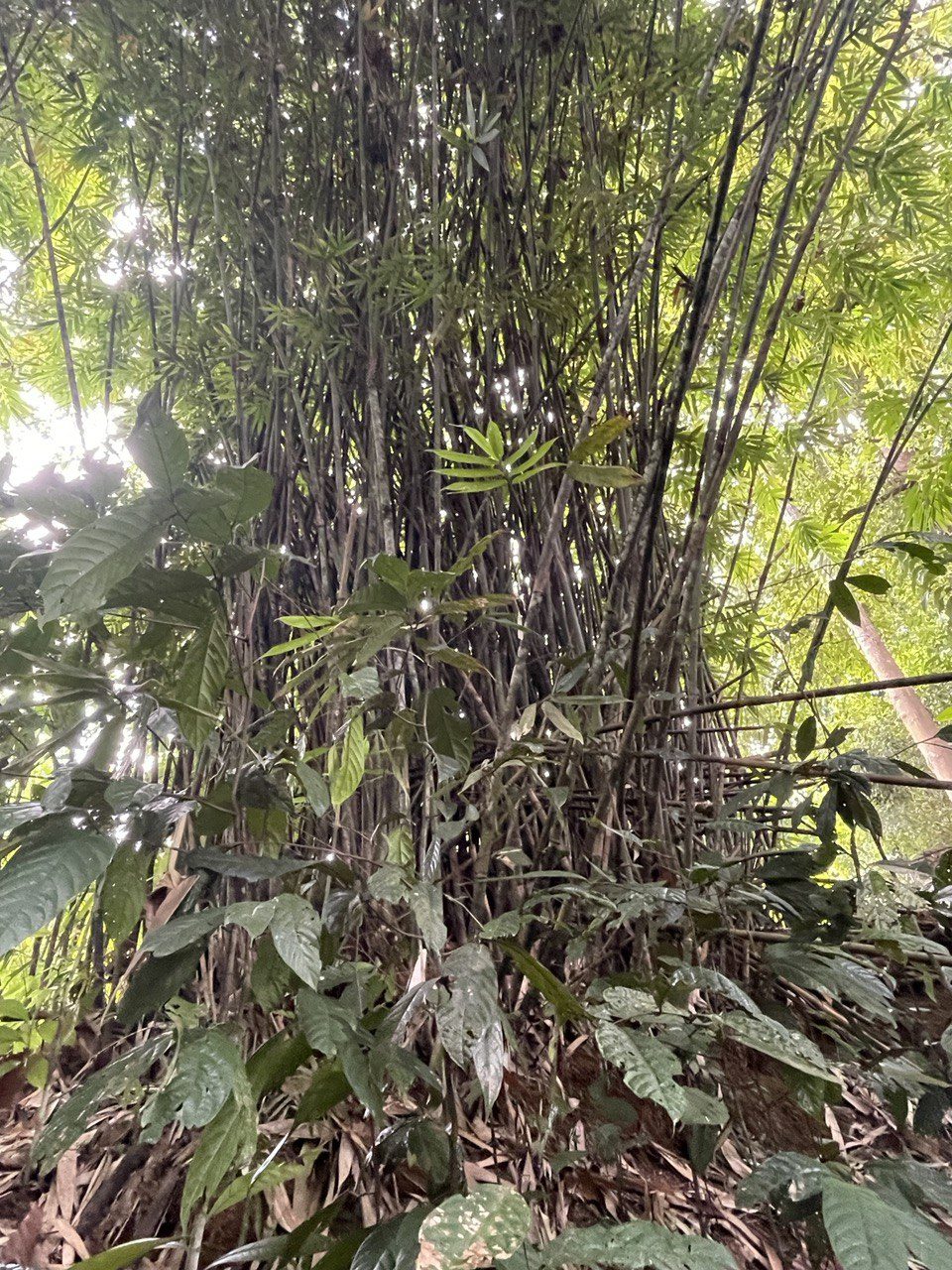
Bamboo is not a tree but a giant grass — a subfamily of the grass family whose largest species can grow 30 centimetres or more in a day. For thousands of years Asia has built, written, eaten and travelled with it; in the 1880s it lit Thomas Edison's first practical lamps; today engineers laminate it into structural beams.
At a Glance
- Family
- Poaceae — the grass family; subfamily Bambusoideae
- Growth
- Giant bamboo can grow up to about 30 cm a day at peak (Kew)
- Diversity
- More than 1,400 known species in over 100 genera
- Traditional uses
- Scaffolding, houses, paper, food (shoots), baskets, instruments
- Edison connection
- Carbonised bamboo was the standard filament in Edison's early lamps
- Wildlife
- Giant pandas eat almost exclusively bamboo
Introduction
Bamboo is a grass. That single fact explains almost everything about it: the hollow, jointed stems, the speed — Kew records giant bamboo growing up to 30 centimetres a day in peak season, among the fastest growth of any plant — and the way a cut stand regrows from its own root system without replanting. The bamboos form the subfamily Bambusoideae of the grass family Poaceae, more than 1,400 species ranging from small ornamentals to forest giants 25 metres tall.
Humans noticed early. Across South, Southeast and East Asia, bamboo became the default material of everyday life: scaffolding and houses, bridges and rafts, baskets, paper, chopsticks, musical instruments and food, its young shoots eaten as a vegetable. No other plant has served so many purposes for so long — and its career was not finished. In the 19th century it entered the electric age, and in the 21st it is being engineered into a structural material to rival timber.
Origins
Bamboos are mostly evergreen perennial grasses of tropical and temperate regions, concentrated in Asia. A bamboo stem, or culm, does its growing in a single season, rising to full height and then adding only branches and leaves in later years — which is why a bamboo grove can look like a forest that appeared overnight. The plant's underground rhizome system stores the energy for that sprint, and lets the stand survive cutting, fire and grazing.
Human use is ancient in China and across monsoon Asia, where bamboo was worked for tools, construction and writing surfaces long before paper made from its pulp became common. Kew notes that giant bamboo is 'highly valued as a crafting material, used for everything from scaffolding to musical instruments', and that its stems also yield charcoal and its young shoots food. In Japan, China and Southeast Asia alike, the plant became so embedded in building and craft that bamboo objects — from flutes to flooring — remain cultural signatures.
Timeline
- Ancient China
Bamboo is worked for tools, construction and writing material; bamboo use in China is traced back some 7,000 years.
- For centuries in Asia
Bamboo scaffolding, houses, bridges, baskets and paper spread across South, Southeast and East Asia as standard technology.
- 1815
The German botanist Charles Kunth publishes the taxonomic work that formalises bamboo's place in the grass family.
- Spring 1880
Thomas Edison first tries bamboo as a lamp filament, after paper filaments prove unsatisfactory.
- c. 1886
Edison's commercial lamps use single-arch bamboo filaments — the Smithsonian holds examples of the type.
- 20th century
Bamboo remains a staple construction and craft material across Asia, and the staple food of the giant panda in China's mountain forests.
- 2024
A six-storey engineered mass-bamboo building is completed in China, the tallest of its kind at the time.
- 2025
Systematic reviews assess laminated bamboo and bamboo scrimber as structural materials comparable in some measures to engineered timber.
Significance
Edison's filament is bamboo's most surprising chapter. Searching for a filament that would last, Edison's team tried thousands of materials; carbonised bamboo, sourced after a worldwide search that settled on a Japanese supply, burned for over 1,200 hours in tests and became the standard filament in Edison lamps for years. The Science Museum Group's collection notes that paper filaments 'were not entirely satisfactory' while bamboo 'proved to be much better' — a grass from Asian hillsides carried the first electric lighting industry.
The ecological story runs in parallel. Bamboo is the main food of the giant panda, making up about 99 per cent of its diet, and a staple for red pandas and bamboo lemurs; the University of Wisconsin notes that pandas may eat up to a quarter of their body weight in bamboo a day. For people, the same plant offers a crop that regrows annually, stabilises soil and provides fibre, fuel and food from one stand — versatility no timber tree matches.
Legacy
Bamboo's newest career is structural engineering. Laminated bamboo and bamboo scrimber — strips or fibre bundles bonded and pressed into boards and beams — show tensile and flexural strengths comparable to, and in some studies exceeding, conventional timber products, and a six-storey engineered mass-bamboo building has now been built and instrumented in China. Standardisation remains the obstacle: properties vary with species, age and processing, and design codes are still catching up. Even so, engineered bamboo is already at work in ordinary buildings as flooring, wall panels, columns and building envelopes, and researchers describe it as a viable replacement for traditional wood and even steel in some structural and architectural uses — provided the variability between species and batches can be controlled by shared testing standards, which is now the field's central project.
That is a familiar position for bamboo. It has repeatedly been the material the future arrives on — writing, building, lighting, and now low-carbon construction — while remaining the material of baskets, scaffolding and panda forests. A grass that outgrows trees, feeds bears and lit the first lamps has earned its place in any history of useful things.
Sources
- Royal Botanic Gardens, Kew — Giant bamboo
- Smithsonian National Museum of American History — Edison bamboo filament incandescent lamp
- Science Museum Group — Light-bulb, filament carbon
- University of Wisconsin–Madison, GROW — Five things everyone should know about bamboo
- Wikipedia — Bamboo
The facts on this page were checked against these sources on 19 November 2026. The History Trail's permanent pages are researched and written for this site; the live profiles elsewhere on The History Trail are assembled automatically from Wikipedia and Wikidata.
About the Author
Researched and written by the The History Trail Editorial Team — the accountable editorial function behind this site's permanent story pages. The team works from the published sources cited on each page; it does not invent historians, reviewers or credentials, and it corrects errors openly.
Fact Check
Every load-bearing fact on this page traces to one of the sources listed above, and significant claims link to their source in the text. Our checking method is described on the methodology page; errors can be reported via the corrections page.
Sources & Citations
Cite this page as: The History Trail Editorial Team, The History Trail — this article's title, publication and update dates are shown beneath its headline. The full source list appears under Sources above; the site's source standards are on the sources page.