
Vehicles
HMS Victory
Launched in 1765, HMS Victory was already a veteran flagship when Nelson took her into Trafalgar in 1805 and died on her deck. Preserved at Portsmouth since 1922, she is still in commission — the oldest warship in the world still on the Royal Navy's books.
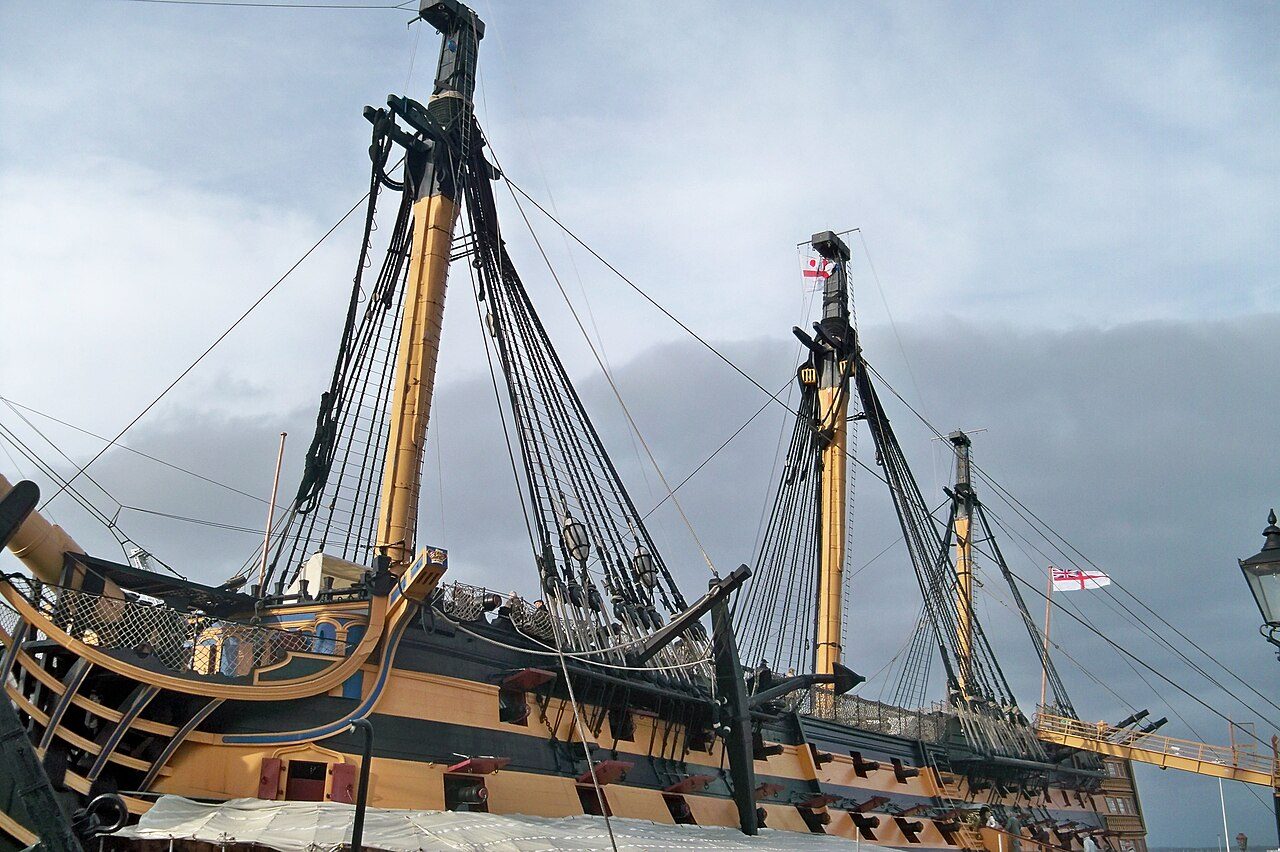
At a Glance
- Type
- 104-gun first-rate ship of the line, Royal Navy
- Designed by
- Sir Thomas Slade, Surveyor of the Navy
- Built
- Chatham Dockyard; keel laid 1759, launched 7 May 1765
- Armament
- 104 guns across three gun decks
- Crew
- About 850 officers and men
- Defining action
- Battle of Trafalgar, 21 October 1805 — Nelson's flagship; Nelson killed aboard
- Home since 1922
- No. 2 Dry Dock, Portsmouth Historic Dockyard
- Status today
- The world's oldest commissioned warship; flagship of the First Sea Lord since 2012
Introduction
HMS Victory is the most famous warship in the world, and she earned the fame the slow way: forty years of service before her greatest day. Launched at Chatham in 1765 as a first-rate ship of the line — 104 guns on three decks, a crew of about 850 men — she was flagship to a succession of admirals before Horatio Nelson ever stepped aboard. When he did, in 1803, she was already a veteran; when he died on her quarterdeck at Trafalgar on 21 October 1805, she became a national relic while still a working warship.
She is still both. Victory sits today in No. 2 Dry Dock at Portsmouth Historic Dockyard, where she has been preserved since 1922, and she remains a commissioned ship of the Royal Navy — the oldest commissioned warship in the world — and the flagship of the First Sea Lord. Visitors walk decks where sailors ate, slept, worked and fought in 1805, and stand in the cockpit where Nelson spent his final hours.
Background
Victory was ordered in 1758, during the Seven Years' War, and designed by Sir Thomas Slade, the Navy's Surveyor. Her keel was laid at Chatham Dockyard in July 1759, and she was launched on 7 May 1765 — then, peace having come, she spent years in reserve before her first commission in 1778. That long fuse was typical of great wooden warships, which were capital assets built to serve for decades, repaired and rebuilt as navies' needs changed.
Her active career reads like a roll of the sailing navy's greatest names. She was Keppel's flagship at the First Battle of Ushant in 1778, Howe's at Cape Spartel, and Jervis's at Cape St Vincent in 1797. Between 1800 and 1803 she underwent a large repair that amounted to a rebuild. Then, in 1803, war with France resumed and Nelson raised his flag in her as commander of the Mediterranean Fleet — the appointment that led, two years later, to Trafalgar.
Timeline
- 14 July 1758
Victory is ordered, a first-rate ship of the line designed by Sir Thomas Slade.
- 23 July 1759
Her keel is laid at Chatham Dockyard.
- 7 May 1765
Victory is launched at Chatham — then laid up in reserve, as peacetime navies kept their great ships.
- 1778
First commissioned, she serves as Admiral Keppel's flagship at the First Battle of Ushant.
- 1797
As Admiral Jervis's flagship, she fights at the Battle of Cape St Vincent.
- 1800–1803
A large repair rebuilds her; a contemporary full-hull model made during the work shows her as she will fight at Trafalgar.
- 1803
Nelson raises his flag in Victory as commander of the Mediterranean Fleet.
- 21 October 1805
At the Battle of Trafalgar, Victory leads the British fleet into action against the combined French and Spanish fleets; Nelson is fatally wounded aboard her.
- 1824
Her seagoing career over, Victory becomes a harbour ship at Portsmouth.
- 1922
She is moved into No. 2 Dry Dock at Portsmouth and preserved as a museum ship.
- 2012
Ownership passes to the HMS Victory Preservation Trust within the National Museum of the Royal Navy; she becomes flagship of the First Sea Lord.
Significance
Trafalgar was the decisive naval battle of the Napoleonic Wars: the combined French and Spanish fleets were shattered, and Britain's command of the sea — the foundation of its nineteenth-century power — was never again seriously challenged in the age of sail. Victory stood at the head of Nelson's weather column as it broke the enemy line, and the ship absorbed the battle's full fury: her foretopsail alone, preserved to this day, was pierced by more than ninety shot. Nelson's death at the moment of victory fused ship, admiral and nation into a single story that Britain has told ever since.
Her significance is also material. Victory is the only surviving ship of the line — the sole intact example of the great three-decked wooden warships that were the supreme weapons system of their century. Everything known about how such ships were built, sailed, fought and lived in can be checked against her timbers: the gun decks where some 850 men ate and slept between the cannon, the captain's and admiral's cabins, the hold and magazines below the waterline.
Legacy
Victory's second career has now lasted far longer than her first. Preserved in dry dock since 1922, rededicated repeatedly, and transferred in 2012 to a dedicated preservation trust within the National Museum of the Royal Navy, she is currently undergoing the largest conservation project in her history — Victory Live: The Big Repair — a decade-scale programme of structural work that visitors can watch in progress from walkways around the hull.
She remains, uniquely, both museum and warship: a commissioned vessel of the Royal Navy with a serving crew, flagship of the First Sea Lord, and the service's focus for remembrance of those who died at sea — including the Trafalgar Day tradition of laying a wreath where Nelson fell. Two and a half centuries after her launch, the ship built for one war is still on duty in another role entirely: keeping the age of sail physically, walkably real.
Sources
- Portsmouth Historic Dockyard — HMS Victory (National Museum of the Royal Navy)
- National Museum of the Royal Navy — Portsmouth Historic Dockyard teachers' highlights
- Wikipedia — HMS Victory (corroboration)
The facts on this page were checked against these sources on 19 November 2026. The History Trail's permanent pages are researched and written for this site; the live profiles elsewhere on The History Trail are assembled automatically from Wikipedia and Wikidata.
About the Author
Researched and written by the The History Trail Editorial Team — the accountable editorial function behind this site's permanent story pages. The team works from the published sources cited on each page; it does not invent historians, reviewers or credentials, and it corrects errors openly.
Fact Check
Every load-bearing fact on this page traces to one of the sources listed above, and significant claims link to their source in the text. Our checking method is described on the methodology page; errors can be reported via the corrections page.
Sources & Citations
Cite this page as: The History Trail Editorial Team, The History Trail — this article's title, publication and update dates are shown beneath its headline. The full source list appears under Sources above; the site's source standards are on the sources page.