
Things
United States Constitution
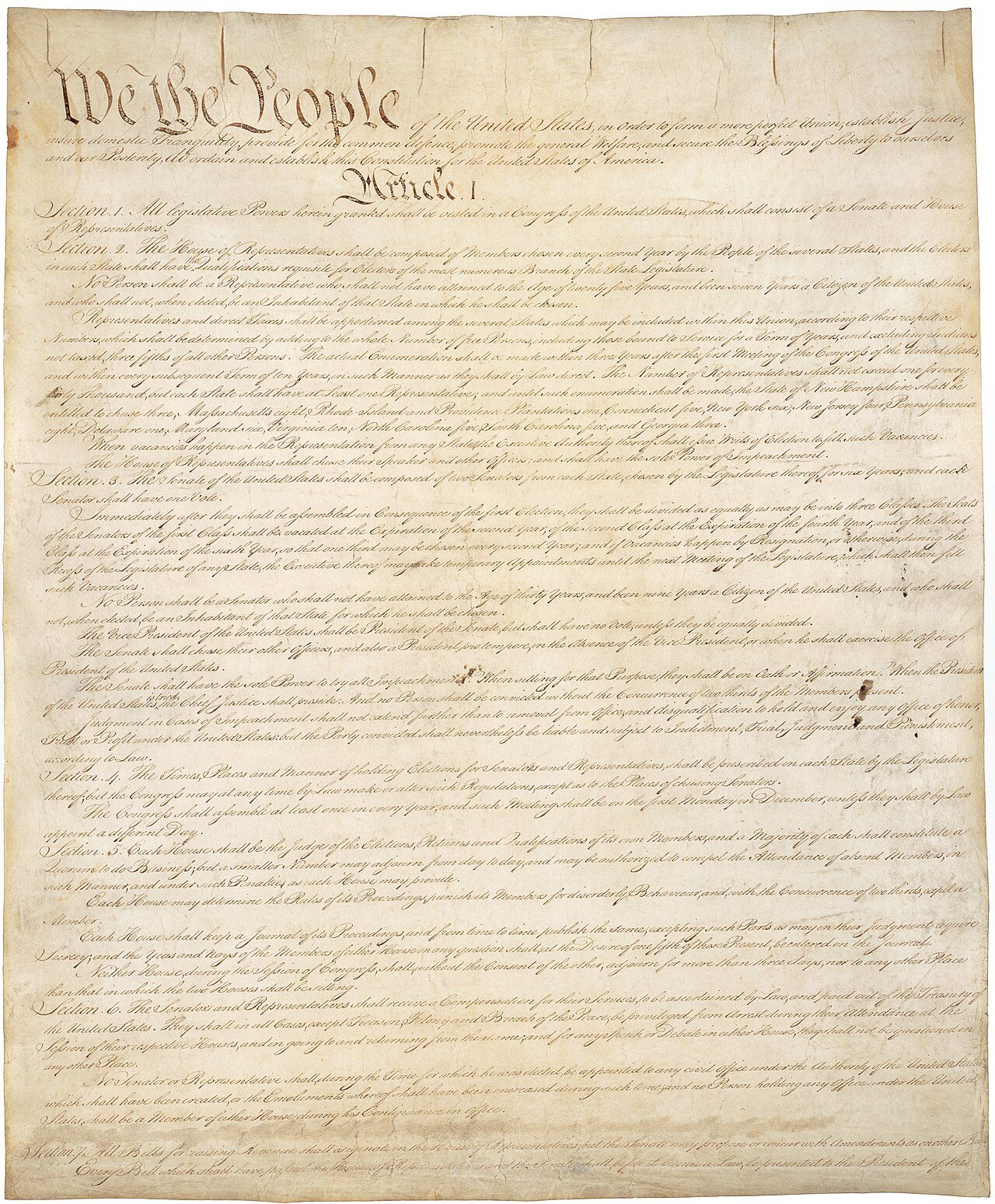
The Constitution of the United States is the supreme law of the United States. Written at Philadelphia in the summer of 1787 by delegates who had met to repair the Articles of Confederation, signed on 17 September 1787 and in force from 4 March 1789, it created the federal government of Congress, president and courts - and, amended 27 times, remains the oldest written national constitution still in use.
At a Glance
- What it is
- The supreme law of the United States - Britannica calls it the fundamental law of the US federal system and the oldest written national constitution in use
- Written
- Summer 1787 in Philadelphia, by 55 delegates to a convention called to amend the Articles of Confederation
- Signed
- 17 September 1787, by 39 delegates; three present refused to sign because it lacked a bill of rights
- Ratified
- 21 June 1788, when New Hampshire became the ninth state to ratify, as Article VII required
- In effect
- 4 March 1789, when the new federal government began proceedings and the Articles of Confederation were superseded
- Structure
- A preamble - We the People - and seven articles establishing Congress, the presidency and the courts, plus the amendment process in Article V
- Amendments
- 27 in total; the first ten, ratified on 15 December 1791, are the Bill of Rights; the last, ratified in 1992, was proposed in 1789
Introduction
Britannica calls it the fundamental law of the United States federal system and a landmark document of the Western world: the oldest written national constitution in use. In a preamble and seven articles - barely four pages of parchment - it defines the principal organs of government and their jurisdictions and the basic rights of citizens, and it has done so, amended only 27 times, since 1789.
The original document, engrossed by Jacob Shallus and signed in Philadelphia, is kept with the Declaration of Independence and the Bill of Rights in the Rotunda of the National Archives in Washington, D.C. Together the three are known as the Charters of Freedom. The Constitution's opening words state its theory of power: authority comes not from a king or a parliament but from We the People of the United States.
Origins: The Failure of the Articles of Confederation
The United States had a constitution before this one. The Articles of Confederation, ratified on 1 March 1781, were the country's first written constitution, and they tried to preserve as much independence and sovereignty for the states as possible, assigning the central government only functions the states could not handle individually. By 1787 the experiment had failed on its own terms: the national government could not levy direct taxes or regulate interstate commerce, and its inability to act during Shays's Rebellion of 1786-87 in Massachusetts showed, in Britannica's judgement, that the Articles were unworkable.
A convention was therefore called at Philadelphia, ostensibly to amend the Articles. Fifty-five delegates from twelve states - Rhode Island sent none - arrived in May 1787 and decided instead to write an entirely new frame of government. George Washington presided; James Madison, whose Virginia Plan supplied the first working draft and whose notes remain the best record of the debates, became its chief strategist.
Compromise in Philadelphia
The Constitution was the product of political compromise after long and often rancorous debates over states' rights, representation and slavery. The Virginia Plan proposed representation by population in both houses of the legislature; the New Jersey Plan kept equal votes for each state, as under the Articles. The Connecticut delegation's proposal - remembered as the Great Compromise - broke the deadlock: a Senate in which all states are equally represented, and a House of Representatives apportioned by population.
The slavery compromises were darker. Representation in the House was calculated on a state's free population plus three-fifths of its enslaved population - the three-fifths compromise - and a further bargain barred Congress from prohibiting the importation of enslaved people before 1808. The framers built a structure of separated legislative, executive and judicial powers, each checking the others, designed to strike a balance between authority and liberty. After the disputes were bridged, 39 delegates signed the finished text on 17 September 1787; it was submitted to the states on 28 September. Three delegates present refused to sign, the National Archives records, because the Constitution lacked a bill of rights.
Timeline
- 1 March 1781
The Articles of Confederation, the first United States constitution, are ratified - a loose league of sovereign states with no power to tax.
- 1786-1787
Shays's Rebellion in Massachusetts exposes the Confederation government's inability to act, strengthening the case for a new constitution.
- May-September 1787
Fifty-five delegates from twelve states meet in Philadelphia, ostensibly to amend the Articles, and instead draft a new constitution.
- 17 September 1787
Thirty-nine delegates sign the Constitution; three present refuse, objecting that it lacks a bill of rights.
- 28 September 1787
The Constitution is submitted to the thirteen states for ratification by conventions.
- 21 June 1788
New Hampshire becomes the ninth state to ratify, the number Article VII required for the Constitution to take effect.
- 4 March 1789
The new federal government commences proceedings under the Constitution, which supersedes the Articles of Confederation.
- 25 September 1789
Congress proposes twelve amendments to the states, answering the demand for a bill of rights that had shadowed ratification.
- 15 December 1791
Ten of the twelve amendments are ratified and certified - the Bill of Rights, guaranteeing freedoms of religion, speech and the press among others.
- 1803
In Marbury v. Madison, the Supreme Court establishes judicial review, the power to strike down laws as unconstitutional.
- 1865
The Thirteenth Amendment abolishes slavery, beginning the Reconstruction amendments that rewrote the Constitution's promises after the Civil War.
- 1992
The Twenty-seventh Amendment - on congressional pay, proposed in 1789 as part of the original twelve - is finally ratified, the last amendment to date.
Ratification and the Federalist Papers
Ratification was a public argument, not a formality. Supporters, calling themselves Federalists, faced Anti-Federalists who feared the new government would overwhelm the states and who demanded explicit protection for individual rights. In 1787-88 Alexander Hamilton, John Jay and James Madison published 85 essays in New York newspapers under the shared pseudonym Publius, defending the Constitution article by article; collected in 1788 as The Federalist, the essays became a classic exposition of the document's logic and are still cited by courts.
The argument was won conditionally. Delaware ratified first, in December 1787, and New Hampshire's vote on 21 June 1788 supplied the ninth ratification Article VII required. But in many states ratification was contingent on the promised addition of a bill of rights. Congress honoured the bargain in September 1789, proposing twelve amendments; ten were ratified by December 1791.
Significance
The Constitution's significance is partly its design - federalism dividing power between nation and states, separation of powers dividing it among three branches, and an amendment process in Article V that makes change possible but deliberately difficult, requiring two-thirds of Congress to propose and three-fourths of the states to ratify. Only 27 amendments have passed that test in more than two centuries.
It is also a model that travelled. Britannica notes that its brevity and ambiguity allowed it to adapt to changing circumstances and that it served as a model for other nations. Written constitutions with separated powers, federal structures and entrenched rights - now the world norm - descend in large part from the Philadelphia experiment.
Myths and disputes
Was the Constitution a democratic document from the start? Only in part, and this page states the limits plainly. The original text accommodated slavery in the three-fifths clause and the protection of the slave trade until 1808; the vote belonged, in practice, to a minority of the population; and senators were chosen by state legislatures, not by voters, until the Seventeenth Amendment in 1913. The document Americans revere was expanded towards democracy by amendment and struggle, not delivered complete in 1787.
Did James Madison write the Constitution? He is often called its father, and his Virginia Plan framed the debate and his notes record it - but the text was the convention's work, argued over for four months and reshaped by committees and compromises he sometimes opposed. Madison himself resisted the singular credit. The safer statement is the one the evidence supports: no single author wrote it, which is precisely why its meaning is still argued over.
Even the claim that it is the world's oldest written constitution needs its qualifier. Britannica's careful form - the oldest written national constitution in use - is the accurate one: older constitutional documents exist, including the statutes of San Marino from 1600, but no other single national constitution has remained continuously in force for so long.
Legacy
The Constitution's legacy is a working government that has outlasted every other written national constitution, through civil war, depression and expansion from thirteen states to fifty. Its parchment original rests in the National Archives Rotunda, where the Archives displays it as one of the three Charters of Freedom - the Declaration announcing the nation's ideals, the Constitution building its government, and the Bill of Rights limiting that government's reach.
Its deepest legacy may be procedural: the idea that a people's fundamental law is a written text, superior to ordinary legislation, enforceable by courts, and changeable only by a special, demanding process. That idea was not obvious in 1787. Philadelphia made it ordinary, and most of the world now lives under some version of it.
Sources
- Encyclopaedia Britannica - Constitution of the United States of America
- National Archives - America's Founding Documents
- National Archives - Join the Signers
- National Archives Museum - Founding Documents
The facts on this page were checked against these sources on 19 November 2026. The History Trail's permanent pages are researched and written for this site; the live profiles elsewhere on The History Trail are assembled automatically from Wikipedia and Wikidata.
About the Author
Researched and written by the The History Trail Editorial Team — the accountable editorial function behind this site's permanent story pages. The team works from the published sources cited on each page; it does not invent historians, reviewers or credentials, and it corrects errors openly.
Fact Check
Every load-bearing fact on this page traces to one of the sources listed above, and significant claims link to their source in the text. Our checking method is described on the methodology page; errors can be reported via the corrections page.
Sources & Citations
Cite this page as: The History Trail Editorial Team, The History Trail — this article's title, publication and update dates are shown beneath its headline. The full source list appears under Sources above; the site's source standards are on the sources page.