
Things
Gravity
Gravity is the weakest force in nature, yet it steers every planet and galaxy. Newton explained it as a universal attraction in 1687; Einstein replaced the force with the curvature of space-time — and both accounts are still in daily use.
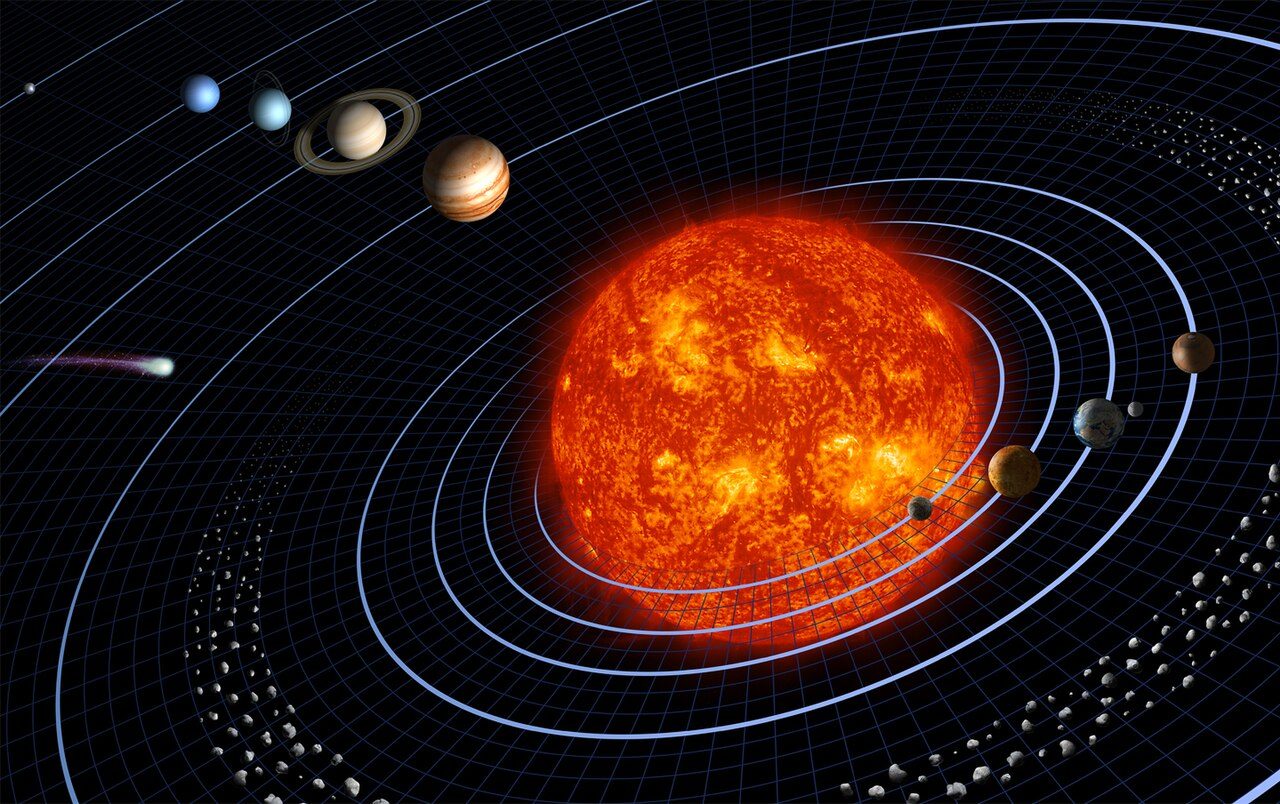
At a Glance
- Definition
- The universal attraction between all bodies of matter; the weakest known force
- At Earth's surface
- Acceleration of about 9.8 metres per second per second for falling bodies
- At the Moon's surface
- Acceleration of about 1.6 metres per second per second
- Newton's law
- Force proportional to the product of the masses, inversely proportional to the square of the distance; Principia, 1687
- Einstein's account
- General relativity (1915): gravity as curvature of space-time
- Status today
- Newton's theory suffices for all but the most precise applications
Introduction
Gravity, in mechanics, is the universal force of attraction acting between all bodies of matter. It is by far the weakest of the known forces, and it plays no role in the internal properties of everyday matter — yet through its long reach and universal action it controls the trajectories of bodies in the solar system and the structures and evolution of stars, galaxies and the whole cosmos. On Earth it gives every body weight, a downward pull proportional to its mass, measured by the acceleration it gives to falling objects: about 9.8 metres per second per second at the surface.
Two men dominate the theory of gravity. Isaac Newton held that the same force that pulls an apple to the ground keeps the Moon in orbit, and his law of universal gravitation, published in the Principia in 1687, ruled physics for more than two centuries. Albert Einstein then recast gravity entirely: in general relativity it is not a force reaching across space but a geometric effect, the curvature of space-time itself. Newton's theory still serves for all but the most precise applications; Einstein's changed what physicists think gravity is.
Background
The Greeks had kept heaven and Earth apart. Aristotle held that heavenly bodies followed their own natural, perpetually repeating motions, unaffected by anything like gravity, while heavy earthly objects tended naturally toward Earth's centre. Two further ideas blocked progress for centuries: that a body moving at constant speed needs a continuous force to keep it moving, and that force must act by contact rather than at a distance. Those assumptions prevailed until the 16th and early 17th centuries.
The impasse broke in stages. Copernicus put the Sun, not Earth, at the centre, reviving an argument that went back to Aristarchus. Kepler, working from Tycho Brahe's improved measurements of planetary movements, reduced the orbits to three quantitative laws: planets move in ellipses with the Sun at one focus, sweep out equal areas in equal times, and have orbital periods whose squares are proportional to the cubes of their distances. Galileo, studying falling bodies, found motion of constant acceleration, with distance travelled varying as the square of the time — and showed by experiment that bodies fall with the same acceleration whatever they are made of.
Timeline
- 1543
Copernicus publishes his proof of a heliocentric, Sun-centred universe, displacing Earth from the centre of planetary motion.
- Early 1600s
Kepler sets out his three laws of planetary motion from Tycho Brahe's observations; Galileo shows falling bodies accelerate uniformly and fall alike whatever their composition.
- 1687
Newton's Principia publishes the law of universal gravitation: every two bodies attract with a force proportional to their masses and inversely proportional to the square of the distance between them.
- 1687–1915
Newton's theory reigns for over two centuries, sufficient for nearly every calculation of falling bodies, tides and orbits.
- 1915
Einstein completes general relativity: gravity is the curvature of space-time caused by mass and energy, not a force acting at a distance.
- 1919
Eclipse expeditions measure starlight bending as it passes the Sun, matching Einstein's prediction and making him world-famous.
- Space age
Space vehicles and research from them greatly improve measurements of gravity around Earth, the other planets and the Moon, and experiments on gravitation's nature.
Significance
Newton's achievement was unification. Before him, the fall of an apple and the orbit of the Moon belonged to different sciences, terrestrial and celestial. His law bound them into one mechanics: the invisible force acting between the Sun and the planets is the same one that gives weight to a stone. With a single inverse-square formula, astronomers could compute trajectories across the solar system, and the theory's predictive success made it the model of what a physical law should be.
Einstein's significance was conceptual rather than numerical. General relativity predicts only minute quantitative differences from Newton's theory except in a few special cases — Mercury's orbit, strong fields, the universe at large. But it replaced force with geometry: massive bodies curve space-time, and other bodies follow the curves. That departure reshaped cosmology, predicted black holes and an expanding universe, and set the terms in which physicists still think about the large-scale world.
Legacy
Gravity remains the odd force out. It is the weakest known, irrelevant inside atoms, yet it alone sculpts the cosmos — holding planets to stars, stars to galaxies, and setting the universe's overall evolution. Newton's equations still navigate spacecraft for most purposes, while Einstein's are required wherever precision matters, from Mercury's anomalous orbit to the timing signals modern navigation depends on, and the search for a quantum theory of gravity continues.
The story's pattern is worth keeping: a framework can be predictively superb and conceptually wrong at once. Newton's gravity worked for 228 years while saying nothing about how attraction crosses empty space; Einstein answered that question by abolishing the force altogether. The next revision, whenever it comes, will likely do the same to ideas we now treat as final.
Sources
- Encyclopaedia Britannica — Gravity
- Encyclopaedia Britannica — Albert Einstein (relativity and legacy)
- Wikipedia — Gravity
The facts on this page were checked against these sources on 19 November 2026. The History Trail's permanent pages are researched and written for this site; the live profiles elsewhere on The History Trail are assembled automatically from Wikipedia and Wikidata.
About the Author
Researched and written by the The History Trail Editorial Team — the accountable editorial function behind this site's permanent story pages. The team works from the published sources cited on each page; it does not invent historians, reviewers or credentials, and it corrects errors openly.
Fact Check
Every load-bearing fact on this page traces to one of the sources listed above, and significant claims link to their source in the text. Our checking method is described on the methodology page; errors can be reported via the corrections page.
Sources & Citations
Cite this page as: The History Trail Editorial Team, The History Trail — this article's title, publication and update dates are shown beneath its headline. The full source list appears under Sources above; the site's source standards are on the sources page.