
Things
Big Bang
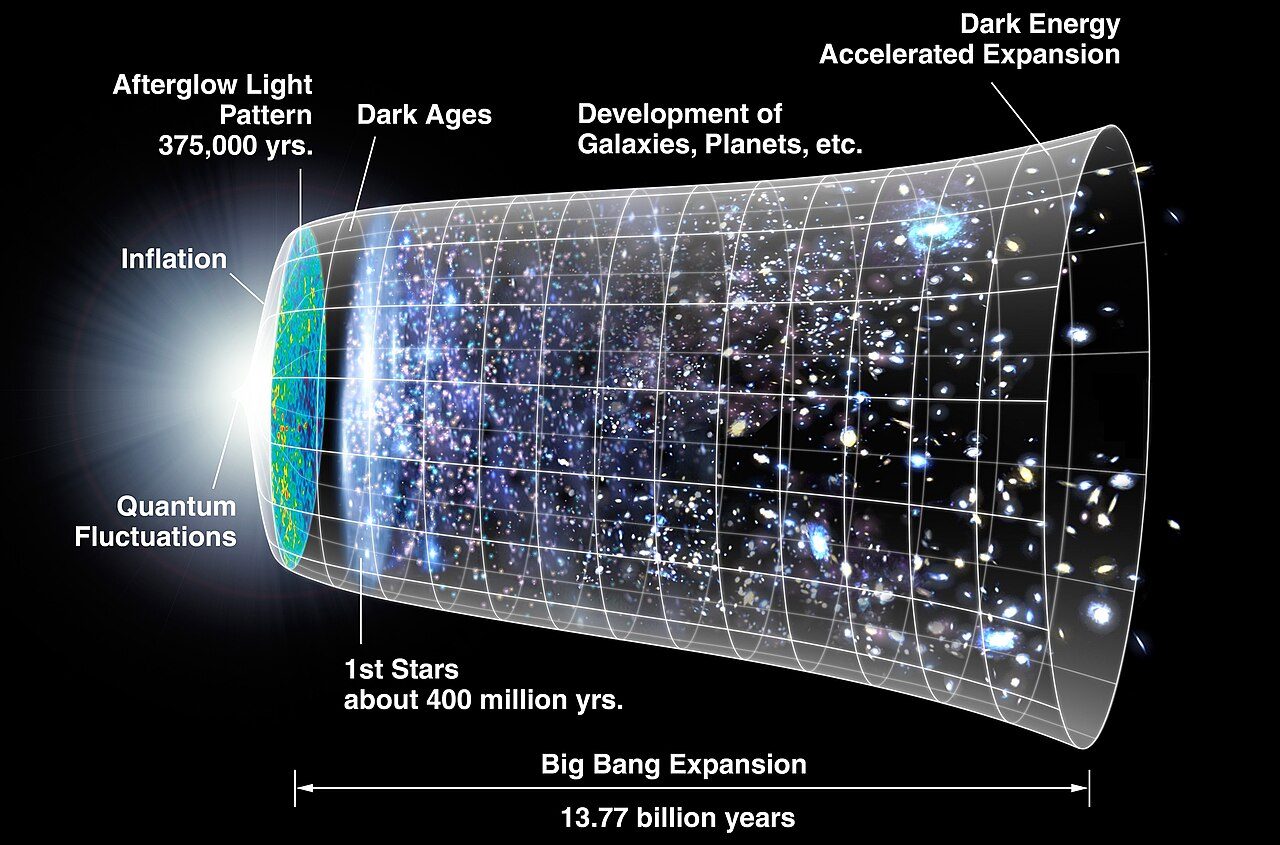
The Big Bang says the universe began about 13.8 billion years ago in a state too hot and dense for atoms, and has expanded and cooled ever since. It rests on three pillars anyone can check: fleeing galaxies, a faint microwave afterglow, and the chemistry of the lightest elements.
At a Glance
- What it describes
- The universe expanding and cooling from an extremely hot, dense early state
- Age of the universe
- About 13.8 billion years (Planck measurements)
- Key evidence 1
- Galaxies recede at speeds proportional to distance (Hubble, 1929)
- Key evidence 2
- Cosmic microwave background at 2.73 K, detected by Penzias and Wilson
- Key evidence 3
- Observed abundances of the lightest elements match hot-beginning predictions
- Proposed by
- Georges Lemaître (expanding universe 1927; primeval atom 1931), building on Friedmann (1922)
- Name coined
- Fred Hoyle, BBC radio, 1949, while arguing for the rival theory
- First clear light
- About 380,000 years in, when atoms formed and light travelled freely
Introduction
The Big Bang is the scientific account of how the universe began and evolved: the claim that the cosmos started, roughly 13.8 billion years ago, in an extremely hot, dense state, and has been expanding and cooling ever since. It is not a story about an explosion in space but about the expansion of space itself, inferred backwards from what telescopes measure today: galaxies receding from one another, a faint glow of leftover heat filling the whole sky, and chemical abundances that match what a hot early universe should have cooked.
Few ideas have travelled further on evidence. In the 1920s the universe was widely pictured as static and eternal. Within fifty years, observations had replaced that picture with a cosmos that has a history and a beginning in time. The name itself was an accident of broadcasting: the astronomer Fred Hoyle, champion of the rival steady-state theory, used the words big bang on BBC radio in 1949, and the label stuck to the theory he opposed.
Background
The mathematics came first. Einstein's general relativity, completed in 1915, described gravity in terms of curved spacetime, and in 1922 the Russian physicist Alexander Friedmann found solutions to Einstein's equations in which the universe expands or contracts rather than standing still. In 1927 the Belgian priest and physicist Georges Lemaître independently proposed an expanding universe and estimated its rate, then in 1931 took the logic to its end: if the cosmos expands as time runs forward, running time backwards ends at a beginning, which he called the primeval atom.
Observation caught up in 1929, when Edwin Hubble reported that distant galaxies are receding from us at speeds proportional to their distance, the farther, the faster. Space itself stretching explains the pattern naturally and a static universe cannot. Through the 1930s and 1940s George Gamow and colleagues worked out the physics of the hot early phase, predicting both the forging of the lightest elements in the first minutes and a cooled remnant of the primordial heat, a background radiation that should still fill the universe at a few degrees above absolute zero.
Timeline
- 1915
Albert Einstein completes general relativity, the theory of gravity on which modern cosmology is built.
- 1922
Alexander Friedmann publishes expanding-universe solutions to Einstein's equations, showing a dynamic cosmos is mathematically natural.
- 1927
Georges Lemaître proposes an expanding universe and derives the relation between galaxy distances and recession speeds.
- 1929
Edwin Hubble reports that galaxies recede faster the farther away they are, the observational foundation of cosmic expansion.
- 1931
Lemaître proposes the primeval atom: the universe began from a single initial state and has expanded ever since.
- 1948
Ralph Alpher, Hans Bethe and George Gamow publish the theory of how the lightest elements formed in the hot early universe; Alpher and Robert Herman predict leftover background radiation.
- 1949
Fred Hoyle uses the phrase big bang in a BBC radio broadcast while criticising the theory; the name catches on.
- 1964
Arno Penzias and Robert Wilson at Bell Laboratories detect a persistent microwave glow from every direction, the cosmic microwave background predicted by the theory; they share the 1978 Nobel Prize for the discovery.
- 1989
NASA launches the COBE satellite, which confirms the background's thermal spectrum and finds the first ripples in it.
- 2009
The European Space Agency launches Planck, whose maps of the microwave background pin the universe's age at about 13.8 billion years.
Significance
The cosmic microwave background is the theory's portrait of the infant universe. For roughly its first 380,000 years the cosmos was an opaque plasma of particles and light locked together; only when it cooled enough for atoms to form could light travel freely, and that liberated light, stretched by expansion into microwaves, is what COBE, WMAP and Planck photographed. Its temperature, 2.73 degrees above absolute zero, and its tiny fluctuations, about one part in a hundred thousand, match the hot-beginning account in detail and seeded every galaxy that followed.
Together with expansion and the measured abundances of hydrogen, helium and lithium, the background makes the Big Bang the framework within which all other cosmology is done. The framework also has honest edges: it describes the universe's evolution from an early hot state, not the origin of that state itself, and measurements of the expansion rate by different methods currently disagree enough to keep cosmologists arguing, which is what a living theory looks like.
Legacy
The Big Bang changed humanity's address in time. A universe with a measurable age, a hotter denser youth and a continuing expansion replaced the eternal stage-set of earlier cosmology, and every science of deep time now works inside its chronology. Its central instruments, the great space observatories, were built substantially to test it, and their data have turned creation from a matter of doctrine into a matter of measurement with error bars.
Its legacy includes a new kind of question made respectable: not only how the universe behaves, but why there is a universe with these contents at all, and what, if anything, preceded the hot early state the theory describes. Cosmology does not yet answer those questions, and says so. That a priest proposed the primeval atom, a radio antenna found its afterglow by accident, and its mocking nickname became its name, is a fair summary of how the theory actually grew: unevenly, publicly, and on evidence anyone could check.
Sources
- NASA Science — The Big Bang (Universe overview)
- European Space Agency — Planck and the cosmic microwave background
- NobelPrize.org — Arno Penzias, Facts (Nobel Prize in Physics 1978)
- Wikipedia — Big Bang
The facts on this page were checked against these sources on 19 November 2026. The History Trail's permanent pages are researched and written for this site; the live profiles elsewhere on The History Trail are assembled automatically from Wikipedia and Wikidata.
About the Author
Researched and written by the The History Trail Editorial Team — the accountable editorial function behind this site's permanent story pages. The team works from the published sources cited on each page; it does not invent historians, reviewers or credentials, and it corrects errors openly.
Fact Check
Every load-bearing fact on this page traces to one of the sources listed above, and significant claims link to their source in the text. Our checking method is described on the methodology page; errors can be reported via the corrections page.
Sources & Citations
Cite this page as: The History Trail Editorial Team, The History Trail — this article's title, publication and update dates are shown beneath its headline. The full source list appears under Sources above; the site's source standards are on the sources page.