
Things
Mars
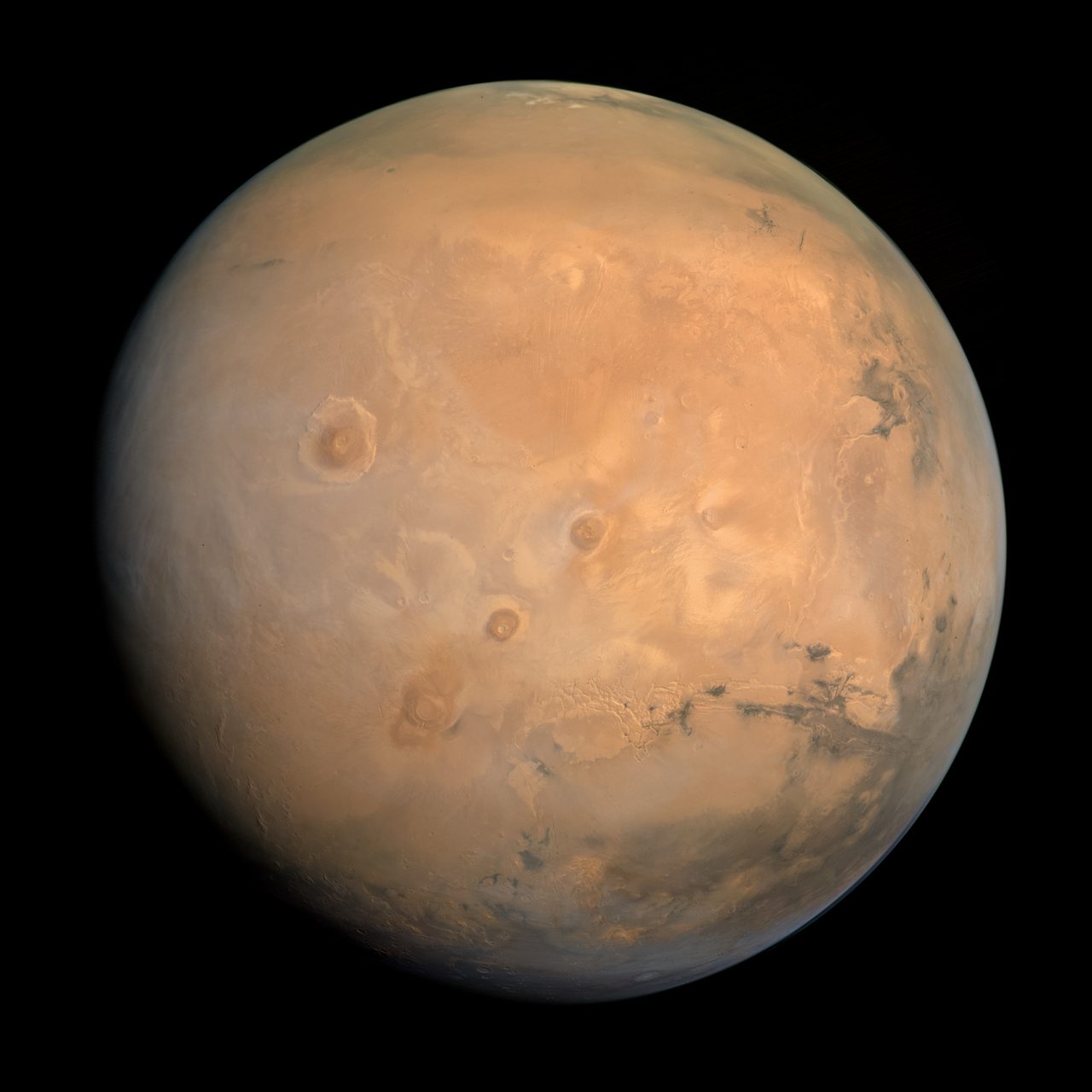
Mars is the planet we know best after our own, and the only one populated — so far — entirely by robots. Its rust-red deserts hold the largest volcano and the deepest canyon in the solar system, and a buried history of rivers, lakes and floods from a warmer age.
At a Glance
- Position
- Fourth planet from the Sun
- Radius
- 3,390 km — about half the size of Earth
- Distance from the Sun
- 1.5 AU (about 228 million km); sunlight takes 13 minutes to arrive
- Day / year
- 24.6 hours (a sol) / 687 Earth days
- Axial tilt
- 25 degrees — Mars has seasons much like Earth's
- Moons
- Two small, lumpy moons — Phobos and Deimos
- Largest volcano
- Olympus Mons, the tallest volcano in the solar system, its base covering an area the size of Arizona
- Atmosphere
- Very thin, mostly carbon dioxide, with nitrogen and argon
Introduction
Mars has been watched for as long as people have watched the sky. Its blood-red colour — the Egyptians called it “the red one”, and the Romans named it for their god of war — comes from iron minerals in its rocks and dust rusting, quite literally, in place. It is one of the easiest planets to spot, a bright red point of light, and for centuries that was all anyone knew: a wandering red star that sometimes looped backwards across the sky.
Up close it is a cold desert world, half the size of Earth, with a wisp of an atmosphere, extinct volcanoes, polar ice caps, seasons and weather. But the spacecraft that have mapped it from orbit and roamed it with rovers have found the marks of a different planet underneath the dust: ancient river valleys, deltas and lakebeds, and rocks and minerals that could only have formed in liquid water. Mars was once wetter and warmer, with a thicker atmosphere. The story of Mars is the story of where that world went.
Background
Mars formed about 4.5 billion years ago with a dense iron-nickel-sulfur core, a rocky mantle and a solid crust — the same architecture as Earth, at half scale. Its surface geography is outsized, though. Olympus Mons, the largest volcano in the solar system, stands with a base the size of Arizona; the canyon system Valles Marineris runs about 3,870 kilometres, more than ten times longer and wider than the Grand Canyon. With almost no atmosphere to erode them and no plate tectonics to recycle them, such features simply persist.
Today water survives as ice just under the surface and at the poles, and in briny flows that seasonally darken some slopes, because the air is too thin for liquid water to last on the surface. Temperatures swing from a mild 20°C to −153°C. Mars has no global magnetic field now, though magnetised crust in its southern hemisphere betrays one from four billion years ago — and when that shield failed, the solar wind could strip the air of the warmer, wetter world away into space.
Timeline
- 14 July 1965
NASA's Mariner 4 flies past Mars and returns the first close-up images of another planet: 21 pictures of a cratered, moonlike surface.
- 13 November 1971
Mariner 9 becomes the first spacecraft to orbit Mars, arriving during a planet-wide dust storm and going on to map the volcanoes and canyon systems.
- 20 July 1976
Viking 1 makes the first successful landing on Mars and sends back the first photograph from its surface, exactly seven years after Apollo 11.
- 1997
Mars Pathfinder lands and releases Sojourner, a rover the size of a microwave oven — the first wheeled vehicle to drive on another planet.
- January 2004
The twin rovers Spirit and Opportunity land on opposite sides of Mars; Opportunity, built for 90 days, works for nearly fifteen years.
- 6 August 2012
The car-sized Curiosity rover is lowered onto Gale Crater by a rocket-powered sky crane and begins reading the rocks of an ancient lakebed.
- 18 February 2021
Perseverance lands in Jezero Crater, an ancient lake basin, carrying the Ingenuity helicopter — which makes the first powered flight on another world.
Significance
Mars is the solar system's controlled experiment in planetary climate. Earth and Mars began as rocky worlds with water and air; one kept them, the other lost them. Every rover finding — lake sediments in Gale Crater, a river delta in Jezero, organic molecules in ancient mudstone — tightens the account of how a habitable world dries and freezes, and whether life ever got started during the wet years. That is why NASA's rovers are aimed not at finding living things now, but at signs of life that existed long ago.
It is also the rehearsal space for human exploration. Mars is the only planet where we have landed rovers to roam the landscape, and the robotic fleet — orbiters mapping water ice, rovers caching samples, a helicopter proving flight — is explicitly pathfinding for astronauts. Perseverance is sealing tubes of rock for a future return to Earth, which would put Martian material in terrestrial laboratories for the first time.
Legacy
Two rovers are still at work today, Curiosity climbing Mount Sharp through layers of Martian climate history and Perseverance exploring terrain nearly four billion years old on the rim of Jezero — two machines reading opposite ends of the planet's biography at once. Orbiters from several nations watch from above, and twin ESCAPADE spacecraft are on their way to study how the solar wind still strips the air.
Mars has already repaid the attention in one currency: perspective. It is the standing evidence that a planet can be Earth-like and then stop — that oceans, air and habitability are not permanent features but phases. Whatever the rovers find about ancient life, that lesson is secure.
Sources
- NASA Science — Mars: Facts
- NASA JPL — Advances in NASA Imaging Changed How World Sees Mars
- NASA Space Place — The Mars Rovers
The facts on this page were checked against these sources on 19 November 2026. The History Trail's permanent pages are researched and written for this site; the live profiles elsewhere on The History Trail are assembled automatically from Wikipedia and Wikidata.
About the Author
Researched and written by the The History Trail Editorial Team — the accountable editorial function behind this site's permanent story pages. The team works from the published sources cited on each page; it does not invent historians, reviewers or credentials, and it corrects errors openly.
Fact Check
Every load-bearing fact on this page traces to one of the sources listed above, and significant claims link to their source in the text. Our checking method is described on the methodology page; errors can be reported via the corrections page.
Sources & Citations
Cite this page as: The History Trail Editorial Team, The History Trail — this article's title, publication and update dates are shown beneath its headline. The full source list appears under Sources above; the site's source standards are on the sources page.