
Things
Earth
Earth is the only world known to hold liquid-water oceans, breathable air and life — yet for most of history we could not say how big it was, whether its continents moved, or what it looked like from outside. Its story is the story of learning to measure our own home.
At a Glance
- Position
- Third planet from the Sun
- Equatorial diameter
- 12,756 km — largest of the terrestrial planets
- Distance from the Sun
- About 150 million km — exactly 1 astronomical unit (AU)
- Day / year
- 23.9 hours / 365.25 days
- Atmosphere
- 78% nitrogen, 21% oxygen, 1% other gases
- Surface water
- Oceans cover about 71% of the surface and hold 97% of Earth's water
- Age
- Formed about 4.5 billion years ago
- Moon
- One — the fifth largest moon in the solar system
Introduction
Earth is the third planet from the Sun and, by every measure we can take, an outlier. It is the biggest of the four rocky terrestrial planets and the fifth largest planet overall, yet size is not what sets it apart. It is the only world known to keep liquid water standing openly on its surface, the only one with an atmosphere rich in free oxygen, and the only one known to be inhabited. Its global ocean covers about 71 percent of the surface and holds about 97 percent of all its water.
It is also the planet we know from the inside out and the outside in. Every other world is studied from afar; Earth is studied by standing on it, drilling into it, and — only since the middle of the twentieth century — by looking back at it from space. The history of understanding Earth is therefore double: a slow, ground-level science of rocks, oceans and air, and a sudden, recent revelation of the whole planet at once, small and blue against black space.
Background
Earth formed about 4.5 billion years ago, when gravity pulled swirling gas and dust together into the third planet. Like its rocky neighbours it settled into layers: a solid inner core of iron and nickel some 1,221 kilometres in radius, a liquid outer core, a thick mantle of hot, slowly flowing rock, and a thin crust. The churning liquid core generates a magnetic field that shields the surface from the solar wind and lights the polar skies with aurorae when charged particles are trapped and funnelled downward.
The crust is not a single shell. Earth's lithosphere is divided into huge plates that are constantly moving — the North American plate creeps westward at roughly the rate fingernails grow — grinding past, colliding and splitting to raise mountains, open oceans and trigger earthquakes. Above it all, an atmosphere of 78 percent nitrogen and 21 percent oxygen moderates the temperature, carries the weather, and burns up most incoming meteoroids before they can reach the ground.
Timeline
- c. 240 BCE
The Greek scholar Eratosthenes, working in Alexandria, compares noon shadows at two Egyptian cities and calculates Earth's circumference — landing remarkably close to the true value using geometry alone.
- 1912
German meteorologist Alfred Wegener proposes continental drift, arguing that the continents were once joined and have slowly moved apart; most geologists reject the idea.
- 1946
A camera carried on a captured V-2 rocket takes the first photographs of Earth from space, showing the planet's curved horizon from above the atmosphere.
- 1960s
Mapping of the ocean floors reveals seafloor spreading, vindicating Wegener: continental drift is recast as plate tectonics and becomes the organising theory of geology.
- 24 December 1968
Apollo 8 astronaut William Anders photographs Earthrise — the blue planet climbing over the grey lunar horizon — during the first crewed orbit of the Moon.
- 7 December 1972
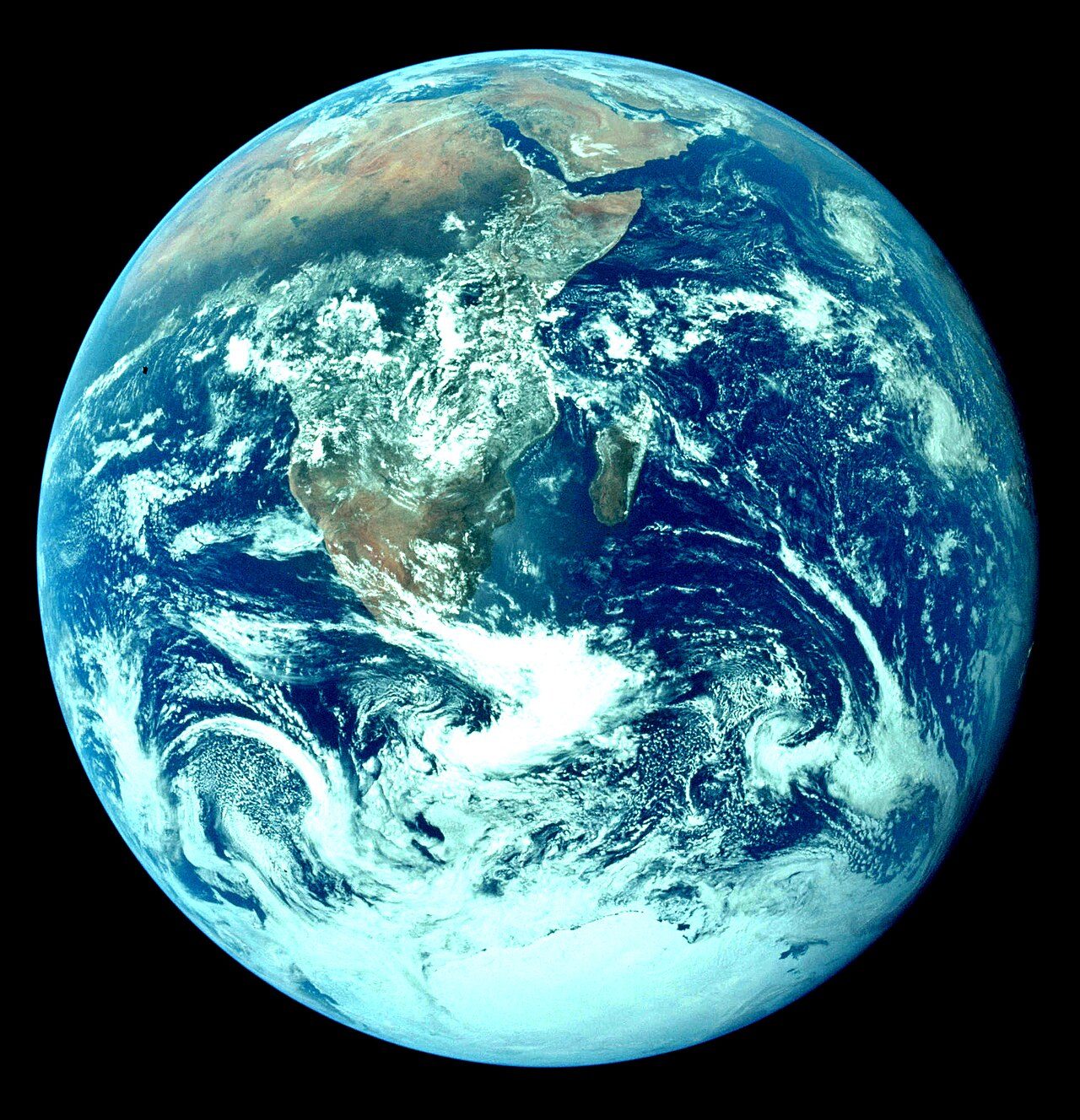
The crew of Apollo 17, the last Apollo mission, photograph the fully illuminated Earth: the Blue Marble, perhaps the most reproduced image ever made.
- 3 April 2026
An Artemis II astronaut photographs the whole Earth from a crewed spacecraft heading for the Moon — the first such human-taken portrait in more than half a century.
Significance
Earth is the reference point for all planetary science. The astronomical unit — the yardstick used to measure the solar system — is defined by Earth's own distance from the Sun, and sunlight takes about eight minutes to cross it. Every exoplanet is described by comparison with this one world: its size in Earth radii, its orbit in Earth years, its habitability judged against Earth's narrow band of temperatures where water stays liquid. We calibrate the universe against home.
The whole-Earth photographs changed Earth's place in culture as much as in science. Earthrise and the Blue Marble showed a single, borderless, visibly fragile world, and they are widely credited with feeding the modern environmental movement. NASA now studies Earth as a system from orbit — atmosphere, oceans, ice and land together — because the planet's parts interact in ways that only the view from outside makes obvious.
Legacy
The measurements have never stopped improving. Geodesy — the science of measuring Earth's shape, gravity and rotation — now tracks the planet's dimensions to within a centimetre using GPS and satellites, refining numbers Eratosthenes first estimated with a stick and a well. The plates still move, the magnetic field still wanders and occasionally reverses, and the ocean still covers most of a world we named, inaccurately and affectionately, after the land.
Earth's deepest legacy may be as a standard of comparison and a warning combined: the one confirmed example of a living world, and proof of how much of its habitability rests on balances — of water, air, heat and motion — that took billions of years to settle.
Sources
- NASA Science — Facts About Earth
- NASA Goddard Space Flight Center — Solar System Tour: Earth
- NASA — What Is Earth? (Grades 5-8)
- University of North Texas — Earth: Physical Properties (course chapter)
The facts on this page were checked against these sources on 19 November 2026. The History Trail's permanent pages are researched and written for this site; the live profiles elsewhere on The History Trail are assembled automatically from Wikipedia and Wikidata.
About the Author
Researched and written by the The History Trail Editorial Team — the accountable editorial function behind this site's permanent story pages. The team works from the published sources cited on each page; it does not invent historians, reviewers or credentials, and it corrects errors openly.
Fact Check
Every load-bearing fact on this page traces to one of the sources listed above, and significant claims link to their source in the text. Our checking method is described on the methodology page; errors can be reported via the corrections page.
Sources & Citations
Cite this page as: The History Trail Editorial Team, The History Trail — this article's title, publication and update dates are shown beneath its headline. The full source list appears under Sources above; the site's source standards are on the sources page.