
Animals
Horse
The horse evolved in North America, died out there, and conquered the world from the Eurasian steppe. Domesticated about six thousand years ago, it ploughed, hauled and carried humanity until the engine arrived — and its fossils remain evolution's most famous exhibit.
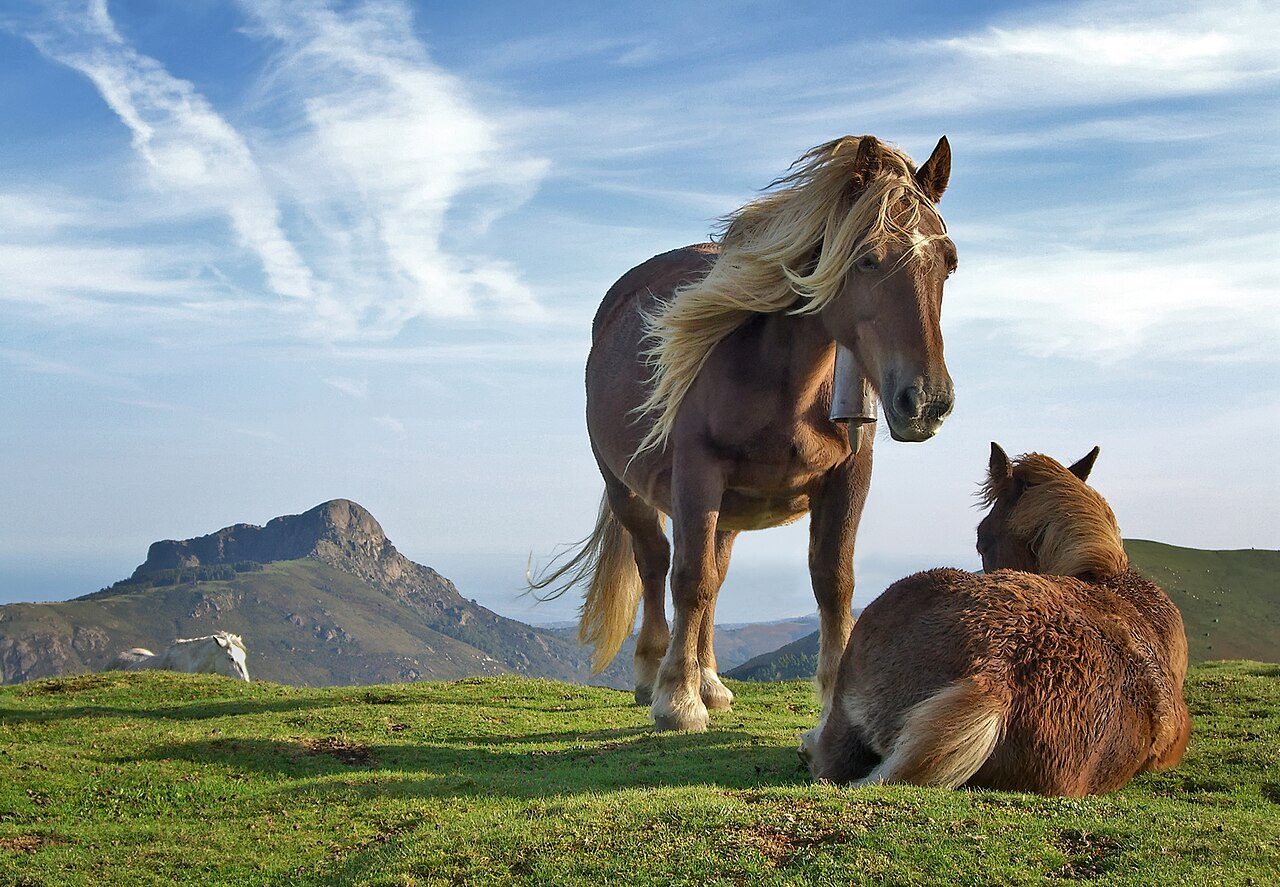
At a Glance
- Scientific name
- Equus caballus
- Family
- Equidae — horses, asses and zebras
- Earliest ancestor
- Eohippus (Hyracotherium), early Eocene, about 55 million years ago
- Domesticated
- By about 6,000 years ago, in the steppes north of the Black Sea
- Homeland of modern domestic horses
- The lower Volga-Don region (Nature ancient-DNA study, 2021)
- Breeds
- More than 200 recognised breeds, plus hundreds of local varieties
- American chapter
- Extinct in the Americas about 10,000–8,000 years ago; reintroduced by Spanish explorers in the early 1500s
- Status
- Domesticated, worldwide
Introduction
The horse family has one of the best-documented evolutionary histories in all of palaeontology. It begins in the Eocene Epoch, some 55 million years ago, with Hyracotherium — better known as Eohippus, the 'dawn horse' — a browsing mammal barely half a metre tall with an arched back, found as fossils in both North America and Europe. From that small forest animal, the line shows a steady set of trends: increase in size, reduction in the number of toes to a single hoof, lengthening of the legs, elongation of the muzzle, and the development of high-crowned, crested teeth suited to grazing.
The modern horse, Equus caballus, is a hoofed herbivore of the family Equidae, a single species divided into more than 200 recognised breeds. For the roughly six thousand years between its domestication and the arrival of mechanised vehicles, it was the world's draft animal and one of the chief means of human transport — a partnership so deep that the history of the horse and the history of civilisation are difficult to separate.
Background
The genus Equus — which includes horses, asses and zebras — evolved from Pliohippus some four to four and a half million years ago, and flourished in its North American homeland through the Pleistocene. Then, about ten thousand to eight thousand years ago, horses disappeared from the Americas entirely, whether through disease, human hunting, or both; the submergence of the Bering land bridge cut off any return from Asia. The horse was not reintroduced to its native continent until Spanish explorers brought it back in the early sixteenth century — arriving, this time, as a domestic animal.
In the Old World, the stock credited as ancestral to the domestic horse includes Przewalski's horse of central Asia, the tarpan of the eastern European and Ukrainian steppes, and the forest horse of northern Europe. The genetics are tangled in an instructive way: mitochondrial DNA, inherited from the mother, shows enormous diversity, with lineages traced back to an 'Ancestral Mare' that lived 130,000 to 160,000 years ago — evidence that wild mares from many regions were folded into domestic herds. The paternally inherited Y chromosome shows almost no variation, suggesting few stallions founded the paternal lines.
Timeline
- About 55 million years ago
Eohippus, the dawn horse, appears in the early Eocene — a small, multi-toed browsing mammal standing only about 43 to 51 centimetres high.
- About 4–4.5 million years ago
Equus, the genus of all modern equines, evolves from Pliohippus during the Pliocene and spreads across the Old and New Worlds.
- About 10,000–8,000 years ago
Horses die out in North and South America, their original homeland, and the flooded Bering land bridge prevents any natural return.
- About 6,000 years ago
Archaeological evidence shows horses had been domesticated by this time in the western steppe, north of the Black Sea from Ukraine to Kazakhstan.
- About 2200 BCE
Ancient DNA research published in Nature in 2021 locates the homeland of modern domestic horses in the lower Volga-Don region of the Pontic-Caspian steppe.
- Early 16th century
Spanish explorers reintroduce the horse to the Americas — the animal returns to its native continent as a domesticated species.
- 2018
Genomic comparison of ancient horses shows the Botai horses of Kazakhstan are not ancestors of modern domestic horses, but a separate branch leading to Przewalski's horse.
- 2021
The Nature study of ancient horse genomes rewrites the domestication story, showing modern horses spread rapidly across Eurasia from about 2000 BCE, replacing local populations.
Significance
Domestication made the horse the engine of the pre-industrial world. Britannica records that before mechanised vehicles, the horse was widely used as a draft animal and riding was one of the chief means of transportation; horses ploughed fields, hauled harvests, carried soldiers, messengers and goods, and set the speed limit of every human society that used them for millennia. Early domestic horses were also milked and eaten, as they still are in parts of Central Asia — the partnership began as much at the table as in the traces.
The horse's second significance is scientific. Because its fossil record is so complete, the horse became the textbook demonstration of evolution by gradual transformation — the Eohippus-to-Equus sequence of growing size, lengthening limbs and grazing teeth. And because its domestication was recent and well preserved, ancient DNA work on horses has become a model for how genetics can overturn archaeological consensus: the Botai culture of Kazakhstan, long credited as the first horse domesticators around 3500 BCE, turned out to have managed a lineage that led not to our horses but to Przewalski's.
Legacy
Mechanisation ended the horse's working reign within a single century, but not its cultural one. More than 200 breeds persist — heavy draft horses such as the Shire, descended from medieval chargers; ancient riding breeds such as the Arabian, which has refined almost every breed in the world; and the Thoroughbred, bred for racing yet influential across the horse sports. Horse meat is still widely consumed, and the horse remains a companion and athlete on every continent.
Przewalski's horse — the branch that split away at Botai — survives as the closest thing to a truly wild horse, a living footnote to the DNA detective story. The domestic horse's legacy is the world it built: the roads, farms, battlefields and languages of Eurasia were all shaped by an animal that a steppe people caught, bred, and ultimately carried around the entire planet.
Sources
- Encyclopaedia Britannica — Horse: Origin of horse domestication
- Encyclopaedia Britannica — Horse: Evolution of the horse
- Encyclopaedia Britannica — 6 Domestic Animals and Their Wild Ancestors
- Wikipedia — Horse (domestication genetics summary)
The facts on this page were checked against these sources on 19 November 2026. The History Trail's permanent pages are researched and written for this site; the live profiles elsewhere on The History Trail are assembled automatically from Wikipedia and Wikidata.
About the Author
Researched and written by the The History Trail Editorial Team — the accountable editorial function behind this site's permanent story pages. The team works from the published sources cited on each page; it does not invent historians, reviewers or credentials, and it corrects errors openly.
Fact Check
Every load-bearing fact on this page traces to one of the sources listed above, and significant claims link to their source in the text. Our checking method is described on the methodology page; errors can be reported via the corrections page.
Sources & Citations
Cite this page as: The History Trail Editorial Team, The History Trail — this article's title, publication and update dates are shown beneath its headline. The full source list appears under Sources above; the site's source standards are on the sources page.