
Things
Korean War
North Korea invaded the South in June 1950, and the Cold War turned hot. Three years, a daring landing, a Chinese intervention and at least 2.5 million dead later, the guns stopped — at almost exactly the line where they had started.
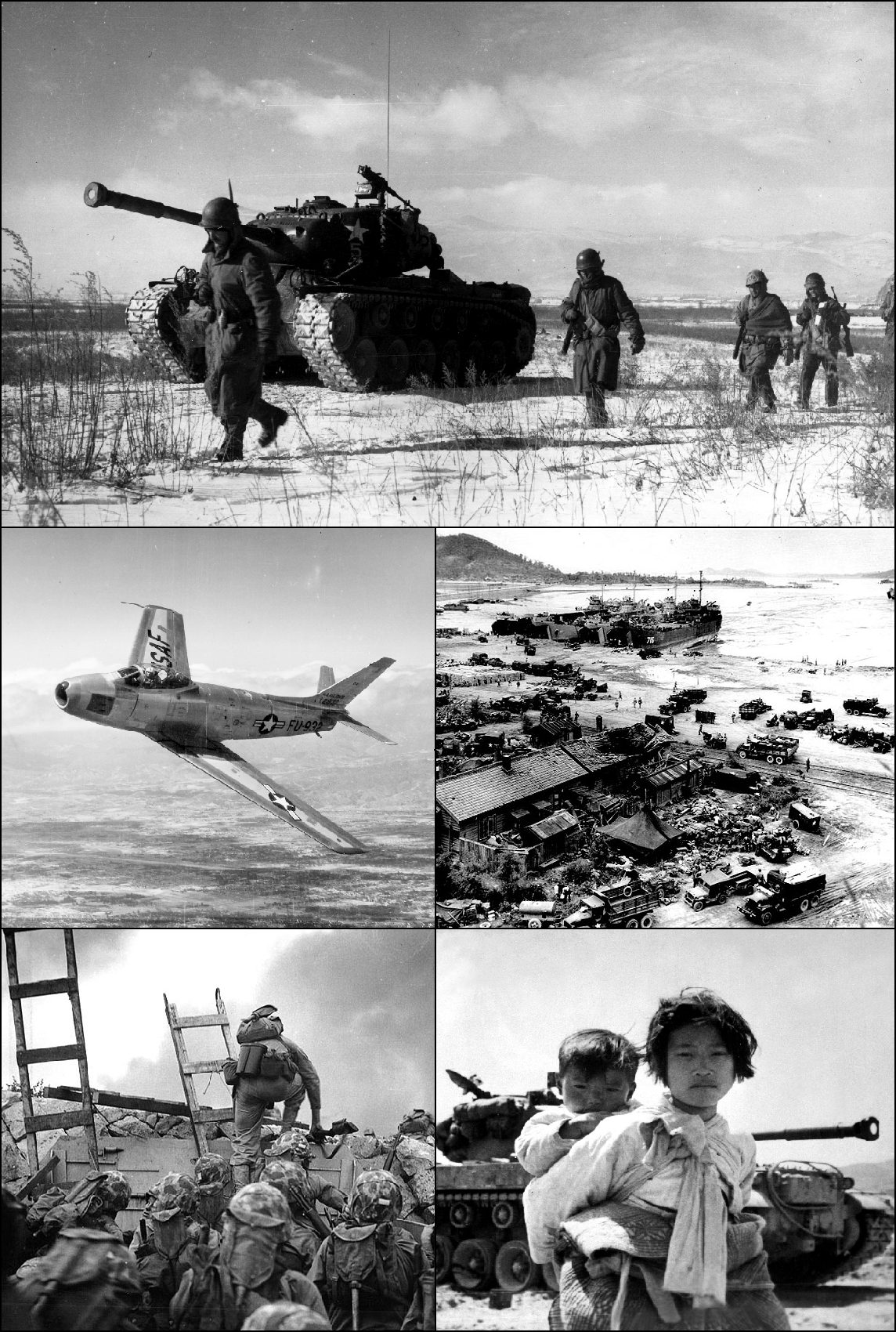
At a Glance
- Fought
- 25 June 1950 – 27 July 1953 (armistice; no peace treaty)
- Belligerents
- North Korea, China and Soviet support vs South Korea and the US-led UN Command
- Trigger
- North Korea's invasion across the 38th parallel, 25 June 1950
- Turning point
- The Inchon landing, 15 September 1950, and China's intervention that autumn
- Deaths
- At least 2.5 million in total (Britannica); about 37,000 Americans (US Army)
- Outcome
- Armistice at Panmunjom; Korea remains divided near the 38th parallel
- UN dimension
- The first war fought under a United Nations command
Introduction
The Korean War began before dawn on 25 June 1950, when North Korean forces crossed the 38th parallel and invaded South Korea. Within days the United States was fighting under a United Nations flag; within months Chinese armies had entered the war; and within three years the peninsula had been fought over from end to end and back again, at a cost Britannica puts at at least 2.5 million dead. It ended on 27 July 1953 not with a peace treaty but with an armistice — a ceasefire that, technically, still holds today, which is why Korea remains divided by a demilitarised zone along roughly the line where the war began.
It is sometimes called the Forgotten War, wedged between the triumph of 1945 and the trauma of Vietnam. That forgetfulness is a Western habit, not a Korean one: for Koreans the war is the defining catastrophe of the modern age, splitting families across a sealed border for three generations.
Background
Korea's division was an accident of August 1945. As Japan's empire collapsed, the United States and the Soviet Union agreed to accept the Japanese surrender in Korea on either side of the 38th parallel — a line drawn hastily in Washington. The temporary arrangement hardened: by 1948 there were two Korean states, the Soviet-backed Democratic People's Republic in the north under Kim Il-sung and the American-backed Republic in the south under Syngman Rhee, each claiming to be the legitimate government of the whole peninsula and each skirmishing along the border.
Kim Il-sung, having secured Stalin's approval and Mao's acquiescence, struck south in June 1950 expecting a quick victory before America could react. The reaction was faster than he calculated. With the Soviet delegate boycotting the United Nations Security Council over China's seat, the Council condemned the invasion and called on members to repel it; the United States, which saw the invasion as a test of containment, provided the overwhelming majority of the UN force under General Douglas MacArthur. The North Korean army, spearheaded by Soviet-supplied tanks, took Seoul in three days and drove the defenders into a shrinking pocket around the southern port of Pusan.
Timeline
- 25 June 1950
North Korea invades South Korea across the 38th parallel; Seoul falls within three days.
- 27 June 1950
The UN Security Council, with the Soviet Union boycotting, calls on member states to help repel the invasion.
- August–September 1950
UN and South Korean forces hold the Pusan Perimeter in the south-east against repeated North Korean assaults.
- 15 September 1950
MacArthur lands at Inchon, far behind North Korean lines; Seoul is recaptured by the end of the month and the northern army collapses.
- October 1950
UN forces cross the parallel, take Pyongyang and advance towards the Yalu River; Chinese troops begin crossing into Korea in secret from 19 October.
- Late November 1950
A massive Chinese offensive drives UN forces out of North Korea in bitter winter fighting, including the Chosin Reservoir campaign.
- April 1951
President Truman dismisses MacArthur for insubordination after the general publicly challenges the policy of limited war.
- July 1951
Armistice talks begin at Kaesong, later moving to Panmunjom; the war settles into two years of static, costly attrition near the parallel.
- 27 July 1953
The Korean Armistice Agreement is signed at Panmunjom; fighting ends that evening. South Korea's President Rhee refuses to sign, and no peace treaty ever follows.
Significance
The war's military course is a study in momentum and its limits. The Inchon landing of 15 September 1950 — an amphibious assault through extreme tides at Seoul's port — cut North Korean supply lines and reversed the war in a fortnight; the advance to the Yalu then reversed it again, bringing China in and producing the longest retreat in American military history. By mid-1951 both sides understood that neither total victory nor direct war with the other superpower's patron was available, and the remaining two years were fought for bargaining position along a line close to where the war had started.
The cost fell overwhelmingly on Koreans. Britannica's figure of at least 2.5 million dead includes civilians in roughly equal agony on both sides of the parallel, and the United States Air Force's bombing campaign left few substantial buildings standing in the North. The United States Army's own anniversary account records about 37,000 American dead, over 92,000 wounded and 8,000 missing, and South Korean casualties of 1.3 million, including 415,000 dead — numbers that explain why all parties, by 1953, preferred an unsatisfying armistice to a wider war.
Legacy
Korea set the template for Cold War conflict: a war fought under an international flag, for limited aims, with the superpowers careful never to fight each other openly — the United States even maintained the fiction that hundreds of thousands of Chinese soldiers were 'volunteers'. It entrenched the American military presence in East Asia, where US forces remain in South Korea today, and it hardened both Korean states into the armed, divided pair that still confronts each other across the Demilitarized Zone.
For Koreans, the legacy is human before it is strategic: a peninsula of one language and one history cut in two, millions of family separations never healed, and two societies shaped in opposite directions by the same three years of destruction. The Forgotten War is forgotten almost nowhere that it was fought.
Sources
- Encyclopaedia Britannica — Korean War
- United States Army — America marks 70th anniversary of end of Korean War
- Encyclopaedia Britannica — Cold War
The facts on this page were checked against these sources on 19 November 2026. The History Trail's permanent pages are researched and written for this site; the live profiles elsewhere on The History Trail are assembled automatically from Wikipedia and Wikidata.
About the Author
Researched and written by the The History Trail Editorial Team — the accountable editorial function behind this site's permanent story pages. The team works from the published sources cited on each page; it does not invent historians, reviewers or credentials, and it corrects errors openly.
Fact Check
Every load-bearing fact on this page traces to one of the sources listed above, and significant claims link to their source in the text. Our checking method is described on the methodology page; errors can be reported via the corrections page.
Sources & Citations
Cite this page as: The History Trail Editorial Team, The History Trail — this article's title, publication and update dates are shown beneath its headline. The full source list appears under Sources above; the site's source standards are on the sources page.