
Things
Treaty of Tordesillas
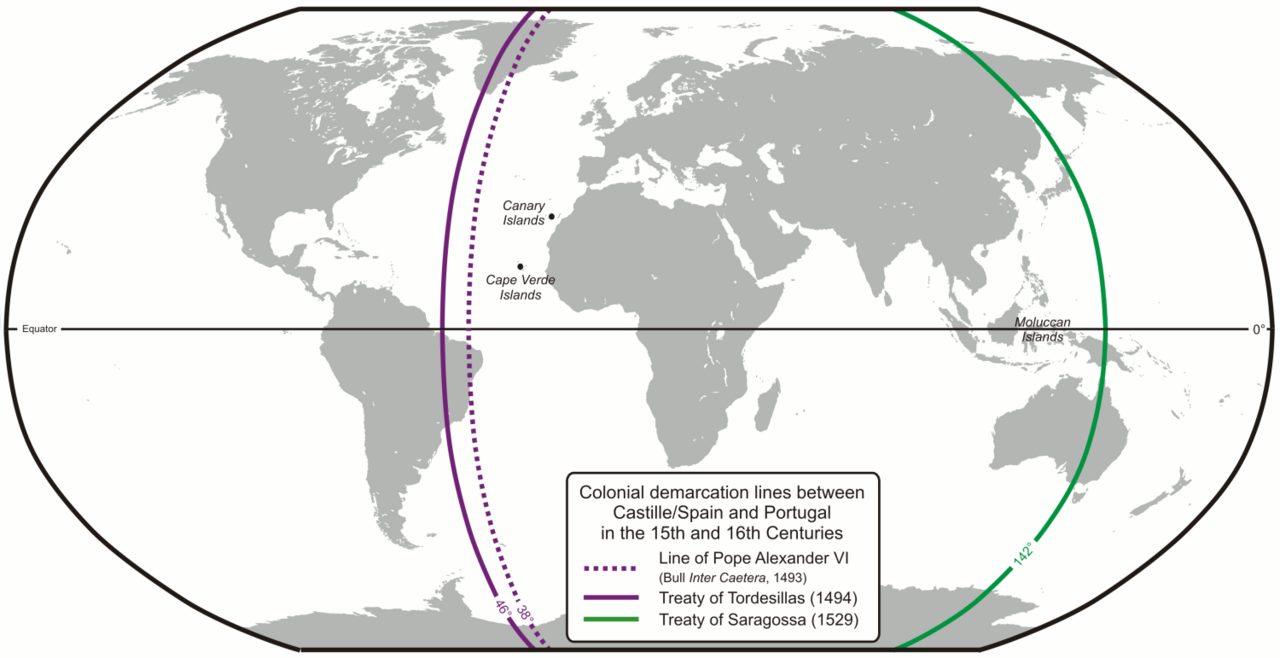
The Treaty of Tordesillas, signed on 7 June 1494, was the agreement in which Spain and Portugal divided the newly discovered lands outside Europe between them along a meridian 370 leagues west of the Cape Verde Islands: everything east of the line to Portugal, everything west of it to Spain. It moved the line Pope Alexander VI had drawn in 1493, gave Portugal its claim to Brazil, and was never accepted by any other European power.
At a Glance
- Signed
- 7 June 1494 at Tordesillas, north-western Spain, between the Crown of Castile (Spain) and the Kingdom of Portugal
- The line
- A meridian from pole to pole 370 leagues (about 1,185 miles) west of the Cape Verde Islands, roughly 46 degrees 30 minutes west of Greenwich
- The division
- Lands east of the line to Portugal - Africa, the route to India and, after 1500, the coast of Brazil; lands west of it to Spain
- Before it
- Pope Alexander VI's bulls of 1493 had set the line at only 100 leagues west of Cape Verde; Portugal negotiated the move west
- Ratified
- By Spain on 2 July 1494 and by Portugal on 5 September 1494; Pope Julius II sanctioned the change in 1506
- The other side
- The Treaty of Zaragoza (1529) drew the corresponding line in the Pacific and assigned the Moluccas to Portugal
- Today
- Originals are held in Seville and Lisbon; UNESCO added the treaty to its Memory of the World register in 2007
Introduction
In 1492 Christopher Columbus, sailing for Spain, reached lands across the Atlantic that Europeans had not known existed. Portugal, which had spent the fifteenth century working its way down the coast of Africa toward India, saw a threat to its routes and its claims. Two rival kingdoms, two sets of voyages, and one ocean that both claimed: the ingredients of a quarrel that could easily have become a war.
Instead, Spain and Portugal negotiated. The result, signed at Tordesillas in north-western Spain on 7 June 1494, drew a single imaginary line down the Atlantic, from pole to pole, and assigned everything east of it to Portugal and everything west of it to Spain. No other nation was consulted - least of all the peoples who already lived in the lands being divided. It remains the most audacious boundary ever drawn on a map neither party could yet read.
The Pope's Line and Portugal's Objection
The first line was not the treaty's. In 1493, after reports of Columbus's discoveries reached Spain, the Spanish rulers Ferdinand and Isabella enlisted papal support for their claims. The Spanish-born Pope Alexander VI issued bulls setting a line of demarcation from pole to pole 100 leagues - about 320 miles in Britannica's conversion - west of the Cape Verde Islands. Spain received exclusive rights to newly discovered and undiscovered lands west of the line; Portuguese expeditions were to keep east of it, and neither power was to occupy territory already held by a Christian ruler.
King John II of Portugal was dissatisfied. Under the papal line, Portugal's rights in the New World were insufficiently affirmed, and the Portuguese would not even have sufficient room at sea for their African voyages, on which their route to India depended. Rather than defy the pope outright, Portugal negotiated directly with Spain - and Spain, which wanted a secure title more than it wanted a quarrel, agreed to move the line.
The Treaty: 370 Leagues West
Meeting at Tordesillas, Spanish and Portuguese ambassadors reaffirmed the principle of the papal division but moved the line itself to 370 leagues west of the Cape Verde Islands - 1,185 miles in Britannica's figure, or about 46 degrees 30 minutes west of Greenwich. Spain ratified the treaty on 2 July 1494 and Portugal on 5 September 1494; Pope Julius II finally sanctioned the change in 1506. The treaty declared that the division was to continue in force and remain firm, stable and valid forever and ever.
The consequences were immediate and accidental in equal measure. The eastward bulge of South America crosses the line, so when Pedro Alvares Cabral reached the coast of Brazil in 1500, his landfall lay on Portugal's side - which is why Brazil became Portuguese while the rest of South America became Spanish. East of the line, the treaty protected Portugal's African coast and its sea route to India, opened by Vasco da Gama in 1498. West of it, Spain claimed the Caribbean and, in time, the mainland empires of Mexico and Peru.
Timeline
- 1493
Pope Alexander VI issues bulls drawing a line 100 leagues west of the Cape Verde Islands, granting Spain exclusive rights west of it.
- 7 June 1494
Spain and Portugal sign the Treaty of Tordesillas, moving the line to 370 leagues west of the Cape Verde Islands.
- 2 July and 5 September 1494
Spain ratifies the treaty at Arevalo; Portugal ratifies it at Setubal.
- 1498
Vasco da Gama reaches India by sea, securing the eastern route the treaty was designed to protect for Portugal.
- 1500
Pedro Alvares Cabral reaches the coast of Brazil, east of the Tordesillas line, and claims it for Portugal.
- 1506
Pope Julius II sanctions the revised line agreed at Tordesillas.
- 1519-1522
The Magellan-Elcano expedition, sailing for Spain, completes the first circumnavigation - and raises the question of where the line falls on the far side of the world.
- 22 April 1529
The Treaty of Zaragoza draws an antimeridian in the Pacific, assigning the Moluccas, the Spice Islands, to Portugal and the Pacific to Spain.
- 16th century
Brazilian exploration and settlement push far west of the line, laying the basis for Brazil's claims to vast areas of the South American interior, while other European powers colonise in disregard of the treaty.
- 2007
UNESCO inscribes the Treaty of Tordesillas on its Memory of the World register; originals are held at the Archivo General de Indias in Seville and the Torre do Tombo archive in Lisbon.
Significance
Tordesillas was one of the first attempts to order the whole world by a single legal instrument. It gave Spain and Portugal a shared framework that kept the two pioneering maritime powers from open war over their discoveries for a generation, and it shaped the map in ways still visible today: the Portuguese language in Brazil, the largest country in South America, is the treaty's most obvious living monument, and Brazilian settlement later pushed far west of the line, laying, as Britannica puts it, a firm basis for Brazil's claims to vast areas of the South American interior.
It also marks a way of thinking: that lands unknown to Europe could be assigned by European law, by a line on a chart, without reference to their inhabitants. The treaty divided, in its own terms, the non-Christian world - a category that treated the peoples of the Americas, Africa and Asia as having no title to their own homes.
Myths and disputes
Did the pope divide the world? Only in the first draft. Alexander VI's 1493 line was papal; the line that mattered, at 370 leagues, was set by bilateral negotiation between two crowns at Tordesillas, and a later pope, Julius II, merely sanctioned the change in 1506. The popular image of a pope ruling a line through the ocean compresses a negotiation into a decree.
Where exactly was the line? Nobody could say, and this page flags that as the treaty's central defect. Fifteenth-century navigators could not measure longitude accurately, a league was an imprecise unit, and the treaty never fixed the line by agreed degrees; each side preferred the interpretation most favourable to itself, and disputes over its position continued into modern times. Nor did the rest of Europe accept it: as Britannica notes, no other Atlantic power ever accepted the papal disposition or the agreement derived from it, and England, France and the Netherlands pursued their own colonisation regardless. Finally, the treaty said nothing about the far side of the globe - a silence that forced the second division, at Zaragoza in 1529, once Spanish and Portuguese ships met in the Spice Islands.
Legacy
The line itself faded. The Iberian Union of 1580 to 1640 put both crowns on one head, Brazil's expansion rendered the meridian irrelevant in South America, and later treaties replaced the division altogether. What survives is the document and the idea. The originals, kept in Seville and Lisbon, were jointly nominated by Spain and Portugal and entered on UNESCO's Memory of the World register in 2007.
Tordesillas endures in language and in law's history: Portuguese in Brazil, Spanish across most of the rest of Latin America, and a permanent example of both the power and the limits of paper boundaries - a line that two kingdoms agreed to treat as real, that no one could locate precisely, and that the rest of the world never accepted at all.
Sources
- Encyclopaedia Britannica - Treaty of Tordesillas
- UNESCO Memory of the World - Treaty of Tordesillas
- World History Encyclopedia - Treaty of Tordesillas
- Princeton University Library - Demarcation Lines
- Wikisource - European Treaties bearing on the History of the United States: Treaty of Tordesillas, 1494
The facts on this page were checked against these sources on 19 November 2026. The History Trail's permanent pages are researched and written for this site; the live profiles elsewhere on The History Trail are assembled automatically from Wikipedia and Wikidata.
About the Author
Researched and written by the The History Trail Editorial Team — the accountable editorial function behind this site's permanent story pages. The team works from the published sources cited on each page; it does not invent historians, reviewers or credentials, and it corrects errors openly.
Fact Check
Every load-bearing fact on this page traces to one of the sources listed above, and significant claims link to their source in the text. Our checking method is described on the methodology page; errors can be reported via the corrections page.
Sources & Citations
Cite this page as: The History Trail Editorial Team, The History Trail — this article's title, publication and update dates are shown beneath its headline. The full source list appears under Sources above; the site's source standards are on the sources page.