
Things
Ramadan
Ramadan is the ninth month of the Islamic calendar and Islam's holy month of fasting. From dawn to dusk, observant Muslims abstain from food and drink; after sunset, families and communities gather to eat, pray and read the Qur'an, in a rhythm that reshapes daily life for a month each year.
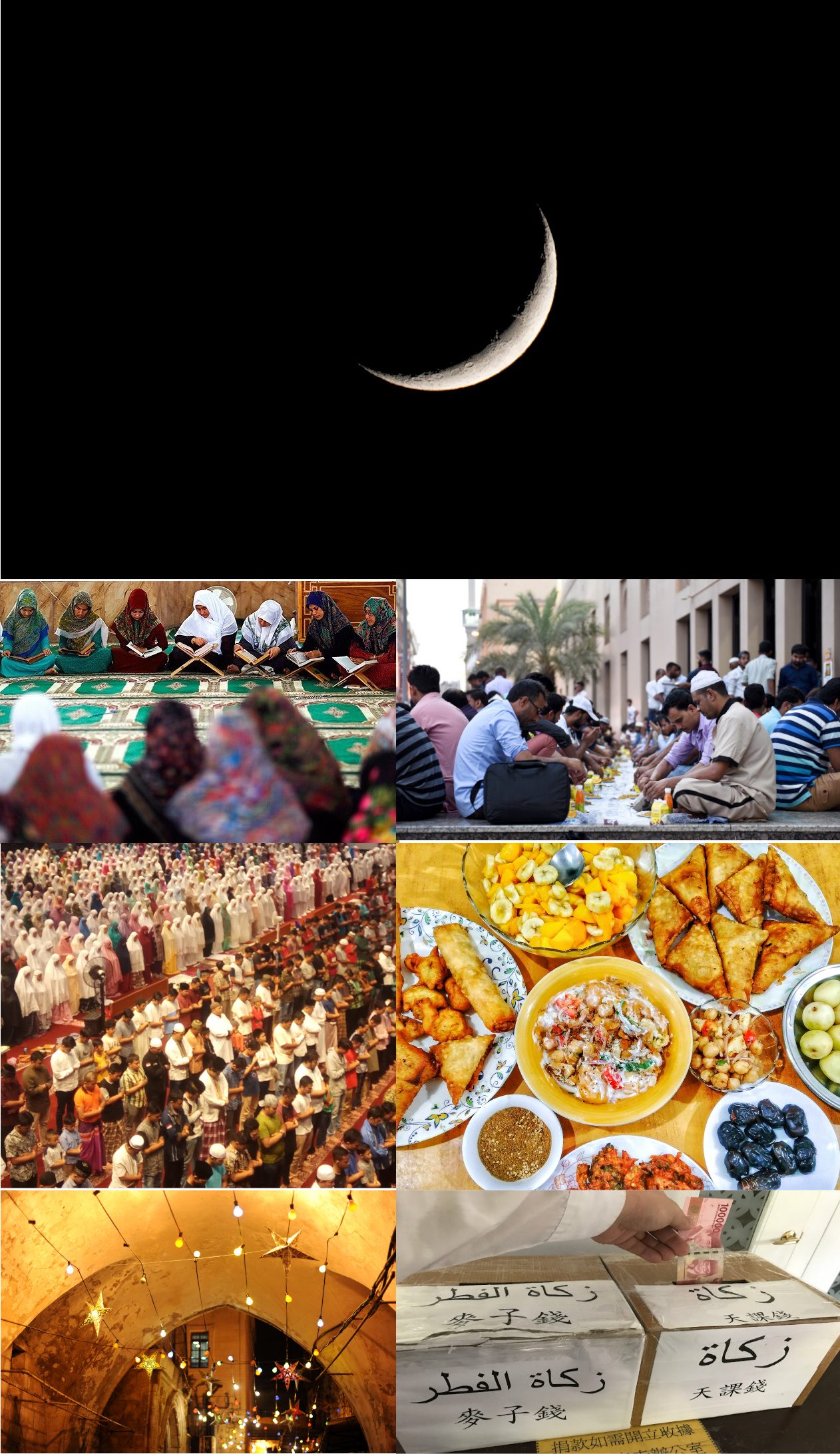
At a Glance
- Position
- Ninth month of the Islamic (lunar) calendar
- Length
- 29 or 30 days, from one crescent-moon sighting to the next
- Core practice
- Fasting (sawm) from dawn to sunset — one of the Five Pillars of Islam
- Evening meal
- Iftar, the meal that breaks the fast after sunset
- Pre-dawn meal
- Suhur, eaten before the fast begins
- Holiest night
- Laylat al-Qadr, the Night of Power, in the last 10 nights
- Ends with
- Eid al-Fitr, the Feast of Fast-Breaking
Introduction
Ramadan is the ninth month of the Muslim calendar and the holy month of fasting in Islam. During Ramadan, Muslims fast from dawn until dusk, and are permitted to eat and drink only before sunrise and after sunset. Observing the daily fast is one of the Five Pillars of Islam, the core practices of the faith. Alongside fasting, the month is a period of introspection, communal prayer in the mosque, and reading of the Qur'an.
The month begins with the sighting of the waxing crescent moon and lasts 29 or 30 days, until the next crescent appears. Because the Islamic year is shorter than the solar Gregorian year, Ramadan starts 10 to 12 days earlier each year, moving through every season over a cycle of about 33 years. A fast kept in the long days of a northern summer is a very different physical experience from one kept in winter — and over a lifetime, observant Muslims experience both.
Background
The observance of Ramadan is laid down in the Qur'an, in its second chapter, Al-Baqarah, verses 183 to 187, which prescribe fasting for believers and permit eating and drinking until, in the Qur'an's image, the white thread of dawn becomes distinguishable from the dark thread of night. Verse 185 identifies Ramadan as the month in which the Qur'an was revealed, 'a guidance for mankind'.
Muslim tradition holds that the first revelation of the Qur'an to the Prophet Muhammad, through the angel Gabriel, took place on one of the final ten nights of Ramadan in 610 CE. That night is commemorated as Laylat al-Qadr, the Night of Power, one of the holiest nights of the year; its exact date is not fixed, and it is most commonly observed on the 27th night by Sunni Muslims and the 23rd by Shi'i Muslims. Tradition also associates Ramadan with earlier revelations — a scroll to Abraham, the Torah to Moses and the Gospel to Jesus.
Timeline
- 610 CE
Muslim tradition dates the first revelation of the Qur'an to Muhammad to a night in Ramadan, later commemorated as Laylat al-Qadr, the Night of Power.
- Qur'anic prescription
The Qur'an (Al-Baqarah 2:183–187) prescribes the fast, sets its dawn-to-sunset hours, and allows exemptions for the sick and for travellers.
- Each year — the sighting
Ramadan begins when the waxing crescent moon is sighted; some communities use astronomical calculation, others require visual confirmation, so start dates can differ by a day.
- Daily — suhur
A pre-dawn meal, suhur, is eaten before the fast begins; in some communities drummers or bells wake households in time to eat.
- Daily — iftar
At sunset the fast is broken with iftar, often beginning with dates and water, and shared with family, friends and neighbours at home or at the mosque.
- The last 10 nights
The final third of the month is considered especially blessed; some worshippers withdraw to the mosque for itikaf, a period of intensive prayer, and Laylat al-Qadr is sought among these nights.
- 1 Shawwal
Ramadan ends and Eid al-Fitr, the Feast of Fast-Breaking, opens the next month with prayer, new clothes, gifts and family meals.
Significance
Fasting at Ramadan — sawm, an Arabic word meaning 'to refrain' — is understood as far more than abstaining from food. The obligation extends, between dawn and dusk, to drink, sexual activity and immoral behaviour, including unkind thoughts and false words; a day of hunger accompanied by dishonesty is traditionally held to damage the fast as surely as eating would. The Qur'an gives the purpose plainly: fasting is prescribed 'so perhaps you will become mindful of God'.
The month is therefore also a season of generosity. Almsgiving and charity are said to count for more during Ramadan, communal iftars feed strangers alongside family, and the discipline of hunger is widely understood as a lesson in empathy for the poor. Fasting itself is not treated as absolute: children, the elderly, the ill, travellers on long journeys, and pregnant or nursing women are among those exempt, and missed days can be made up later or replaced by feeding the poor.
Legacy
Ramadan's place in world culture extends well beyond the mosque. Its lanterns, night markets and shared iftars shape the calendar of cities from Jakarta to London, its greeting phrases — Ramadan mubarak, 'Blessed Ramadan', and Ramadan kareem, 'Generous Ramadan' — are recognised across languages, and employers and schools in many countries now routinely accommodate fasting staff and students. The month ends as it began, with the moon: the sighting of the next crescent closes the fast and opens Eid al-Fitr.
For the world's Muslims, though, the legacy is internal. A month of restraint, prayer and charity, returning every year and migrating slowly through the seasons, gives the Islamic calendar a heartbeat — a recurring season in which ordinary routines of eating, sleeping and working are deliberately rearranged around devotion, family and community.
Sources
- Encyclopaedia Britannica — Ramadan
- Encyclopaedia Britannica — What is Ramadan?
- Britannica Kids — Ramadan
- Wikipedia — Ramadan
The facts on this page were checked against these sources on 19 November 2026. The History Trail's permanent pages are researched and written for this site; the live profiles elsewhere on The History Trail are assembled automatically from Wikipedia and Wikidata.
About the Author
Researched and written by the The History Trail Editorial Team — the accountable editorial function behind this site's permanent story pages. The team works from the published sources cited on each page; it does not invent historians, reviewers or credentials, and it corrects errors openly.
Fact Check
Every load-bearing fact on this page traces to one of the sources listed above, and significant claims link to their source in the text. Our checking method is described on the methodology page; errors can be reported via the corrections page.
Sources & Citations
Cite this page as: The History Trail Editorial Team, The History Trail — this article's title, publication and update dates are shown beneath its headline. The full source list appears under Sources above; the site's source standards are on the sources page.