
Things
Pompeii: The Lost Roman City Beneath Vesuvius's Ash
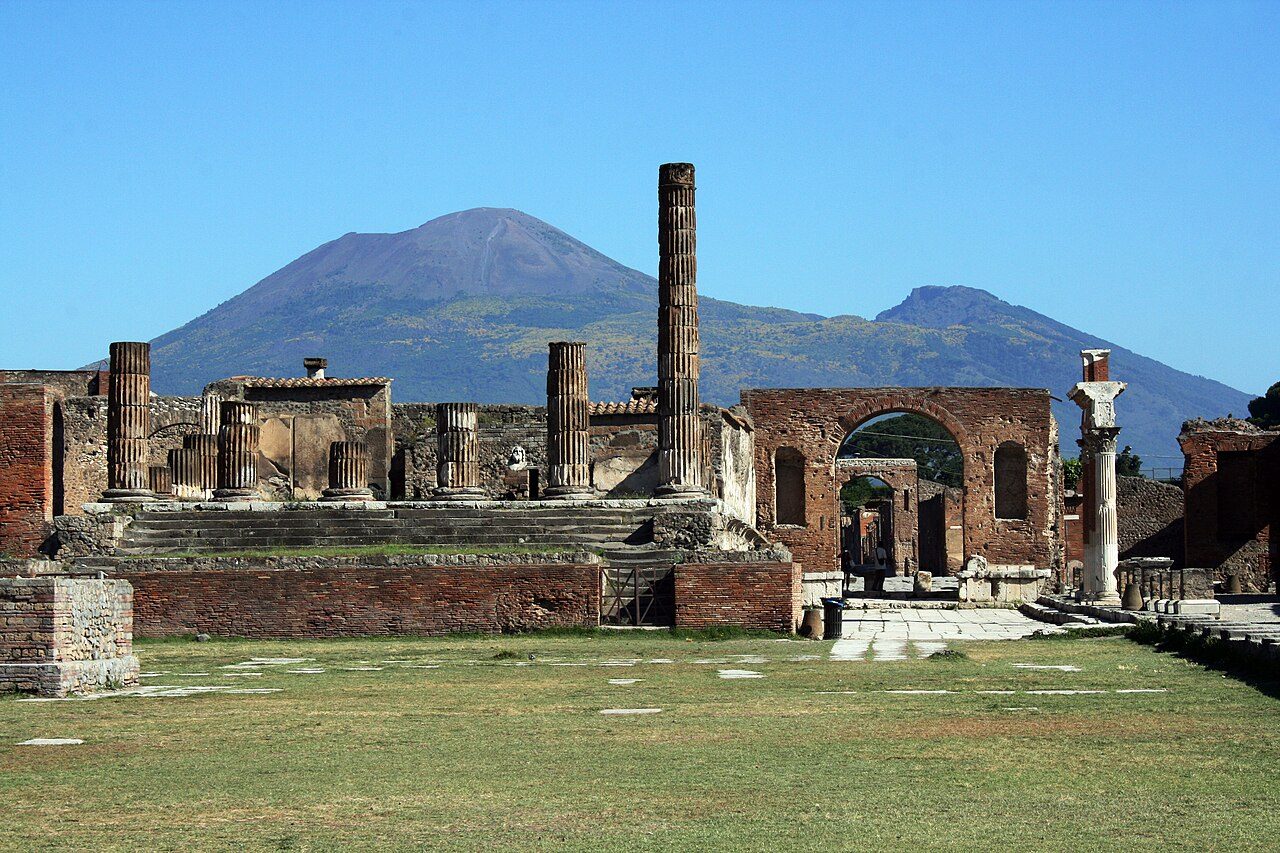
Pompeii was a working Roman port town near Naples until Mount Vesuvius buried it under metres of pumice and ash in AD 79. Lost for more than sixteen centuries, its excavated streets, houses, shops and plaster-cast victims now offer the most complete surviving picture of everyday life in the Roman world.
At a Glance
- Location
- Campania, Italy, 23 km southeast of Naples, at the southeastern base of Mount Vesuvius
- Early history
- An Oscan settlement, later Samnite; besieged by Sulla in 89 BC and refounded as a Roman veteran colony
- Population in AD 79
- Estimated at 10,000 to 20,000
- Destroyed
- AD 79, buried under six to seven metres of pumice and ash
- Excavated area
- 44 hectares of a walled city of about 66 hectares
- Excavations began
- 1748, under Charles III of Bourbon, king of Naples
- World Heritage
- Inscribed by UNESCO in 1997, together with Herculaneum and Torre Annunziata
Introduction
Pompeii is the ancient Roman city that a volcano accidentally saved. In AD 79 the eruption of Mount Vesuvius, a few miles to the northwest, covered the town in pumice and ash so quickly and so deeply that streets, houses, furniture, food and even the shapes of the dead were preserved where they fell. The excavated area covers 44 hectares, and UNESCO calls Pompeii the only archaeological site in the world that provides a complete picture of an ancient Roman city.
That completeness is what sets Pompeii apart from every other ruin. Visitors walk real streets between bakeries, bars, laundries and temples, read election slogans on the walls, and stand in houses whose owners were still repairing earthquake damage when the end came. Yet the famous final day is only part of the story: Pompeii had already lived for some seven centuries — as an Oscan, Samnite and finally Roman town — before the eruption froze it, and roughly a third of it still lies underground today.
Oscans, Samnites and a Roman Colony
Pompeii began as a settlement of Oscan-speaking people on a lava spur above the mouth of the Sarnus, the modern Sarno river, a position that made it a natural river port. Greeks and Etruscans from across the Bay of Naples influenced the growing town, but toward the end of the fifth century BC the Samnites, an Italic people from the inland hills, took control, and Pompeii became a Samnite town. It first enters written history in 310 BC, when a Roman fleet landed at its port during the Samnite Wars.
Rome absorbed Pompeii gradually, then decisively. The town joined the Italian revolt known as the Social War and was besieged by the general Sulla in 89 BC; afterwards a colony of Roman veterans was planted there, Latin replaced Oscan as the official language, and Pompeii was rebuilt in Roman form — forum, temples, baths and a great amphitheatre. The prosperous port traded wine and the fish sauce garum across the Mediterranean. In AD 59 a riot between Pompeians and visiting Nucerians bloodied the amphitheatre, and in AD 62 a powerful earthquake wrecked much of the city. Repairs were still unfinished seventeen years later.
Timeline
- c. 600 BC
An Oscan settlement grows above the mouth of the Sarno river, in contact with Greek and Etruscan traders across the bay.
- 310 BC
Pompeii is first mentioned in history, when a Roman fleet lands at its Sarno port during the Second Samnite War.
- 89 BC
After Pompeii joins the Social War revolt, Sulla besieges the town; a colony of Roman veterans is then settled there.
- AD 59
A riot between Pompeians and fans from Nuceria erupts in the amphitheatre, an event recorded by the historian Tacitus.
- AD 62
A major earthquake devastates Pompeii and Herculaneum; rebuilding and redecoration continue for the rest of the city's life.
- AD 79
Vesuvius erupts and buries Pompeii beneath six to seven metres of pumice and ash, preserving the city almost intact.
- 1590s
Workmen cutting a water channel for a nobleman's villa strike inscribed ancient stones, but the buried city is not identified.
- 1748
Official excavations begin at Pompeii under Charles III of Bourbon, king of Naples, a decade after work started at Herculaneum.
- 1863
Excavation director Giuseppe Fiorelli pours plaster into voids in the ash, creating the first casts of the eruption's victims.
- 1997
UNESCO inscribes Pompeii, Herculaneum and Torre Annunziata together on the World Heritage List.
- 2023–2025
New excavations in Regio IX uncover a black-walled dining room and, in February 2025, the House of Thiasus with its vast Dionysian fresco.
Why Pompeii Changed Archaeology
The excavations that began in 1748 are often described as the starting point of modern archaeology, and they reshaped European taste as well: the unearthed houses, paintings and objects fed the eighteenth century's fascination with the classical world. But Pompeii's deeper importance is evidential. Because the burial was sudden and total, it preserved the ordinary alongside the monumental — loaves in bakery ovens, graffiti on walls, an election campaign interrupted mid-slogan — evidence that the written histories of Rome, concerned with emperors and armies, almost never supply.
Fiorelli's casts gave that evidence a human face. From the nineteenth century on, excavators have made about a hundred casts of victims, as well as of doors, furniture and animals, by filling the voids that decomposed organic material left in the hardened ash. The casts are not petrified bodies, as they are often mistaken for, but plaster forms that still contain the victims' bones. A permanent exhibition in the site's Palestra Grande now presents twenty-two of them, arranged by the context in which each person died.
A City Still Being Read
Pompeii today is a working archaeological park as much as a monument. The Grande Progetto Pompei, a major European Union-backed programme begun in 2012, stabilised the buildings at highest risk and shifted conservation toward whole districts rather than single showpieces. The wider World Heritage property draws more than two and a half million visitors a year, and new seasons of excavation keep revising what the city was: the Regio IX work of 2023 to 2025 alone added more than fifty rooms, including a bakery and a laundry installed in converted houses.
Its cultural afterlife matches its scholarly one. Pompeii taught Europe what a Roman street actually looked like, gave volcanology its type example of an explosive eruption, and still sets the standard against which every other ancient site is judged: nowhere else can you walk into a town and find the bread still in the oven.
Sources
- UNESCO World Heritage Centre — Archaeological Areas of Pompei, Herculaneum and Torre Annunziata
- Pompeii Sites (Archaeological Park of Pompeii) — The plaster casts of Pompeii
- Smarthistory — Pompeii, an introduction
- Encyclopaedia Britannica — Pompeii
- Smithsonian Magazine — See the Stunning Frescoes of a Mysterious Dionysian Cult Discovered in Ancient Pompeii
The facts on this page were checked against these sources on 19 November 2026. The History Trail's permanent pages are researched and written for this site; the live profiles elsewhere on The History Trail are assembled automatically from Wikipedia and Wikidata.
About the Author
Researched and written by the The History Trail Editorial Team — the accountable editorial function behind this site's permanent story pages. The team works from the published sources cited on each page; it does not invent historians, reviewers or credentials, and it corrects errors openly.
Fact Check
Every load-bearing fact on this page traces to one of the sources listed above, and significant claims link to their source in the text. Our checking method is described on the methodology page; errors can be reported via the corrections page.
Sources & Citations
Cite this page as: The History Trail Editorial Team, The History Trail — this article's title, publication and update dates are shown beneath its headline. The full source list appears under Sources above; the site's source standards are on the sources page.