
Things
Daily Life in Pompeii: Bread, Baths and Street Food
Pompeii matters because it was ordinary. Its ash preserved not palaces but breakfast: loaves in ovens, snacks in counter jars, election promises on walls. From that evidence we can reconstruct an ordinary day in a Roman town — what people ate, where they washed, how they campaigned and how they spent their afternoons.
At a Glance
- Population
- About 15,000 in AD 79 (estimates range from 10,000 to 20,000)
- Fast food
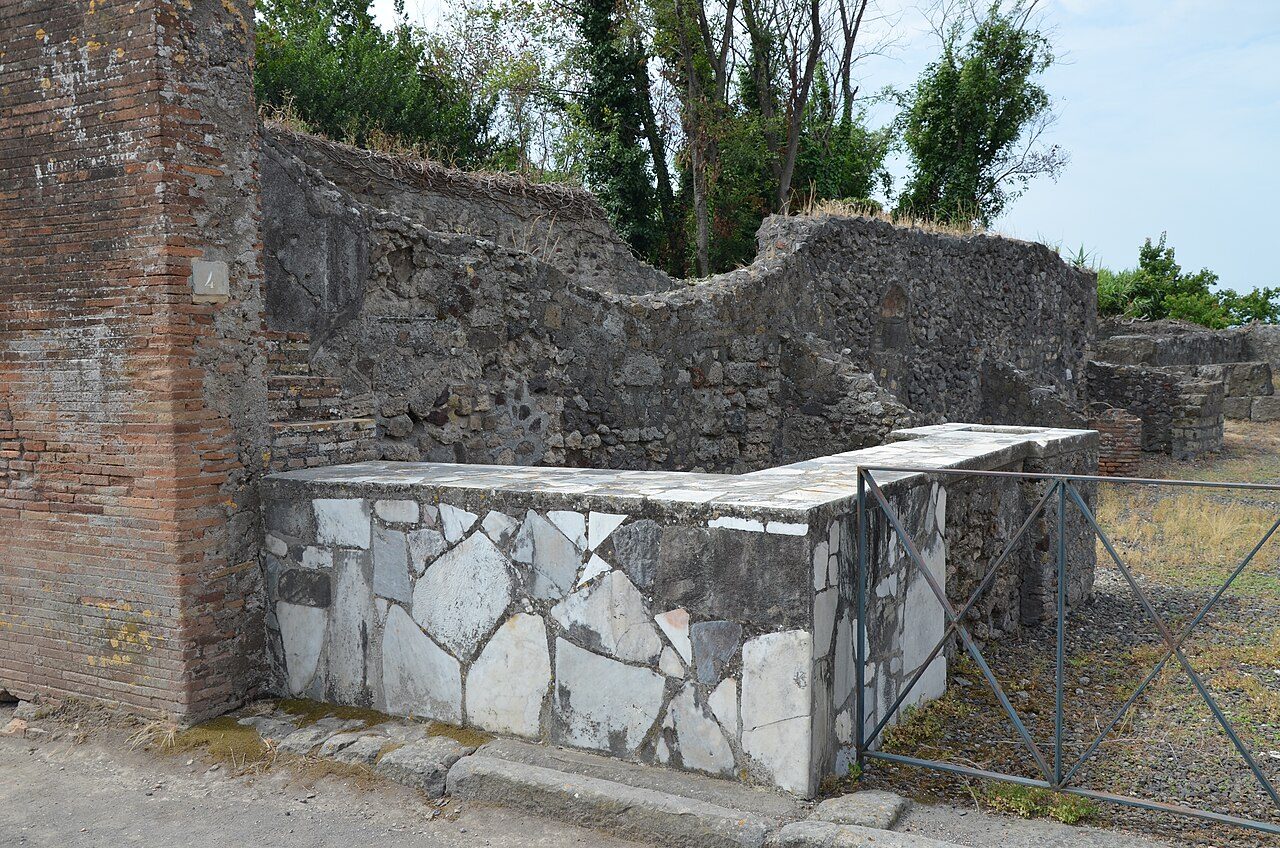
- Around 80 thermopolia — hot-food counters with storage jars set into the masonry
- Public baths
- At least five public bath complexes, plus private baths in wealthy homes
- Amphitheatre
- Built around 70 BC; the oldest surviving stone amphitheatre in the Roman world
- Signature products
- Garum, the fermented fish sauce, and wine, traded from the Sarno river port
- Houses
- The domus was built inward around an atrium, its roof opening above an impluvium rainwater basin
- Writing on walls
- Thousands of graffiti, including election notices from a campaign in progress in AD 79
Introduction
Daily life in Pompeii looked like this: a town of perhaps fifteen thousand people who lived in courtyard houses or single rented rooms, bought hot food from street counters because many homes had no proper kitchen, did business and politics in the forum, washed communally in the public baths, and ended the day at dinner or, on festival days, at the games. We know this in unusual detail because the eruption of AD 79 preserved the evidence mid-use. As Smarthistory puts it, this city of death tells us more about daily life in first-century Italy than even the city of Rome itself.
The town's economy ran on trade. Set above the Sarno river port, Pompeii was a market town known across the Mediterranean for garum, the fermented fish sauce made in local workshops, and its wine travelled as well. Within the walls there was no zoning: workshops, bakeries, fulleries and bars were mixed into the same blocks as grand houses, so a wealthy family's mansion might share a wall with a laundry, and the smell of baking, fish sauce and hot oil hung over streets that were, by modern standards, astonishingly commercial.
The House Around a Hole in the Roof
The classic Pompeian house, the domus, turned inward against the street. A narrow entrance passage, the fauces, led to the atrium, a hall open to the sky through a rectangular opening in the roof; rain fell through it into a shallow marble basin, the impluvium, set into the floor below. Around the atrium lay small bedrooms and the tablinum, where the master of the house received the clients who queued each morning to pay their respects and ask favours. Behind, in grander houses, a columned garden court — the peristyle — supplied light, air and a stage set of frescoes and statues.
The House of the Faun, which fills an entire block, and the House of Menander show the type at its richest, but most Pompeians lived smaller: in one or two rooms, above shops, or behind the workshops where they worked. Enslaved and freed servants kept every household running — cooking in tiny kitchens, carrying water from the public fountains, shopping daily because few houses stored much food. Houses were also businesses and billboards: shops opened from their front rooms onto the street, and their outer walls carried painted advertisements, shop signs and election notices.
Timeline
- Before dawn
Bakers light their ovens and grind grain in hourglass-shaped stone mills; carbonised loaves were still sitting in one bakery's oven when excavators opened it nineteen centuries later.
- Early morning
Clients crowd the atrium of a wealthy patron for the morning greeting, the salutatio, hoping for favours, work, or a gift of food or money.
- Morning
The forum fills: magistrates and lawyers do business around the basilica, deals are struck, and shoppers cross to the macellum, the covered food market beside the square.
- Midday
Work pauses for a light lunch. Many Pompeians eat standing at a thermopolium counter, choosing hot food kept warm in jars sunk into the masonry top.
- Afternoon
The public baths take over the day: exercise in the palaestra, then warm, hot and cold rooms in sequence — as much a social club and business venue as a wash.
- Game days
Crowds stream to the amphitheatre at the town's eastern end for gladiatorial shows; built around 70 BC, it is the oldest surviving stone amphitheatre in the Roman world.
- Evening
In the dining room, family and guests recline on couches around low tables for the cena, the main meal of the day, cooked and served by household slaves.
- After dark
Oil lamps are lit and the taverns fill. Outside, by lamplight, someone scratches one more graffito into a wall — adding to the thousands the town has left us.
The Evidence of Ordinary Things
What Pompeii preserves best is writing by nobodies. UNESCO singles out the wealth of graffiti on its walls: because an election was imminent when the eruption came, the streets were covered with painted endorsements — this candidate is honest, the bakers support that one — alongside declarations of love, insults, prices, tallies and jokes. Together with shop signs, amphora labels and names scratched beside doorways, these texts let historians hear a Roman town talking to itself, in voices that formal literature never recorded.
The food evidence is just as direct. Garum workshops, wine shops, bakeries with their mills and ovens, and dozens of thermopolia map a whole urban diet: bread, wine, olives, cheese, lentils, pork, fish and fruit, eaten at home by the rich and in the street by everyone else. Because the town was buried in a day, archaeologists can study not a monument but a system — how a Roman city fed, washed, entertained and governed itself, all at the same moment.
Still Serving Evidence
Pompeii's daily-life evidence now anchors how museums, textbooks and novelists reconstruct the Roman world: the atrium house, the fast-food counter and the communal bath are all known chiefly from here, because Rome itself was rebuilt too many times to keep them. And the record is still growing. The Regio IX excavations have added a working bakery and a laundry inside the House of Thiasus complex, converted from older houses after the earthquake of AD 62 — proof that even in its last years, this was a town busy remaking its ordinary life.
Sources
- Smarthistory — Pompeii, an introduction
- UNESCO World Heritage Centre — Archaeological Areas of Pompei, Herculaneum and Torre Annunziata
- Pompeii Sites (Archaeological Park of Pompeii) — The plaster casts of Pompeii
- Encyclopaedia Britannica — Pompeii
- AFP — Well preserved 'fast food' bar unearthed in Pompeii (via Malay Mail)
The facts on this page were checked against these sources on 19 November 2026. The History Trail's permanent pages are researched and written for this site; the live profiles elsewhere on The History Trail are assembled automatically from Wikipedia and Wikidata.
About the Author
Researched and written by the The History Trail Editorial Team — the accountable editorial function behind this site's permanent story pages. The team works from the published sources cited on each page; it does not invent historians, reviewers or credentials, and it corrects errors openly.
Fact Check
Every load-bearing fact on this page traces to one of the sources listed above, and significant claims link to their source in the text. Our checking method is described on the methodology page; errors can be reported via the corrections page.
Sources & Citations
Cite this page as: The History Trail Editorial Team, The History Trail — this article's title, publication and update dates are shown beneath its headline. The full source list appears under Sources above; the site's source standards are on the sources page.