
Things
Opal
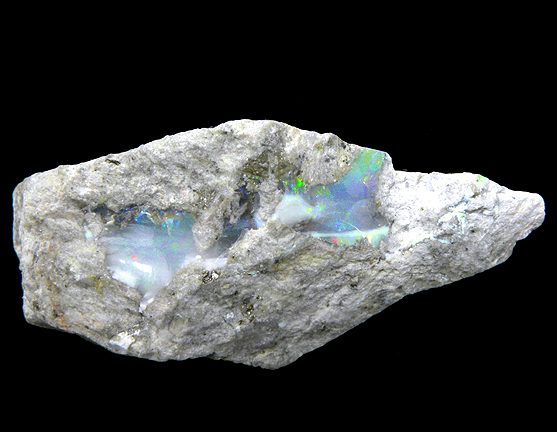
Opal was Rome's most prized gem: Pliny the Elder saw in it the fire of the ruby, the purple of the amethyst and the sea-green of the emerald in one stone. Today Australia produces 95 per cent of the world's precious opal, according to Geoscience Australia - and the famous belief that opals are unlucky is barely two centuries old.
At a Glance
- What it is
- A mineraloid of hydrated silica (SiO2 plus water): stacked silica spheres that diffract light into play-of-colour in precious opal
- Roman verdict
- Prized from about 250 BC; Pliny saw in opal the fire of ruby, purple of amethyst and sea-green of emerald together
- Old source
- For two millennia Europe's precious opal came mainly from mines in present-day Slovakia
- Australian dominance
- Geoscience Australia: Australia produces 95 per cent of the world's precious opal; major producer since 1932, national gemstone since 1993
- The fields
- Coober Pedy (white opal, from 1915), Lightning Ridge (black opal), and Queensland's boulder opal fields
- The superstition
- George Kunz (1913) traced the unlucky-opal belief to a careless reading of Walter Scott's Anne of Geierstein (1829)
Introduction
Opal is not a crystal at all. It is hardened silica gel - tiny spheres of silica stacked in water - and when the spheres are regular, they split white light into shifting colour, the play-of-colour that makes precious opal unlike any other gem. For most of recorded history that colour made opal lucky, prized above other stones. Then, in the nineteenth century, a novel reversed its reputation in a generation, and in the same century a new continent of opal fields in Australia quietly took over the world's supply.
This page traces the documented story: the Roman prizing recorded by Pliny, the old European mines, the Australian fields that Geoscience Australia credits with 95 per cent of the world's precious opal, and the literary origin of the unlucky-opal superstition, which gemologist George Kunz traced to a careless reading of Walter Scott.
Rome: The Stone That Held All Others
Geoscience Australia records that opal artefacts several thousand years old have been found in East Africa, and that as early as 250 BC the Romans prized opals, thought to have come from mines in eastern Europe - the ancient world's main source, in what is now Slovakia. The Romans treated opal as a compound of every other gem's virtue, because it showed every colour at once. Pliny the Elder, in his Natural History in the first century AD, wrote of opals that in them you shall see the living fire of the ruby, the glorious purple of the amethyst, the sea-green of the emerald, all glittering together in an incredible mixture of light.
Pliny also preserved the stone's most famous Roman anecdote: the senator Nonius owned a celebrated opal, and Mark Antony wanted it so much that Nonius chose exile rather than give it up. The story comes to us through Pliny alone and is told here as his account, not as court record - but it shows the rank opal held. Through the Middle Ages the stone kept its good name, called the eye stone and credited in lapidaries with protecting sight and gathering the powers of all coloured gems.
Australia Takes Over the Field
For two thousand years Europe's opal meant the Slovak mines. The change came from the other side of the world. Geoscience Australia records that opal was first mined commercially in Australia at Listowel Downs, Queensland, in 1875, and later at White Cliffs in New South Wales; Australian stones found little favour in European markets at first, but by 1932 Australia had taken over as the major producer of opals in the world, and remains the largest producer today. The same agency states the scale plainly: Australia produces 95 per cent of the world's precious opal, and opal is the country's official national gemstone, proclaimed in 1993.
The fields are distinct. Coober Pedy in South Australia, founded after a 14-year-old boy found opal in 1915 while his father's party prospected for gold, is the main producer of white opal. Lightning Ridge in New South Wales is renowned for black opal, the rarest body type, its dark background carrying the colour. Queensland's boulder opal is cut with its ironstone host rock attached. Australian opal forms in Cretaceous sandstones and mudstones, where silica released by deep weathering hardened in cracks and cavities - even, uniquely, replacing fossils, so that Australia yields opalised shells, bones and a whole pliosaur.
Timeline
- About 250 BC
The Romans prize opal, sourced mainly from mines in eastern Europe, as a stone combining the virtues of all gems.
- 1st century AD
Pliny the Elder describes opal's mingled colours in his Natural History and tells the story of Nonius's opal and Mark Antony.
- Middle Ages
Opal is called the eye stone in Europe and credited with protecting sight and gathering other gems' powers.
- 1829
Walter Scott publishes Anne of Geierstein; readers link its enchanted opal to misfortune, and the unlucky-opal superstition spreads.
- 1875
Opal is first mined commercially in Australia, at Listowel Downs in Queensland.
- 1890s
White Cliffs in New South Wales becomes a major field; Australian opal begins displacing the old European supply.
- 1915
A boy's find at the Stuart Range in South Australia starts the rush that founds Coober Pedy.
- 1932
Australia takes over as the world's major opal producer, a position Geoscience Australia says it still holds.
- 1993
Opal is proclaimed Australia's national gemstone.
- Today
Geoscience Australia credits Australia with 95 per cent of the world's precious opal production.
Significance
Opal's significance is double. Geologically, it is the gem whose beauty is pure physics: no pigment, only silica spheres of the right size diffracting light, as Geoscience Australia explains - larger spheres give the full spectrum, smaller ones only blues and greens, and the rarest reds come from the largest spheres of all. Culturally, opal is the clearest case in gem history of reputation being made and unmade by writing: praised into first place by Pliny, and talked into bad luck by a novel, with the market following the words both times.
Myths and disputes
Are opals unlucky? The belief is modern, and its origin is unusually well documented. In his 1913 book The Curious Lore of Precious Stones, gemologist George Kunz wrote that there can be little doubt that much of the modern superstition regarding the supposed unlucky quality of the opal owes its origin to a careless reading of Sir Walter Scott's novel Anne of Geierstein, published in 1829. In the novel, Lady Hermione wears an enchanted opal that answers her moods; when holy water touches it, its fire dies, and Hermione is found reduced to ashes. Scott's stone was enchanted, like its owner - nothing in the tale says ordinary opals are unlucky - but readers simplified the plot into a rule, and opal sales in Europe are widely reported to have fallen sharply afterwards.
Before 1829 the record runs the other way: Roman hope and purity, medieval eye-stone lore, and centuries of favour. Queen Victoria, who wore opals and gave them to her daughters, helped restore the stone's standing later in the century. One older shadow does exist - a medieval lapidary called opal a patron stone of thieves, because it was said to aid invisibility - but a thief's charm is not the modern fear of misfortune, and conflating the two repeats the original careless reading.
Legacy
Opal's legacy is a gem with two homelands: the Slovak mines that supplied Rome, and the Australian outback towns - Coober Pedy, Lightning Ridge, the Queensland boulder fields - that supply the world now, down to the national-gemstone proclamation of 1993. And it carries a permanent footnote in the history of superstition: the unlucky opal is not an ancient curse but a nineteenth-century reading accident, traceable to a named book, a named character, and a named gemologist who called the reading careless.
Sources
- Geoscience Australia - Opal
- Australian Museum - Australian Museum Opal Collection
- Penn State University Exhibitions - Amorphous: Precious Opal and Cacholong
- NYC Jewelry Week - The History of Why: A Love Letter to the Unlucky Opal
- Diamonds in the Library - Are Opals Bad Luck? (quoting George Kunz, 1913)
The facts on this page were checked against these sources on 19 November 2026. The History Trail's permanent pages are researched and written for this site; the live profiles elsewhere on The History Trail are assembled automatically from Wikipedia and Wikidata.
About the Author
Researched and written by the The History Trail Editorial Team — the accountable editorial function behind this site's permanent story pages. The team works from the published sources cited on each page; it does not invent historians, reviewers or credentials, and it corrects errors openly.
Fact Check
Every load-bearing fact on this page traces to one of the sources listed above, and significant claims link to their source in the text. Our checking method is described on the methodology page; errors can be reported via the corrections page.
Sources & Citations
Cite this page as: The History Trail Editorial Team, The History Trail — this article's title, publication and update dates are shown beneath its headline. The full source list appears under Sources above; the site's source standards are on the sources page.