
Things
Lahore
Lahore, Pakistan's second-largest city and capital of Punjab province, stands on the Ravi River in the upper Indus plain. Its recorded story runs from a Ghaznavid capital through a Mughal golden age of forts, mosques and gardens to the 1940 resolution that demanded Pakistan — and its Fort and Shalimar Gardens are a UNESCO World Heritage site.
At a Glance
- Location
- On the Ravi River, Punjab, Pakistan
- Status today
- Capital of Punjab province; Pakistan's second-largest city
- Legendary founder
- Lava (Loh), son of Rama — legend, not record
- Mughal landmarks
- Lahore Fort, Badshahi Mosque (1671–73), Shalimar Gardens (1641–42)
- Sikh era
- Capital of Ranjit Singh's empire from 1799
- Historic moment
- Lahore Resolution, 23 March 1940
- UNESCO listing
- Fort and Shalamar Gardens, inscribed 1981
Introduction
Lahore is a city whose history can be read in a single walk: a Mughal fort and an imperial mosque at the north-west corner of the walled city, gardens laid out by Shah Jahan to the east, a Sikh ruler's capital, a British provincial headquarters of colleges and cantonments, and the park where, on 23 March 1940, the All-India Muslim League passed the Lahore Resolution demanding independent Muslim-majority states — the demand that led to Pakistan in 1947. Few cities carry so many of South Asia's turning points in one skyline.
Britannica describes Lahore as Pakistan's second-largest city and the capital of Punjab, lying on the Ravi River, a tributary of the Indus. Its earlier centuries are harder to document: little is known of the settlement before the Muslim period, and the famous founding story — that the city was founded by Lava, son of the hero Rama, and named Lohawar after him — is Hindu legend, and is labelled as legend here and by Britannica alike.
Origins
The firm record begins with empire. Lahore was taken into the Ghaznavid world in the early 11th century as Mahmud of Ghazni conquered the Punjab, and from 1163 to 1186 it served as the Ghaznavid dynasty's capital — its last capital before the dynasty fell. The city was then battered for centuries: a Mongol army sacked it in 1241, Mongol attacks recurred through the 14th century, and Timur took it in 1398. Survival, as much as splendour, is the first theme of Lahore's history.
In 1524 the Mughal Babur's troops captured Lahore, and the city's golden age began. Akbar made Lahore an imperial residence, held court there from 1584 and rebuilt the fort in brick and red sandstone from 1566. Under Shah Jahan (1628–58) the city was greatly expanded: the Shalimar Gardens were laid out in 1641–42, and the Wazir Khan Mosque rose inside the walls. Aurangzeb completed the imperial trio with the Badshahi Mosque, built in 1671–73, still one of the largest mosques of the Mughal world.
Timeline
- 1163–1186
Lahore serves as the last capital of the Ghaznavid dynasty.
- 1241
A Mongol army sacks Lahore; Mongol attacks recur through the following century.
- 1524
Babur's troops capture Lahore, opening the city's Mughal golden age.
- 1566
Akbar begins rebuilding Lahore Fort, the complex that now holds 21 surviving Mughal monuments.
- 1584–1598
Akbar holds the Mughal court at Lahore, making the city an imperial capital in practice.
- 1641–42
Shah Jahan lays out the Shalimar Gardens — 16 hectares on three descending terraces.
- 1671–73
Aurangzeb builds the Badshahi Mosque beside the fort.
- 1799
Ranjit Singh takes Lahore and makes it the capital of the Sikh Empire.
- 1849
After the Anglo-Sikh wars, Lahore passes under British rule and becomes capital of British Punjab.
- 23 March 1940
The All-India Muslim League, meeting in Lahore, passes the Lahore Resolution.
- 1947
At Partition, Lahore is assigned to Pakistan amid terrible violence and mass movement of people.
- 1981
UNESCO inscribes the Fort and Shalamar Gardens in Lahore as a World Heritage site.
Significance
Lahore's Mughal layer is its glory, and UNESCO's citation explains why it matters beyond Pakistan: the fort's 21 surviving monuments form an outstanding record of Mughal architecture from Akbar's baked brick and red sandstone to Shah Jahan's marble, inlay and mosaic, while the Shalimar Gardens embody Mughal garden design at its height — two royal complexes, 7 kilometres apart, inscribed together in 1981 as masterpieces of a civilisation that fused Islamic, Persian, Hindu and Mongol sources.
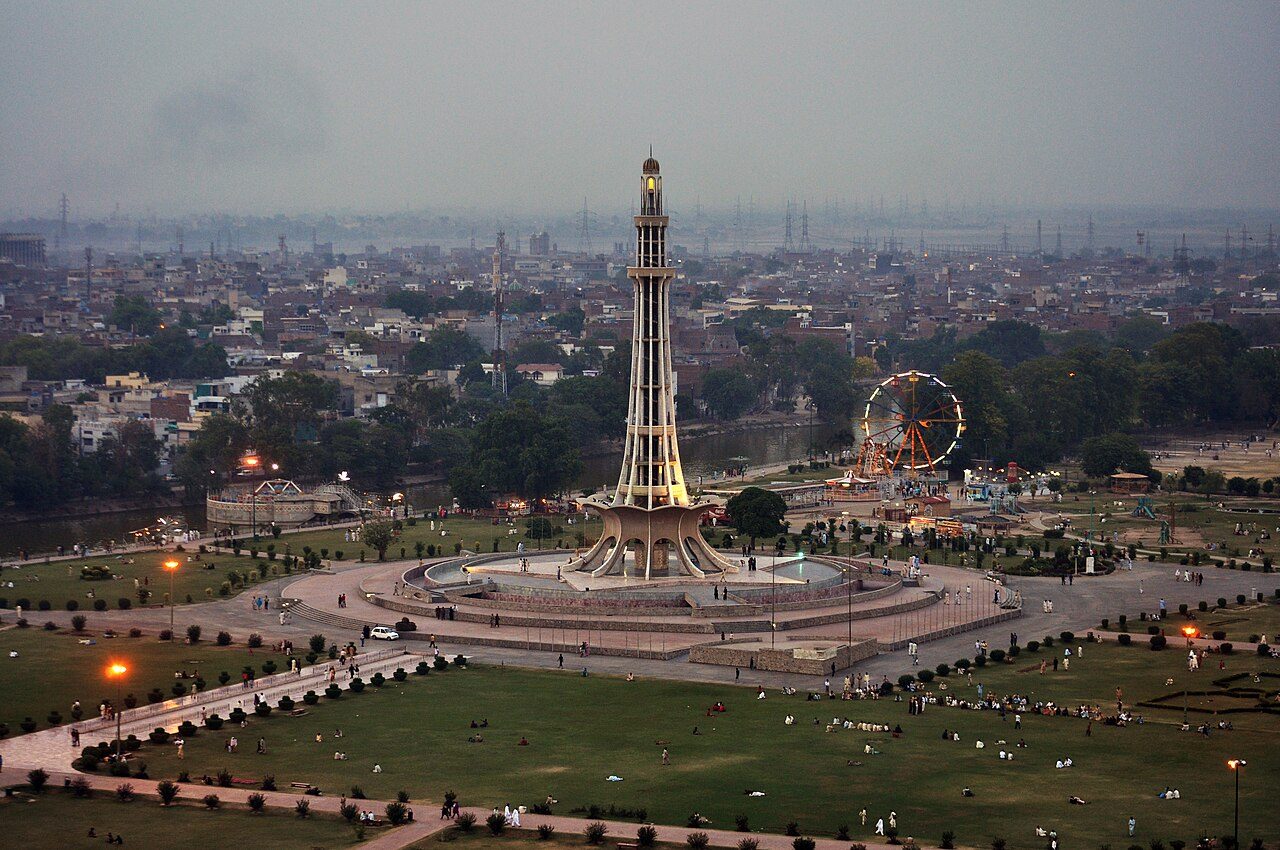
The city's second significance is political. Under Ranjit Singh, from 1799, Lahore was the capital of a Sikh empire that held the Punjab for half a century; under the British after 1849 it became a provincial capital of colleges, courts and railway workshops, and the University of the Punjab, founded in 1882, is Pakistan's oldest university. Then, in 1940, the city gave its name to the resolution that set the subcontinent's partition in motion — a role commemorated by the Minar-e-Pakistan tower on the session's site.
Myths and disputes
Two cautions belong in any honest account of Lahore. The first is the founding legend: the story of Lava, son of Rama, is a cherished tradition, and the 'Labokla' mentioned in Ptolemy's 2nd-century Geography may have been Lahore — but Britannica is explicit that little is known of the settlement before the Muslim period, so legend and identification must not be presented as documented fact. The second is dating the Ghaznavid era: popular accounts often call Lahore a Ghaznavid capital from the 1020s, when Mahmud took the Punjab. Britannica's city history dates its role as the dynasty's capital to 1163–1186, its final phase. This page follows Britannica for the capital dates and treats the earlier period as Ghaznavid rule, which is what the evidence supports.
Legacy
Modern Lahore is a vast commercial, industrial and educational centre wrapped around its old walled core, and its identity still runs on the layers this page has traced: Mughal monuments under continuous conservation — the World Heritage property spent 2000 to 2012 on UNESCO's Danger List after road works damaged the Shalimar Gardens' hydraulic system, a warning the city answered with years of restoration work.
For Pakistan, Lahore is the cultural capital in a way no other city contests: the city of the Resolution, of the fort and the Badshahi Mosque, of gardens built for emperors and a tower built for a founding moment. A thousand years after the Ghaznavids, it remains what it has been under every ruler since — the prize city of the Punjab, and the place where the region's history keeps happening.
Sources
- UNESCO World Heritage Centre — Fort and Shalamar Gardens in Lahore
- Encyclopaedia Britannica — Lahore
- Encyclopaedia Britannica — Lahore Fort and Mughal architecture
- Wikipedia — Lahore
The facts on this page were checked against these sources on 19 November 2026. The History Trail's permanent pages are researched and written for this site; the live profiles elsewhere on The History Trail are assembled automatically from Wikipedia and Wikidata.
About the Author
Researched and written by the The History Trail Editorial Team — the accountable editorial function behind this site's permanent story pages. The team works from the published sources cited on each page; it does not invent historians, reviewers or credentials, and it corrects errors openly.
Fact Check
Every load-bearing fact on this page traces to one of the sources listed above, and significant claims link to their source in the text. Our checking method is described on the methodology page; errors can be reported via the corrections page.
Sources & Citations
Cite this page as: The History Trail Editorial Team, The History Trail — this article's title, publication and update dates are shown beneath its headline. The full source list appears under Sources above; the site's source standards are on the sources page.