
Things
Hypertension
Hypertension is unusual among diseases: for most of human history it could not even be detected. It produced no unmistakable symptom, only a number that did not yet exist. Its history is therefore the history of measurement — of the cuff, the stethoscope and the long studies that proved the number mattered.
At a Glance
- First population measurements
- Frederick Mahomed, Guy's Hospital, London, early 1870s
- Practical cuff invented
- Scipione Riva-Rocci, 1896 — inflatable cuff and mercury manometer
- Diastolic measurement
- Nikolai Korotkoff's auscultation sounds, described 1905
- Mortality link recognised
- Life insurance companies, from 1906; confirmed by Metropolitan Life, 1912
- Classic threshold
- 140/90 mmHg became the defined cutoff for hypertension
- Risk proven at scale
- The Framingham Heart Study, from 1948; mild hypertension shown harmful in the 1960s
- First modern diuretic
- Chlorothiazide, shown to lower blood pressure by salt excretion
Introduction
Most diseases announce themselves. Hypertension, persistently raised pressure in the arteries, generally does not: it damages the heart, brain, kidneys and eyes over years while its owner feels nothing. That is why its history begins not with a patient or a cure but with instruments. Until blood pressure could be measured in ordinary people, quickly and without opening an artery, there was no such thing as a hypertensive patient — only people who died, in the language of the time, of apoplexy, dropsy or Bright's disease.
The discovery of primary hypertension is credited to Frederick Mahomed, who in the early 1870s, as a medical resident at Guy's Hospital in London, measured blood pressure in the general population using a portable spring-based version of the sphygmograph, built with a watchmaker. Physicians knew that patients with kidney disease and protein in the urine could have high pressure. Mahomed found something new: a subset of apparently ordinary people with high pressures and no proteinuria — hypertension as a condition in itself, existing before any organ failed.
Background
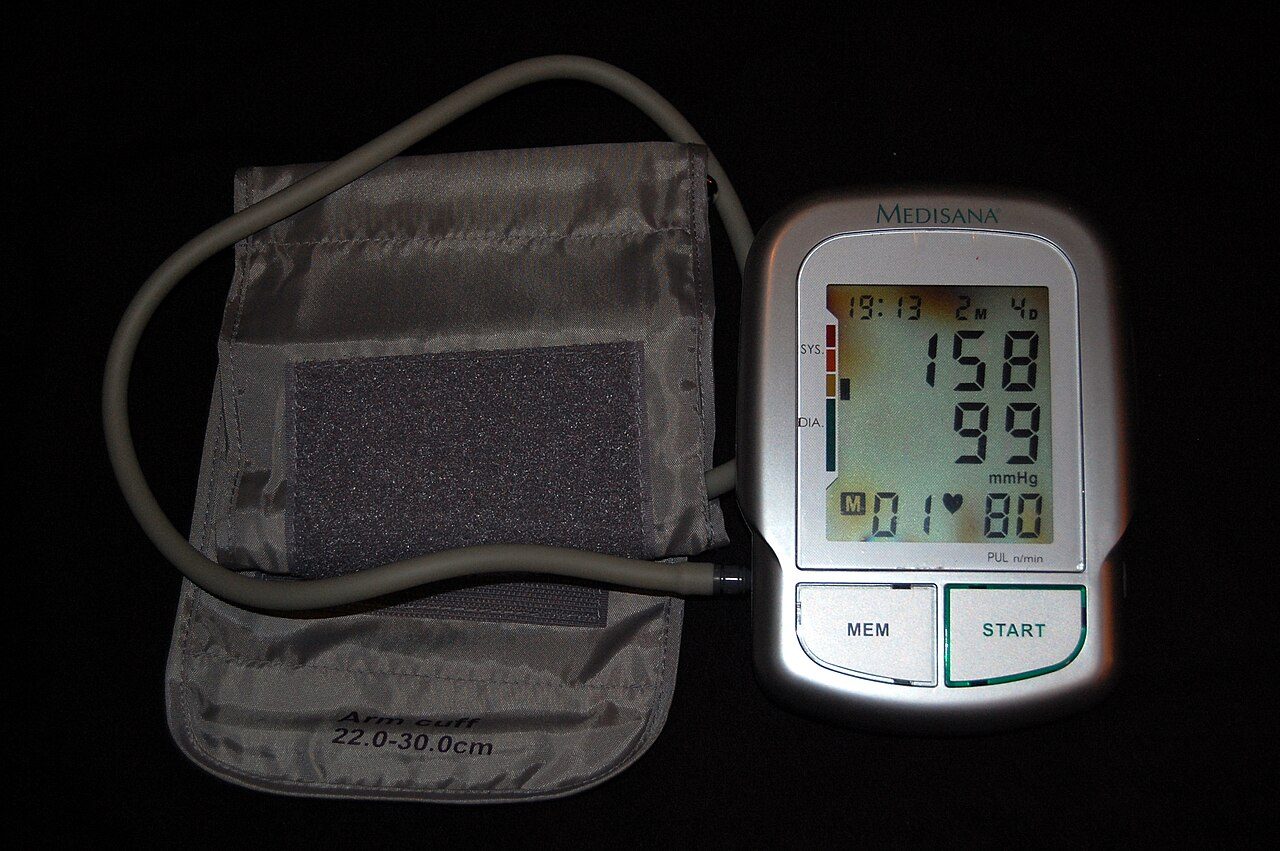
Mahomed's device was delicate, and blood pressure measurement did not become common until the 1890s. The Italian physician Scipione Riva-Rocci invented the practical instrument: an inflatable cuff around the arm connected to a mercury manometer, giving the systolic pressure — the point at which the pulse disappears — in millimetres of mercury. The Russian surgeon Nikolai Korotkoff then added the stethoscope: listening below the cuff as it deflates, he described the appearance and disappearance of sounds that mark systolic and diastolic pressure. His judgement was that hearing is a better guide than the absence of pulsation.
Theodore Janeway and Harvey Cushing helped introduce the sphygmomanometer in the United States, and routine measurement spread. Early studies found systolic pressure above 140 was rare in adults under sixty-five. Then the insurance industry weighed in: by 1906 life insurers recognised that people with hypertension died earlier, a finding confirmed by the Metropolitan Life Insurance Company in 1912. Measurement became standard clinical procedure, and a cutoff of 140 over 90 was defined as hypertension — a disease now made of two numbers.
Timeline
- Early 1870s
Mahomed measures blood pressure across the general population at Guy's Hospital and identifies high pressure without kidney disease.
- 1896
Riva-Rocci presents his inflatable arm cuff and mercury manometer, making non-invasive measurement practical.
- 1905
Korotkoff describes the sounds heard below the cuff, allowing diastolic as well as systolic pressure to be measured.
- 1906
Life insurance companies recognise that hypertension carries increased mortality.
- 1912
A Metropolitan Life Insurance Company report confirms the mortality finding, pushing measurement into standard practice.
- 1948
The Framingham Heart Study begins its long-term tracking of cardiovascular risk in a Massachusetts town.
- 1950s
Chlorothiazide, the first modern diuretic, lowers blood pressure — evidence that salt retention drives the condition.
- 1960s
Framingham and other definitive studies show even mild high blood pressure raises the risk of heart attack, heart failure, stroke and kidney damage.
- 1967
Veterans Administration cooperative studies demonstrate that lowering blood pressure prevents strokes.
Significance
Hypertension's significance in medical history is that it converted a measurement into a risk factor, and a risk factor into one of the largest public health programmes on earth. For decades, many authorities had viewed raised pressure as a compensatory phenomenon — the body forcing blood through stiffened vessels — and doubted that mild hypertension should be treated at all. The Framingham evidence of the 1960s, followed by treatment trials, reversed that view: even mild elevation increased the risk of myocardial infarction, heart failure, stroke and chronic renal damage, and lowering pressure prevented those events.
The numbers since are stark. In the early 1900s hypertension affected under five percent of adults in most of the world; the historical literature now records prevalence of thirty to forty percent of adults in the United States and most regions, making it the most common noncommunicable disease. A condition that required a watchmaker's spring device to detect at all became, within a century, a leading cause of death and disability worldwide — not because it changed, but because measurement, urban diets, salt and ageing populations revealed its true scale.
Legacy
The cuff examination became one of the most performed acts in medicine, and its two numbers among the most familiar in public life. Hypertension research also reshaped physiology: the kidney's role in long-term pressure control, demonstrated when hypertension could be transferred between rats by kidney transplantation, and the pressure-natriuresis ideas developed by Guyton, made a plumbing problem into a systems problem involving salt, vessels, nerves and hormones.
Historically, hypertension is the archetype of the modern chronic disease: asymptomatic, defined by a threshold, proven harmful by cohort studies rather than by symptoms, and managed over decades. The template Framingham built for it — follow a population, measure risk, intervene before events — is now the standard architecture of preventive medicine, applied far beyond blood pressure.
Sources
- PubMed Central — The discovery of hypertension: evolving views on the role of the kidneys (American Journal of Physiology)
- McGill University, Office for Science and Society — The Current Hypertension Controversy
- World Health Organization — Hypertension fact sheet
The facts on this page were checked against these sources on 19 November 2026. The History Trail's permanent pages are researched and written for this site; the live profiles elsewhere on The History Trail are assembled automatically from Wikipedia and Wikidata.
About the Author
Researched and written by the The History Trail Editorial Team — the accountable editorial function behind this site's permanent story pages. The team works from the published sources cited on each page; it does not invent historians, reviewers or credentials, and it corrects errors openly.
Fact Check
Every load-bearing fact on this page traces to one of the sources listed above, and significant claims link to their source in the text. Our checking method is described on the methodology page; errors can be reported via the corrections page.
Sources & Citations
Cite this page as: The History Trail Editorial Team, The History Trail — this article's title, publication and update dates are shown beneath its headline. The full source list appears under Sources above; the site's source standards are on the sources page.