
Things
The First Thanksgiving of 1621
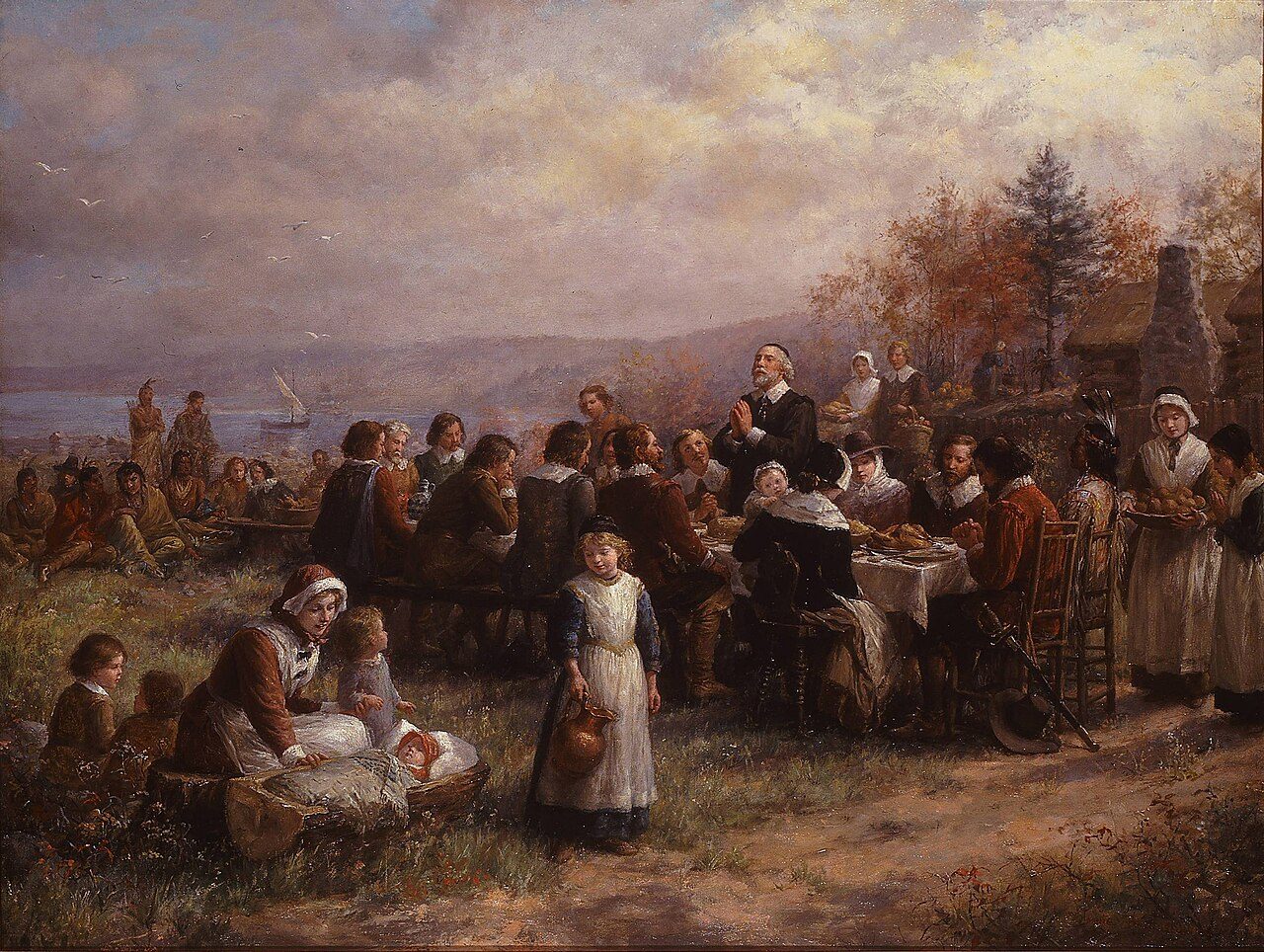
The feast Americans call the First Thanksgiving was a three-day harvest celebration at Plymouth in autumn 1621, shared by about fifty English colonists and Ousamequin, the Wampanoag leader, with some ninety of his men. It was diplomacy as much as dinner — and almost everything familiar about it was added later.
At a Glance
- When
- Autumn 1621, probably late September or early October; the celebration lasted three days
- Where
- Plymouth, Massachusetts — the Wampanoag village site of Patuxet
- Who was there
- Little more than fifty surviving English colonists, and Ousamequin (Massasoit) with about ninety Wampanoag men
- Foods actually documented
- Wildfowl shot by four colonists, and five deer brought by the Wampanoag
- Primary account
- Edward Winslow's letter, published in London in 1622 in the account known as Mourt's Relation
- Second account
- William Bradford's later history, which mentions a great store of wild turkeys that autumn but not at the feast
- The name
- Neither account uses the word Thanksgiving; the 1621 meal was first called the first Thanksgiving in an 1841 collection
Introduction
The First Thanksgiving was not a holiday, a church service or even, at the time, an event with a name. It was a three-day harvest celebration held at Plymouth, in present-day Massachusetts, in the autumn of 1621, after the English colonists had gathered in their first New England crops. Edward Winslow, one of the colonists, described it in a letter written that December: the governor sent four men out shooting birds, and during the festivities Ousamequin — the Wampanoag leader the English called Massasoit — arrived with some ninety men. For three days the two groups feasted together, and the Wampanoag went out, killed five deer and presented them to the colony's leaders.
That single paragraph by Winslow, and a few lines written later by Governor William Bradford, are nearly all the evidence there is. No one present called the gathering a thanksgiving, no menu survives beyond fowl and venison, and no one in 1621 could have guessed that the meal would one day be cast as the founding feast of a national holiday. Understanding the event means separating the three days that actually happened from the tradition that was built on top of them two centuries later.
Before the Feast: Two Peoples Under Strain
Both sides came to the table weakened. The colonists had reached Cape Cod in November 1620 and settled at a place they named Plymouth, on the site of Patuxet, a Wampanoag village emptied by disease. Their first winter was catastrophic: nearly half of the settlers died of sickness, and by the spring of 1621 the survivors were, as the Smithsonian puts it, teetering on extinction. The Wampanoag were in a comparable crisis. Between 1616 and 1619, epidemics carried by European traders and fishermen had swept the Northeast coast in what is now called the Great Dying; the Smithsonian's National Museum of the American Indian estimates that nearly three-quarters of the entire Wampanoag nation died, leaving them exposed to their less-affected Narragansett neighbours.
The alliance came first, and the feast followed from it. In the spring of 1621 Ousamequin decided to bring the newcomers into the Wampanoag network as allies, and the two sides agreed a treaty pledging mutual support. Ousamequin sent Tisquantum — a Patuxet man who spoke English after years of captivity abroad — and Hobbamock to live near the colonists, help them and watch them. Tisquantum taught the settlers how to plant the flint corn that made the 1621 harvest possible. When the corn came in that autumn, the celebration that followed was, in the words of Plimoth Patuxet Museums' historians, a way of cementing a very fresh alliance between two communities still getting acquainted.
Timeline
- 1614
Captain Thomas Hunt kidnaps twenty men from Patuxet, including Tisquantum, and seven men from Nauset, to be sold abroad.
- 1616–1619
The Great Dying: epidemics brought by European traders devastate Wampanoag communities along the Northeast coast.
- December 1620
The Mayflower colonists settle at Patuxet, which they rename Plymouth; nearly half of them die during the first winter.
- Spring 1621
Ousamequin and the colonists agree a mutual-support treaty; Tisquantum and Hobbamock are sent to assist and observe the settlement.
- Autumn 1621
After the harvest, colonists and Wampanoag feast together for three days; the Wampanoag contribute five deer to the colonists' wildfowl.
- 1622
Winslow's account of the feast is published in London in the booklet now known as Mourt's Relation — the only eyewitness description.
- 1841
A Boston collection of Pilgrim writings reprints Winslow's letter and labels the 1621 meal the first Thanksgiving — the name's first known use for it.
- 3 October 1863
President Abraham Lincoln, after Sarah Josepha Hale's long campaign, proclaims a national day of thanksgiving for 26 November.
- 1941–1942
Congress fixes United States Thanksgiving on the fourth Thursday in November, ending decades of shifting dates.
- 1970
Wampanoag leader Wamsutta Frank James, barred from speaking at the Mayflower anniversary, declares Thanksgiving a National Day of Mourning at Plymouth.
Significance
For the people who were there, the feast's significance was diplomatic. The English had guns and trade goods; the Wampanoag had numbers, local knowledge and food. Each side needed the other against the threats it feared most, and three days of eating, sport and military exercises — Winslow mentions the colonists exercising their arms among the recreations — displayed the alliance to anyone watching. The treaty the feast celebrated held, in its essentials, for a generation, and the colony it protected survived to become the seed of New England settlement.
For later Americans, the feast acquired a second, larger significance as an origin story. Nineteenth-century writers, editors and campaigners lifted Winslow's paragraph out of obscurity, named it the first Thanksgiving and attached it to the national holiday proclaimed in 1863. A local harvest meal between two wary peoples became a parable of gratitude, abundance and intercultural peace — a story simple enough for schoolbooks, and powerful enough to define how a country imagined its own beginning.
Myths and disputes
The best-documented myth is the name itself. Neither Winslow nor Bradford calls the 1621 gathering a thanksgiving or mentions giving thanks at it; for the colonists, a thanksgiving was a solemn day of prayer, not a feast, and Winslow's letter describes a secular harvest celebration. The label arrived in 1841, when an editor reprinting the letter called the meal the first Thanksgiving in a footnote, and the holiday it now names was only created nationally in 1863, when Lincoln's proclamation — won by Sarah Josepha Hale's decades of lobbying — fixed a day of thanksgiving in the middle of the Civil War. The feast and the holiday are separated by 242 years.
The menu is the second myth. Winslow names only wildfowl and the five deer; he does not mention turkey at all. Bradford, writing later about that autumn, notes a great store of wild turkeys in the area, so turkey on the table is possible — but Plimoth Patuxet's food historians judge ducks and geese, then migrating through in thousands, the likelier fowl, alongside corn, fish and shellfish. Cranberry sauce, potatoes and pumpkin pie were impossible or decades away. Historians also dispute the invitation: Britannica describes the ninety Wampanoag as a surprise appearance at the settlement gate, while Wampanoag historians argue a party that size, travelling some forty miles, must have been expected and arranged. The record is too thin to settle it.
Legacy
The feast's legacy runs in two directions at once. As the model for Thanksgiving, it shaped the menu, imagery and mythology of North America's great family holiday, retold every November in classrooms and around tables. At the same time, museums such as Plimoth Patuxet and the Smithsonian now present the 1621 gathering as the opening chapter of a harder story — colonisation, land loss and King Philip's War — and many Native people mark the day with the National Day of Mourning held at Plymouth since 1970.
What survives the myth-clearing is arguably more interesting than the legend: two peoples, each recently devastated, sharing food for three days because an alliance suited them both. The paragraph Winslow wrote to reassure readers in England became, by accident, the foundation document of a holiday — and a standing lesson in how much of history is built from very little evidence.
Sources
- Plimoth Patuxet Museums — What did they eat at the 1621 harvest celebration?
- Smithsonian Magazine — How to Tell the Thanksgiving Story on Its 400th Anniversary
- Smithsonian National Museum of the American Indian — Timeline: The First Thanksgiving
- Encyclopaedia Britannica — Thanksgiving Day
- Encyclopaedia Britannica — Why Do We Eat Turkey on Thanksgiving?
The facts on this page were checked against these sources on 19 November 2026. The History Trail's permanent pages are researched and written for this site; the live profiles elsewhere on The History Trail are assembled automatically from Wikipedia and Wikidata.
About the Author
Researched and written by the The History Trail Editorial Team — the accountable editorial function behind this site's permanent story pages. The team works from the published sources cited on each page; it does not invent historians, reviewers or credentials, and it corrects errors openly.
Fact Check
Every load-bearing fact on this page traces to one of the sources listed above, and significant claims link to their source in the text. Our checking method is described on the methodology page; errors can be reported via the corrections page.
Sources & Citations
Cite this page as: The History Trail Editorial Team, The History Trail — this article's title, publication and update dates are shown beneath its headline. The full source list appears under Sources above; the site's source standards are on the sources page.