
Things
Christmas Cards
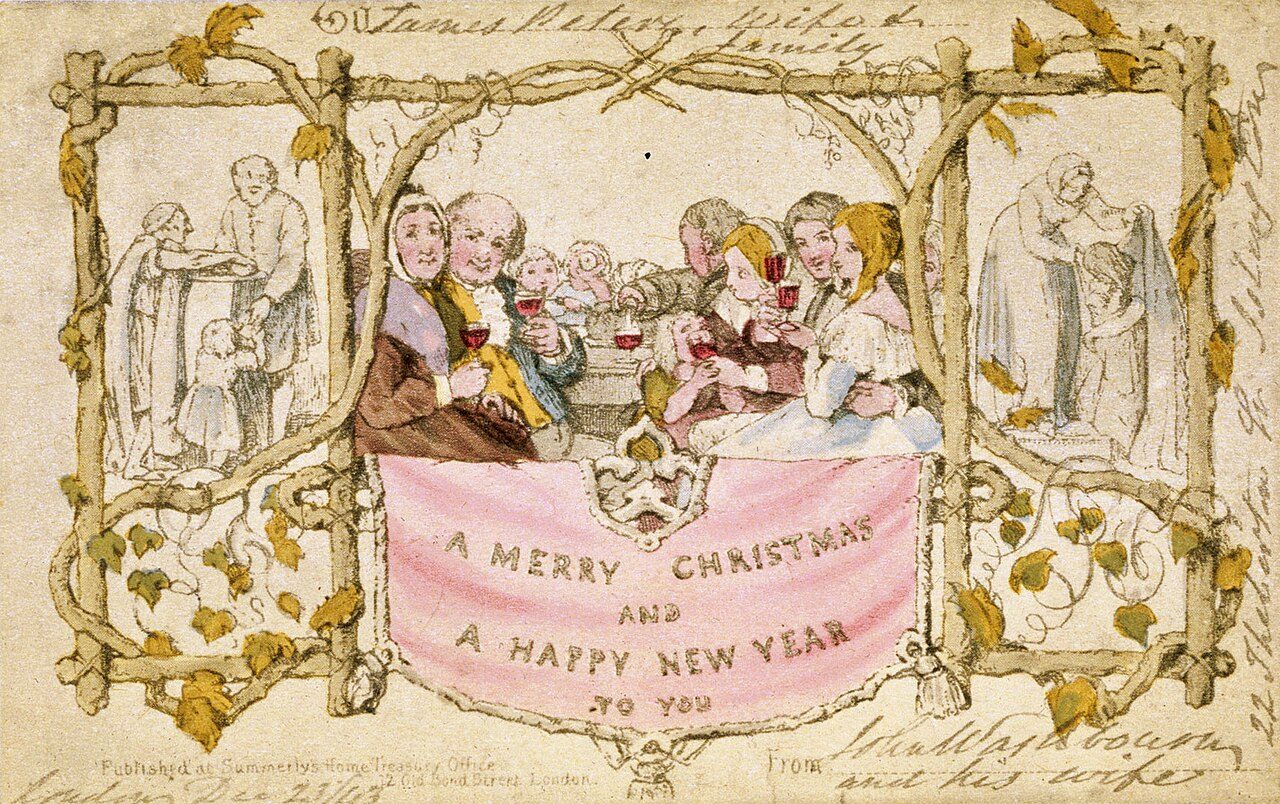
The Christmas card was invented in 1843 as an escape from Christmas letters: Henry Cole, buried in unanswered holiday mail, commissioned John Callcott Horsley to design a printed greeting he could send to everyone — 1,000 copies that began a custom now measured in billions.
At a Glance
- First card
- London, 1843: commissioned by Henry Cole, designed by John Callcott Horsley, 1,000 copies printed
- The design
- A triptych: a family raising a toast in the centre, flanked by scenes of feeding and clothing the poor
- The controversy
- Temperance campaigners objected to children shown with glasses of wine in the family toast
- The price
- One shilling a card — expensive at the time, and the V&A judges the venture a commercial flop
- America
- Louis Prang, a Prussian immigrant printer near Boston, produced the first US-originated card in 1875 and over five million a year by the 1880s
- The standard format
- Hallmark's folded card, four by six inches in an envelope, adopted soon after its first Christmas card in 1915
- Modern scale
- Approximately 1.3 billion Christmas cards sent annually in the United States, according to Hallmark citing the Greeting Card Association
Introduction
The Christmas card began as a time-saving device. In 1843 Henry Cole, a well-connected civil servant who had helped reform the British postal system, faced piles of unanswered Christmas letters — and in Victorian England, not answering mail was impolite. His solution was to print the reply. He commissioned his friend, the artist John Callcott Horsley, to design a card he could personalise with a name and send to everyone: a thousand copies, produced by a London printer, carrying one printed greeting for all.
Cole was the V&A's future founding director, and the museum still holds the card he received back from Horsley, signed with a tiny self-portrait and the date Xmasse 1843. What started as one busy man's shortcut became, within a generation, a Victorian craze, then an American industry, and finally a habit measured in billions of cards a year.
1843: A Toast, a Scandal and a Commercial Flop
Horsley's design was a triptych. The central hand-coloured panel showed three generations of the Cole family raising a toast to the recipient, beneath the words A Merry Christmas and a Happy New Year to You. The side panels showed acts of charity — feeding and clothing the poor — so the card's twofold message was celebration and giving. Space at the top, marked TO, let Cole fill in each recipient's name. Britannica records that an edition of 1,000 hand-coloured copies was placed on sale in London, at a shilling apiece — an expensive price, and the V&A judges the venture a commercial flop.
It also caused offence. The family toast included children with glasses of wine, and in a country with a vigorous temperance movement, critics accused the card of encouraging underage drinking. Smithsonian Magazine reports that the Temperance Society objected to the child sipping wine in the scene. The controversy did not kill the idea: the second Christmas card, designed by William Maw Egley, followed in 1848, and as printing grew cheaper the custom spread. Cole had been ahead of his market, not wrong about it.
Prang, Chromolithography and the American Card
The Victorian heyday of the card, from about 1860 to 1890, was powered by colour printing. The V&A describes how new processes combining chromolithography, metallic inks, fabric applique and die-cutting produced elaborate cards that Victorians exchanged, displayed and collected in vast numbers, establishing the familiar iconography of robins, holly, snowy churches and Santa Claus. Cards were reviewed in newspapers and competed for design prizes; collecting them became a middle-class passion.
America took the card up through Louis Prang, a Prussian immigrant with a print shop near Boston. Prang is credited with creating the first Christmas card originating in the United States in 1875 — a painting of a flower that read simply Merry Christmas, with no Christmas scene at all. His speciality was chromolithography, the multi-stone colour process that let him reproduce paintings vividly and cheaply at scale. Britannica records that by the 1880s Prang was producing more than five million cards a year. His early cards favoured flowers, birds and nature scenes over nativity imagery, and their quality made the American Christmas card a form of popular art.
Timeline
- 1843
Henry Cole commissions John Callcott Horsley; 1,000 copies of the first commercial Christmas card are printed in London and sold for a shilling.
- 1848
William Maw Egley designs the second Christmas card, in a similar triptych format of merriment flanked by charity.
- 1860-1890
The Victorian heyday: chromolithography and cheap postage make cards a mass custom and a collecting craze.
- 1875
Louis Prang, a Prussian immigrant printer near Boston, creates the first Christmas card originating in the United States.
- 1880s
Prang is producing more than five million cards a year using the chromolithography process.
- 1910
Joyce Hall founds the Hall Brothers company in Kansas City, the business that will become Hallmark.
- 1915
The Hall Brothers publish their first Christmas card; the modern Christmas card industry is under way.
- Soon after 1915
Hallmark adopts the folded format — four inches by six, folded once and inserted in an envelope — still the industry standard.
- 1939-1945
Wartime cards, including designs by artist-servicemen in the Second World War, carry greetings between fronts and home.
- 1962
The United States Post Office issues its first Christmas stamp; a billion copies are printed by the end of the year.
- 1977
Hallmark publishes its three-angels card, which becomes the most popular Christmas card of all time, selling 34 million copies.
Significance
The folded card was the industry's decisive invention. Postcard-style greetings left little room to write; a letter demanded too much. Hallmark's Steve Doyal explained the folded format's appeal to Smithsonian Magazine: people did not have enough room to write everything they wanted on a postcard, but they did not want to write a whole letter. The book format — colour outside, a printed sentiment and room for a personal line inside, sealed in an envelope — hit the middle exactly, and in the 1930s to 1950s it made Christmas cards enormously popular.
Cards also proved to be wartime infrastructure. The V&A's collection includes sentimental portrayals of soldiers turned into cards connecting families and friends across the British empire, and the Smithsonian's Archives of American Art holds Christmas cards designed by artist-servicemen in the Second World War. A card was light, cheap, censor-friendly and keepable — the ideal message between a front line and a kitchen table. By 1962 demand was so large that the first United States Christmas stamp needed a billion copies printed in its first year.
Questions readers ask
Did Cole invent sending Christmas greetings? No — Christmas and New Year letters were an old custom, and Cole himself was buried under them. What he invented was the printed, commercial short cut: one design, mass-produced, personalised only by a handwritten name. Earlier hand-made greetings exist, but 1843 is the agreed start of the Christmas card as a product.
Why did the first card cause a scandal? Because of the wine. Horsley's central panel showed the whole family, children included, raising glasses, and temperance campaigners read it as an encouragement to drink. The side panels of charity work were meant to balance the feasting; critics looked only at the glasses.
How many Christmas cards are sent today? Hallmark, citing the Greeting Card Association, puts the figure at approximately 1.3 billion cards sent annually in the United States, making Christmas the largest card-sending holiday. The V&A, for its part, describes around a billion Christmas cards bought in the UK each year. The numbers are lower than the twentieth-century peak — email, phones and social media have taken the everyday greeting — but the seasonal card has proved unusually durable.
What replaced the paper card? Partly the e-card: animated, musical, instant and free, offered by card companies themselves as print volumes fell. Yet the industry's innovation also stayed physical — pop-up cards, audio and video cards, and designs aimed at narrower audiences — and a printed card's very effort is now its message: it says the sender bothered.
Legacy
Few inventions announce their own history as neatly as the Christmas card: its first example survives, its designer and commissioner are known, and the museum its commissioner founded holds the national collection — more than 30,000 greetings cards, over half of them for Christmas. One of Cole's originals, auctioned in 2013, sold for 22,000 pounds, a price that would have astonished the man whose shilling cards flopped.
The card's deeper legacy is the template it set for seasonal communication: a manufactured object carrying a personal feeling, bought by the billion. Every photo card, charity card and e-card since 1843 is a variation on Cole's bargain — the warmth of a letter at the cost of a signature.
Sources
- Smithsonian Magazine — The History of the Christmas Card
- Victoria and Albert Museum — The first Christmas card
- Encyclopaedia Britannica — Christmas card
- Smithsonian Institution, Archives of American Art — Christmas cards designed by artist-servicemen
- Greeting Card Association — Who Sent the First Christmas Card
- Postal Times — Hallmark is once again greeting the season
The facts on this page were checked against these sources on 19 November 2026. The History Trail's permanent pages are researched and written for this site; the live profiles elsewhere on The History Trail are assembled automatically from Wikipedia and Wikidata.
About the Author
Researched and written by the The History Trail Editorial Team — the accountable editorial function behind this site's permanent story pages. The team works from the published sources cited on each page; it does not invent historians, reviewers or credentials, and it corrects errors openly.
Fact Check
Every load-bearing fact on this page traces to one of the sources listed above, and significant claims link to their source in the text. Our checking method is described on the methodology page; errors can be reported via the corrections page.
Sources & Citations
Cite this page as: The History Trail Editorial Team, The History Trail — this article's title, publication and update dates are shown beneath its headline. The full source list appears under Sources above; the site's source standards are on the sources page.