
Animals
Giant panda
The giant panda is a bear that abandoned meat for a grass it cannot fully digest, and must therefore eat for up to sixteen hours a day. Hunted and squeezed into mountain fragments, it became the world's symbol of endangered wildlife — then, unusually, began to recover.
At a Glance
- Scientific name
- Ailuropoda melanoleuca
- Family
- Ursidae — a true bear, confirmed by molecular analyses in the 1990s
- Range
- Bamboo forests of Sichuan, Shaanxi and Gansu, central China
- Diet
- 90–98 percent bamboo; up to 16 hours a day spent feeding
- Wild population
- Fewer than 1,900 (IUCN Red List)
- Newborn weight
- About 112 grams — about 1/800 of the mother's weight
- Distinctive anatomy
- An enlarged wrist bone that functions like a thumb for gripping bamboo
- Conservation status
- Vulnerable since 2016 (previously Endangered)
Introduction
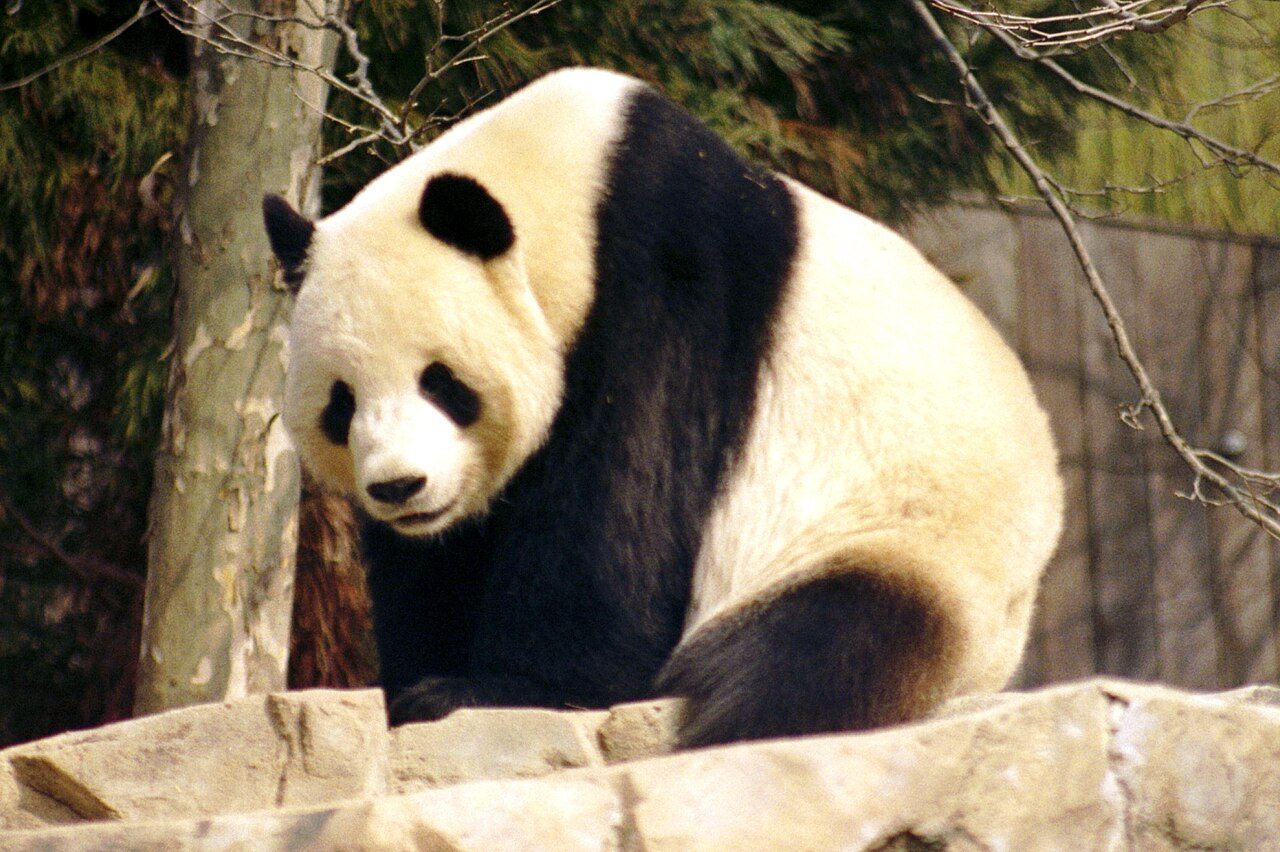
The giant panda is a bear — family Ursidae — wearing the most recognisable coat in the animal kingdom: black ears, eye patches, limbs and shoulders against a white face and torso. Large males reach 1.8 metres in length and weigh more than 100 kilograms. It lives only in the bamboo forests of the mountains of central China, along the eastern edge of the Tibetan Plateau in the provinces of Sichuan, Shaanxi and Gansu, and fewer than 1,900 are thought to remain in the wild.
For decades the panda was also a scientific argument. Its anatomy, behaviour and chemistry were used at different times to place it with the bears, with the raccoons, or in a family of its own. Improved molecular analyses in the 1990s settled the question strongly in favour of the bears — which makes its way of life stranger still, because this bear has effectively given up meat.
Background
Between 90 and 98 percent of the panda's diet is bamboo — the leaves, shoots and stems of a giant grass that grows year-round in its forests. Fossilised teeth show the commitment is ancient: pandas had taken to bamboo as their principal food at least three million years ago. The adaptations are real — powerful jaws, bamboo-crushing teeth, and an enlarged wrist bone that works like a thumb to grip stems — but the digestion never followed. The panda retains the gut of its carnivore ancestors and cannot digest cellulose, the main constituent of bamboo.
Its solution is volume and speed. A panda may spend sixteen of every twenty-four hours feeding, passing prodigious quantities of bamboo quickly through its gut and eliminating waste up to fifty times a day. Outside bamboo forest it cannot naturally survive. Pandas are solitary, each animal keeping to a home range of about four to six square kilometres, and they communicate largely by scent: a large gland beneath the tail is rubbed on trees, rocks and grass to leave messages about identity, sex and readiness to breed, in a brief spring mating season.
Timeline
- At least 3 million years ago
Fossilised dental remains show the giant panda's ancestors had already committed to bamboo as their principal food source.
- Early Pleistocene, 2.6 million years ago onward
Fossils from northern Myanmar, Vietnam and much of China as far north as Beijing show the panda was once widely distributed across eastern Asia.
- 1869
The French Vincentian missionary Armand David obtains panda furs in China — the first record of the animal to reach Western science.
- 1913–15
The Walter Stötzner expedition becomes the first by Europeans to observe a live giant panda in the wild.
- 1936
Su-Lin, the first giant panda exhibited in the West, arrives in the United States as an infant and draws crowds at Brookfield Zoo near Chicago.
- 1990s
China greatly expands panda conservation: the reserve system grows from 14 sites to more than 40, with international cooperation on reserve management and captive breeding.
- 1990s
Molecular analyses settle the panda's long taxonomic dispute, showing bears are its closest relatives.
- 2016
The IUCN moves the giant panda from Endangered to Vulnerable, citing China's success in restoring bamboo forest habitat.
Significance
The panda's reproduction is as improbable as its diet. Females show delayed implantation, and the period of actual fetal growth lasts only about two months, so a newborn weighs on average about 112 grams — roughly one eight-hundredth of its mother's weight, the smallest offspring relative to mother of any placental mammal. The cub is born blind, in a thin white coat, and is cradled against its mother with the help of those thumblike wrist bones. Twins are common in captivity, but a wild mother typically cannot raise more than one. Eyes open at about 45 days; weaning takes until eighteen to twenty-four months.
That fragility made the panda the test case for conservation breeding. The Smithsonian's National Zoo and Conservation Biology Institute, working with Chinese partners over decades, helped unravel panda reproductive biology — including non-invasive hormone tracking and artificial insemination techniques behind the births of Tai Shan, Bao Bao, Bei Bei and Xiao Qi Ji — and has trained more than 1,500 Chinese wildlife professionals and students. The same programme works in the wild, identifying forest corridors and planting bamboo restoration plots to reconnect the fragmented habitat that is the species' core problem.
Legacy
The 2016 downlisting to Vulnerable is the panda's real legacy: one of the very few times a famous endangered species has been moved a step back from the brink because habitat protection demonstrably worked. China now treats the panda as a national treasure, lending agreements with foreign zoos channel funds to wild conservation, and more than 120 pandas live in captivity in China with others in zoos worldwide. The Smithsonian's work now looks ahead — studying how climate change will shift bamboo forests uphill, and which habitat will still suit pandas in fifty years.
None of that makes the species secure. Its habitat totals only about 13,000 square kilometres, periodic mass flowering and die-off of bamboo can still starve local populations, and a bear that must eat for sixteen hours a day has little slack when its forest is cut. The panda endures as both proof and warning: recovery is possible, and it is never finished.
Sources
- Encyclopaedia Britannica — Giant panda
- Smithsonian's National Zoo and Conservation Biology Institute — About the Giant Panda Conservation Program
- Encyclopaedia Britannica — Bear (panda anatomy and classification)
The facts on this page were checked against these sources on 19 November 2026. The History Trail's permanent pages are researched and written for this site; the live profiles elsewhere on The History Trail are assembled automatically from Wikipedia and Wikidata.
About the Author
Researched and written by the The History Trail Editorial Team — the accountable editorial function behind this site's permanent story pages. The team works from the published sources cited on each page; it does not invent historians, reviewers or credentials, and it corrects errors openly.
Fact Check
Every load-bearing fact on this page traces to one of the sources listed above, and significant claims link to their source in the text. Our checking method is described on the methodology page; errors can be reported via the corrections page.
Sources & Citations
Cite this page as: The History Trail Editorial Team, The History Trail — this article's title, publication and update dates are shown beneath its headline. The full source list appears under Sources above; the site's source standards are on the sources page.