
People
Nelson Mandela
Mandela gave up a chieftainship to become a lawyer, gave up the law to become a fugitive, and spent twenty-seven years in prison rather than compromise. He emerged not preaching revenge but negotiation — and within four years of his release he was president of a democratic South Africa.
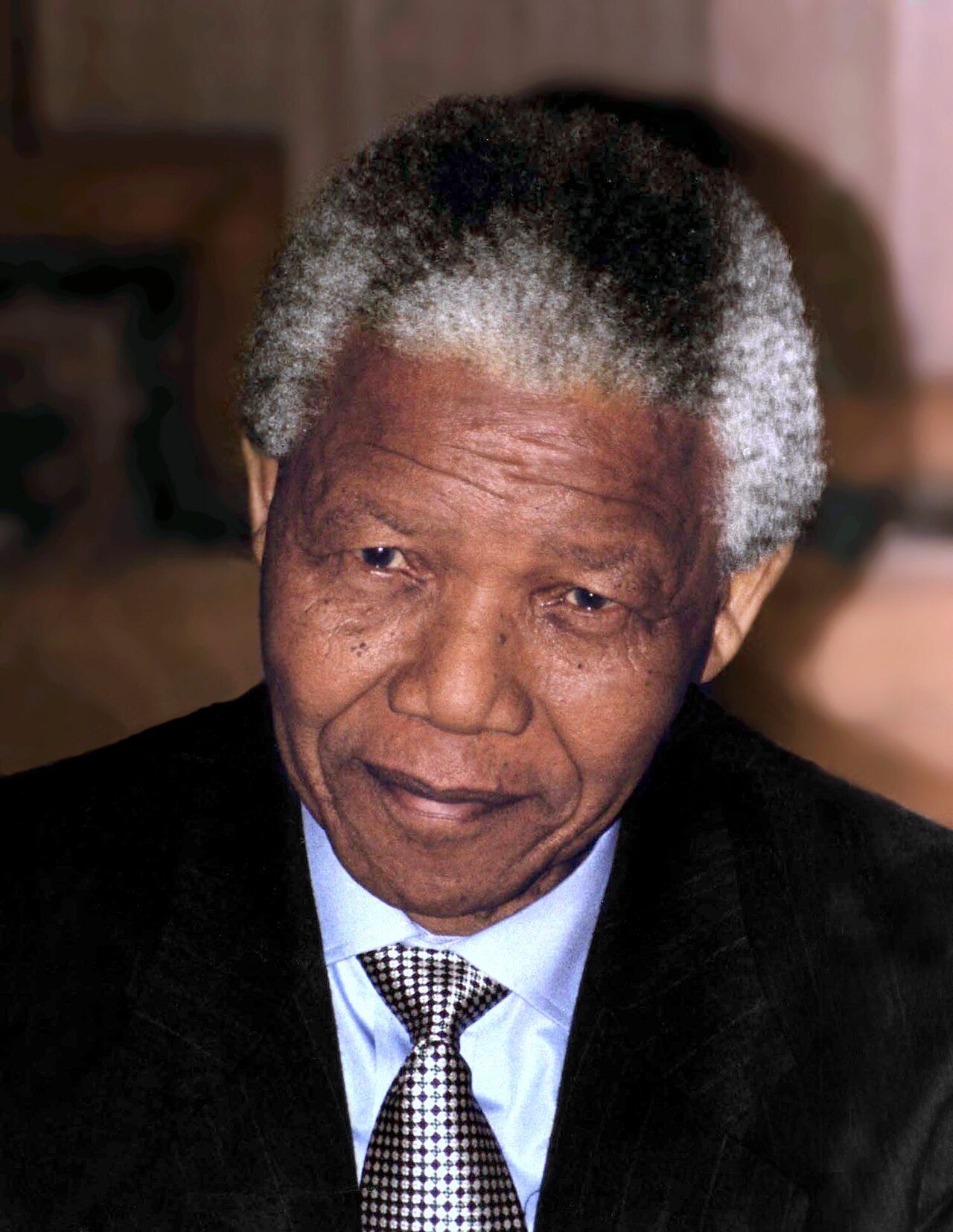
At a Glance
- Born
- 18 July 1918, Mvezo, South Africa
- Died
- 5 December 2013, Johannesburg, aged 95
- Imprisoned
- 1962–1990 — life sentence imposed 12 June 1964; Robben Island 1964–82, then Pollsmoor
- Released
- 11 February 1990
- Nobel Prize
- Peace, 1993 — shared with F. W. de Klerk
- Office
- First Black president of South Africa, 1994–99
- Founded
- South Africa's first Black law practice (1952, with Oliver Tambo); co-founded Umkhonto we Sizwe
Introduction
Nelson Rolihlahla Mandela was born on 18 July 1918 in Mvezo, in South Africa's Transkei, son of Henry Mandela, chief of the Madiba clan of the Xhosa-speaking Tembu people. After his father's death the boy was raised by Jongintaba, regent of the Tembu. He had a claim to the chieftainship himself — and renounced it in order to become a lawyer. He was educated at the South African Native College, later the University of Fort Hare, and studied law at the University of the Witwatersrand, eventually passing the qualification examination.
In 1944 Mandela joined the African National Congress, the Black-liberation organisation, and became a leader of its Youth League. When the ruling National Party imposed its apartheid policies after 1948, he rose through ANC leadership, helping to revitalise the organisation against a system that assigned rights by race. That same year, 1944, he married Evelyn Ntoko Mase.
Background
In 1952, in Johannesburg, Mandela and fellow ANC leader Oliver Tambo established South Africa's first Black law practice, specialising in cases arising from the apartheid legislation passed since 1948. The same year he played an important role in launching a defiance campaign against the pass laws, which required non-white South Africans to carry documents authorising their presence in areas the government reserved for whites. In 1955 he was involved in drafting the Freedom Charter, which called for a nonracial social democracy in South Africa.
The state answered with harassment. From 1952 Mandela was intermittently banned — severely restricted in travel, association and speech. In December 1956 he was arrested with more than a hundred others on treason charges designed to harass anti-apartheid activists; the trial dragged on until his acquittal in 1961. Then, in 1960, police massacred unarmed Black South Africans at Sharpeville and the government banned the ANC. Mandela abandoned his nonviolent stance, went underground — evading capture so deftly he was nicknamed the Black Pimpernel — and helped found Umkhonto we Sizwe, the ANC's military wing.
Timeline
- 18 July 1918
Nelson Rolihlahla Mandela is born in Mvezo, son of a Tembu chief; raised by the regent Jongintaba after his father's death.
- 1944
Mandela joins the African National Congress and becomes a leader of its Youth League; he marries Evelyn Ntoko Mase.
- 1952
With Oliver Tambo he opens South Africa's first Black law practice in Johannesburg, and helps launch the defiance campaign against the pass laws.
- 1955
Mandela is involved in drafting the Freedom Charter, calling for a nonracial social democracy.
- 1956–1961
Arrested with over a hundred others, Mandela stands trial for treason; all the accused are eventually acquitted.
- 1961
After the Sharpeville massacre and the banning of the ANC, Mandela helps found its military wing, Umkhonto we Sizwe.
- 5 August 1962
Arrested at a roadblock in Natal after returning from guerrilla training in Algeria; sentenced to five years' imprisonment.
- 12 June 1964
In the Rivonia Trial, Mandela is sentenced to life imprisonment; he serves 1964–82 on Robben Island, then at Pollsmoor Prison.
- 11 February 1990
Mandela is released, having consistently refused to compromise his political position to obtain his freedom.
- 1993
Mandela and President F. W. de Klerk are jointly awarded the Nobel Prize for Peace.
- 1994–1999
Mandela serves as the first Black president of South Africa, after the peaceful transition to majority rule.
- 5 December 2013
Mandela dies in Johannesburg, aged 95; he is laid to rest at Qunu on 15 December.
Significance
During his years in prison Mandela's reputation grew steadily. He was widely accepted as the most significant Black leader in South Africa and became a potent symbol of resistance as the anti-apartheid movement gathered strength — a symbol made more powerful, not less, by his consistent refusal to compromise his political position to buy his freedom. The prisoner the state had buried became the one man it eventually had to negotiate with.
After his release on 11 February 1990, Mandela plunged into the work he and others had set out almost four decades earlier. In 1991 he was elected president of the ANC. His negotiations with President F. W. de Klerk in the early 1990s helped end the apartheid system of racial segregation and ushered in a peaceful transition to majority rule — a transition many had predicted would be a bloodbath. The two men shared the 1993 Nobel Prize for Peace for it. In 1994 Mandela became South Africa's first Black president, serving a single term, to 1999.
Legacy
Few twentieth-century prisoners have been mourned by the successors of their jailers.
His legacy rests on a choice as much as an achievement. The man with the strongest personal claim to vengeance in his country — twenty-seven years taken, a family harassed, a people humiliated — chose negotiation and a single presidential term, then retirement. That restraint is why his name functions globally as shorthand not just for resistance but for reconciliation: the proof that a liberation movement can win without becoming what it fought.
Sources
- NobelPrize.org — Nelson Mandela, Biographical
- Encyclopaedia Britannica — Nelson Mandela
- NobelPrize.org — The Nobel Peace Prize 1993
The facts on this page were checked against these sources on 19 November 2026. The History Trail's permanent pages are researched and written for this site; the live profiles elsewhere on The History Trail are assembled automatically from Wikipedia and Wikidata.
About the Author
Researched and written by the The History Trail Editorial Team — the accountable editorial function behind this site's permanent story pages. The team works from the published sources cited on each page; it does not invent historians, reviewers or credentials, and it corrects errors openly.
Fact Check
Every load-bearing fact on this page traces to one of the sources listed above, and significant claims link to their source in the text. Our checking method is described on the methodology page; errors can be reported via the corrections page.
Sources & Citations
Cite this page as: The History Trail Editorial Team, The History Trail — this article's title, publication and update dates are shown beneath its headline. The full source list appears under Sources above; the site's source standards are on the sources page.