
On This Day
September 26 in History
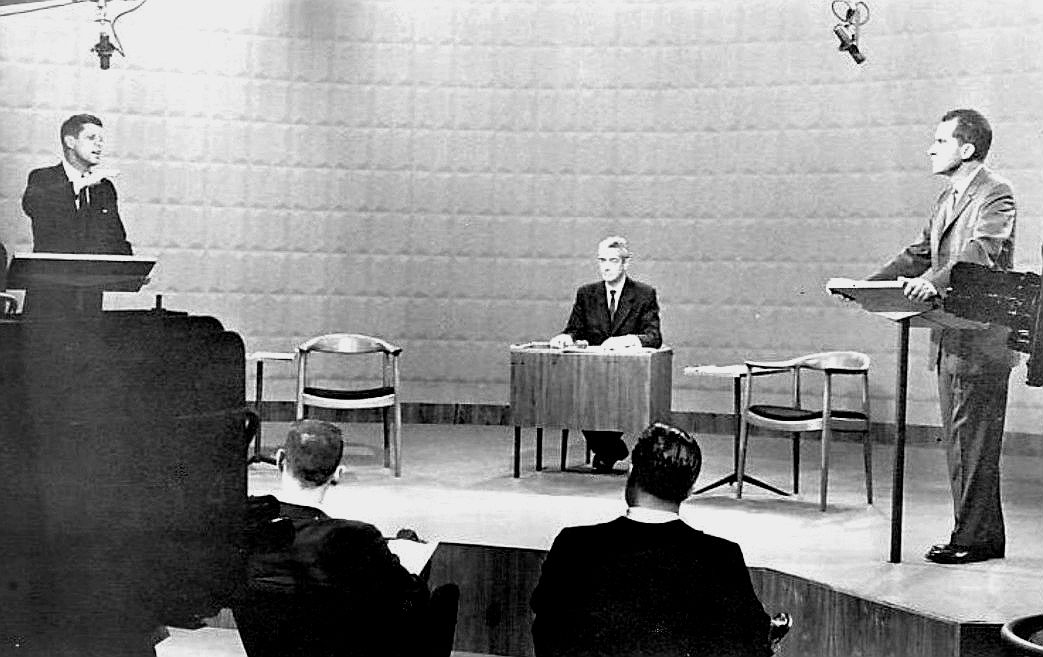
On 26 September 1960, at a CBS studio in Chicago, Senator John F. Kennedy and Vice President Richard M. Nixon met in the first televised debate between presidential candidates — an encounter watched by an estimated 70 million Americans that taught politics, permanently, that how a candidate looked could matter as much as what he said. September 26 is also the day Drake completed his circumnavigation and a Soviet officer refused to start a nuclear war.
Choose another date: open the On This Day calendar to browse events, births and deaths for any day of the year.
At a Glance
- The setting
- WBBM-TV studios, Chicago, 26 September 1960, moderated by Howard K. Smith of CBS
- The audience
- An estimated 70 million Americans watched — the largest political audience in United States history to that date
- The contrast
- Kennedy, tanned and rested, wore a dark suit against the studio grey; Nixon, lately ill and refusing full make-up, appeared pale and shadowed
- The substance
- The first debate covered domestic policy; three more debates followed in October
- The verdict of legend
- Television viewers were widely said to judge Kennedy the winner, radio listeners Nixon — a claim resting on thin survey evidence
- The result
- Kennedy won one of the closest elections in American history, by about 113,000 popular votes
Events on this day
- 1580Francis Drake returns to Plymouth aboard the Golden Hind, completing his circumnavigation of the globe.
- 1687A Venetian shell ignites an Ottoman powder magazine in the Parthenon at Athens, blowing out the centre of the best-preserved temple of the ancient world.
- 1815Russia, Austria and Prussia sign the Holy Alliance, pledging to govern by Christian principles after Napoleon's defeat.
- 1957Leonard Bernstein's musical West Side Story opens on Broadway in New York.
- 1959Typhoon Vera strikes Japan's Ise Bay region; Britannica records more than 5,000 dead and 1.5 million left homeless.
- 1960Kennedy and Nixon meet in the first televised presidential debate — the featured story above.
- 1969The family sitcom The Brady Bunch is broadcast for the first time in the United States.
- 1973A Concorde makes the airliner's first non-stop crossing of the Atlantic, flying from Washington to Paris.
- 1983Soviet officer Stanislav Petrov judges a satellite's report of incoming American missiles to be a false alarm, and does not pass it up as a launch warning.
- 1984China and Britain agree the terms on which Hong Kong will return to Chinese sovereignty in 1997.
Born on this day
- 1888T. S. Eliot — American-born poet of The Waste Land, Nobel laureate who remade English poetry.
- 1889Martin Heidegger — German philosopher whose Being and Time reshaped twentieth-century thought.
- 1897Paul VI — Italian pope who closed the Second Vatican Council and led the Church through its reforms.
- 1898George Gershwin — American composer of Rhapsody in Blue and Porgy and Bess.
- 1932Manmohan Singh — economist and prime minister of India from 2004 to 2014.
- 1948Olivia Newton-John — British-Australian singer and actress, star of Grease.
Died on this day
- 1820Daniel Boone — American frontiersman who blazed the Wilderness Road into Kentucky, dead in Missouri at 86.
- 1945Béla Bartók — Hungarian composer and folk-music collector, dead in exile in New York.
- 1973Anna Magnani — Italian actress, Academy Award winner for The Rose Tattoo.
- 2008Paul Newman — American actor of Cool Hand Luke and founder of the Newman's Own food company, whose profits went to charity.
The featured story: the first televised presidential debate, 26 September 1960
Television had been in American homes for a decade, but in 1960 it swallowed presidential politics whole. Congress had suspended the equal-time rule so the networks could offer free airtime to the two major candidates alone, and both campaigns accepted a series of four debates. The first, on domestic policy, was staged at the WBBM-TV studios in Chicago on 26 September 1960, moderated by Howard K. Smith. An estimated 70 million people — then the largest audience ever for a political broadcast — tuned in to watch a president being chosen, for the first time, on a screen.
The two men arrived in different conditions. Kennedy, 43, had campaigned in California and looked tanned, rested and crisp in a dark suit chosen to stand out against the studio's grey backdrop. Nixon, 47 and the more experienced debater, had spent two weeks in hospital with an infected knee, had reinjured it on a car door that day, and took the stage pale, underweight and sweating under the lights, his five-o'clock shadow darkened only by a dusting of powder he had accepted in place of proper make-up. On points of policy the exchanges were even; on the screen, they were not.
There grew up a famous story — that television viewers judged Kennedy the winner while radio listeners scored it for Nixon. Historians now treat that contrast cautiously, since it rests largely on one small and poorly documented survey; but the deeper claim underneath it is solid. Polls moved toward Kennedy after the first debate, his campaign treated the night as the turning point, and Nixon's own aides spent the remaining three debates — in which the vice president, made up and recovered, performed far better — trying to undo a first impression that television had burned in.
The election finished almost exactly even: Kennedy won the popular vote by roughly 113,000 ballots out of nearly 69 million cast. No one can prove the debate decided it, and no subsequent candidate has dared act as if it did not. After 1960 there were, remarkably, no presidential debates at all until 1976 — incumbents had learned the risk — but once resumed they became a fixed institution, and every candidate since has prepared for the camera as seriously as for the questions. The studio in Chicago is where that education began.
Why this date matters
September 26 is a day about signals — true ones, false ones, and the difference a screen makes. Drake sails home with proof a world can be circled; a satellite lies to Stanislav Petrov and he chooses not to believe it; two candidates discover that a camera transmits things a microphone never did. Even the Parthenon's ruin was a signal misfired, a shell finding powder by chance. The date keeps asking the same question in different centuries: when the message arrives, will you read it rightly?
Sources
- Encyclopaedia Britannica — On This Day: September 26
- HISTORY — This Day in History: September 26
- Wikimedia — On This Day feed: September 26
- John F. Kennedy Presidential Library — First Kennedy-Nixon Debate, 26 September 1960
The facts on this page were checked against these sources on 19 November 2026. The History Trail's permanent pages are researched and written for this site; the live profiles elsewhere on The History Trail are assembled automatically from Wikipedia and Wikidata.
About the Author
Researched and written by the The History Trail Editorial Team — the accountable editorial function behind this site's permanent story pages. The team works from the published sources cited on each page; it does not invent historians, reviewers or credentials, and it corrects errors openly.
Fact Check
Every load-bearing fact on this page traces to one of the sources listed above, and significant claims link to their source in the text. Our checking method is described on the methodology page; errors can be reported via the corrections page.
Sources & Citations
Cite this page as: The History Trail Editorial Team, The History Trail — this article's title, publication and update dates are shown beneath its headline. The full source list appears under Sources above; the site's source standards are on the sources page.