
On This Day
October 8 in History
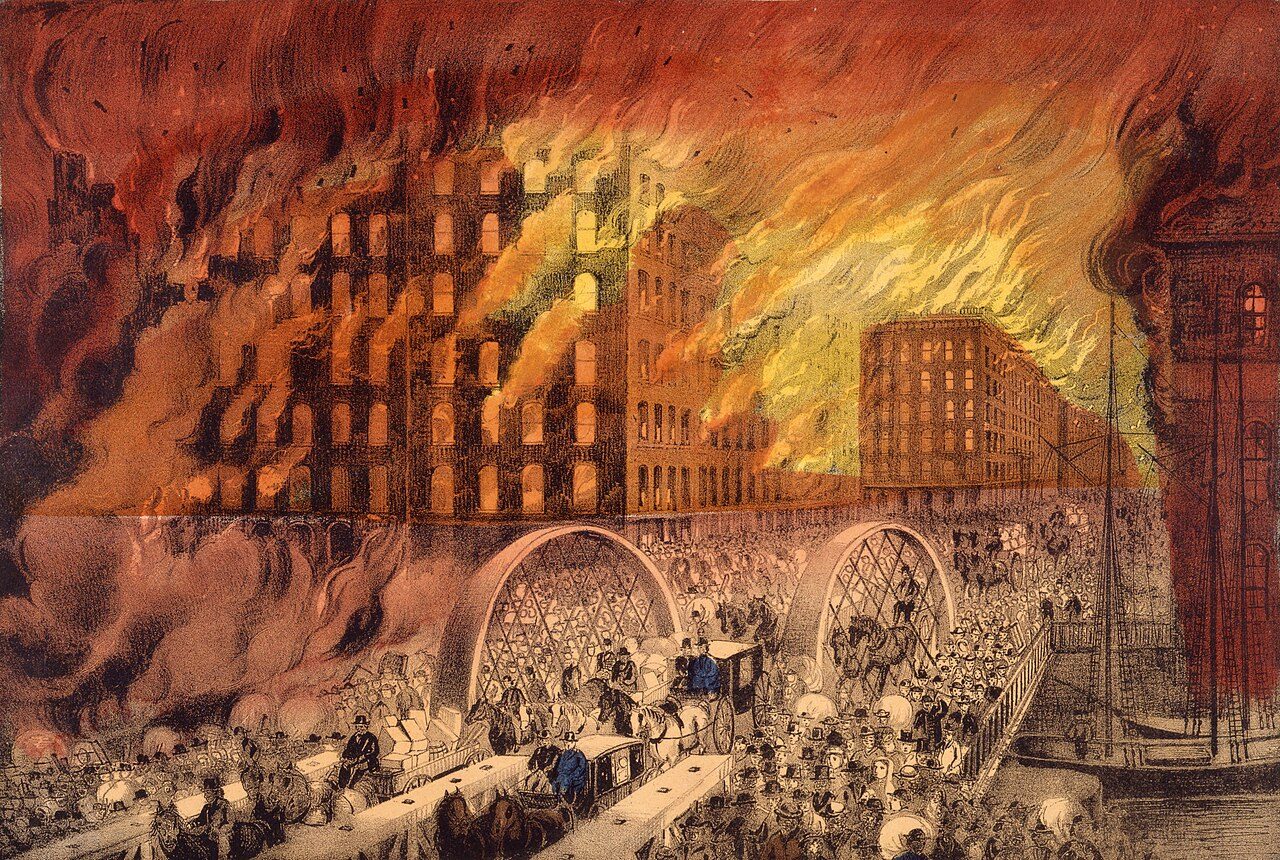
On the night of 8 October 1871 a fire began in Chicago's DeKoven Street and, driven by wind through a city built of wood, burned for two days — destroying an estimated 17,450 buildings, leaving some 100,000 people homeless and killing an estimated 200 to 300. October 8 is also the day of Sergeant York's stand in 1918 and Don Larsen's perfect game in 1956.
Choose another date: open the On This Day calendar to browse events, births and deaths for any day of the year.
At a Glance
- It began
- The evening of 8 October 1871, in or near the O'Leary barn at 137 DeKoven Street
- Why it spread
- A rainless autumn, a city built of wood, and a strong southwest wind; the waterworks burned, cutting off supply
- Buildings destroyed
- An estimated 17,450, across more than three square miles
- Homeless
- Some 100,000 people, about a third of the city
- The dead
- Estimated at between 200 and 300; the exact number was never established
- Damage
- Put at about $200 million at the time
- The legend
- Mrs O'Leary's cow was blamed without evidence; the city council exonerated both in 1997
Events on this day
- 1871The Great Chicago Fire begins in the city's southwest and burns for two days — the featured story above.
- 1871The same night, the Peshtigo Fire destroys the Wisconsin lumber town and surrounding forest, killing an estimated 1,200 people.
- 1918Sergeant Alvin C. York attacks a German machine-gun position in the Argonne, killing more than twenty and capturing 132 prisoners.
- 1919The first transcontinental air race in the United States begins, with aircraft flying between New York and San Francisco.
- 1934Bruno Hauptmann is indicted for the murder of the Lindbergh baby, the 'crime of the century'.
- 1939Germany formally annexes western Poland, incorporating it into the Reich a month after the invasion.
- 1945President Truman announces that the secret of the atomic bomb will be shared only with Britain and Canada.
- 1952Three trains collide at Harrow and Wealdstone station in London, killing 112 people in Britain's worst peacetime rail disaster.
- 1956Don Larsen of the New York Yankees pitches the only perfect game in World Series history.
- 1957Jerry Lee Lewis records 'Great Balls of Fire' at Sun Studio in Memphis.
- 1970Aleksandr Solzhenitsyn is awarded the Nobel Prize in Literature, to the fury of the Soviet authorities.
- 2001President George W. Bush creates the Office of Homeland Security in response to the September 11 attacks.
- 2005A magnitude 7.6 earthquake strikes Kashmir, killing, by some estimates, as many as 88,000 people in Pakistan and India.
Born on this day
- 1890Eddie Rickenbacker — America's top flying ace of the First World War and later an airline pioneer.
- 1895Juan Perón — Argentine president whose movement, Peronism, still shapes his country's politics.
- 1941Jesse Jackson — American civil rights leader and two-time presidential candidate.
- 1943Chevy Chase — American comedian, an original star of Saturday Night Live.
- 1949Sigourney Weaver — American actress of Alien and Gorillas in the Mist.
- 1970Matt Damon — American actor and co-writer of Good Will Hunting.
Died on this day
- 1945Felix Salten — Austrian author of Bambi, the novel behind the Disney film.
- 1967Clement Attlee — British prime minister whose Labour government built the welfare state and the NHS.
- 1992Willy Brandt — West German chancellor whose Ostpolitik won the Nobel Peace Prize, dead at 78.
The featured story: the Great Chicago Fire begins, 8 October 1871
On the night of Sunday, 8 October 1871, fire broke out in or near a small barn behind the O'Leary family's cottage at 137 DeKoven Street, on Chicago's southwest side. The city it entered was a tinderbox: after a dry summer and an autumn almost without rain, Chicago — a booming city of some 300,000 people, built overwhelmingly of wood, down to its sidewalks and many of its streets — was waiting for a spark. A watchman spotted the flames but gave the wrong location to the alarm office, and by the time engines reached the right street the fire had taken hold. Driven by a strong southwest wind, it leapt from building to building, then jumped the river into the heart of the city, generating firestorms so intense that witnesses described whirlwinds of flame.
Through Monday the fire consumed the business district, the courthouse, the waterworks — whose burning left the city without water to fight back — hotels, churches, newspaper offices and the homes of rich and poor alike. Tens of thousands of people fled toward the lake and the prairie, carrying what they could. The official count of the destruction, when it was over, reads like the inventory of a city erased: an estimated 17,450 buildings destroyed across more than three square miles, some 100,000 people — a third of Chicago — left homeless, damage put at around $200 million, and the dead estimated at between 200 and 300, though the true number will never be known, since some bodies were never recovered or identified.
The fire burned itself out early on Tuesday, 10 October, helped at last by rain. What happened next became the second half of the legend: Chicago rebuilt, fast, in brick and stone under stricter fire codes, drawing architects from across the world and inventing, in the process, the skyscraper. Relief poured in from around the globe. And the supposed author of the disaster, Catherine O'Leary, whose cow was said to have kicked over a lantern and started it all, became a figure of folklore — although no evidence ever supported the story, which a reporter later suggested had been invented. In 1997 the Chicago City Council formally exonerated both Mrs O'Leary and her cow.
One more fact gives the night its full scale. Chicago's fire was not even the deadliest fire in America that evening. The same dry, windy night, some 250 miles to the north, fire swept through the lumber town of Peshtigo, Wisconsin, and the forests around it, killing an estimated 1,200 people — several times Chicago's toll — and burning over a million acres. Peshtigo remains the deadliest fire in American history, yet it is Chicago's blaze that the world remembers: the bigger city, the better story, and a cow that almost certainly did not do it.
Why this date matters
October 8 is a date on which the nineteenth and twentieth centuries show their fragility. A wooden city of 300,000 people could be unmade in two nights by one barn fire; a forest town could vanish the same evening almost unnoticed. Yet the date also carries the century's recoveries and records: York's stand in the Argonne, Larsen's perfect game, a Nobel for the Soviet Union's most inconvenient writer. Chicago chose to remember its fire as a beginning rather than an end — the city rebuilt within years, grander than before — and that may be the date's real lesson: catastrophe is a fact, but so is what people decide to build on the ashes.
Sources
- Encyclopaedia Britannica — On This Day: October 8
- HISTORY — This Day in History: October 8
- Nobel Prize — Willy Brandt: Facts
- The Metropolitan Museum of Art — The Great Fire of Chicago, October 8, 1871 (Currier & Ives)
The facts on this page were checked against these sources on 19 November 2026. The History Trail's permanent pages are researched and written for this site; the live profiles elsewhere on The History Trail are assembled automatically from Wikipedia and Wikidata.
About the Author
Researched and written by the The History Trail Editorial Team — the accountable editorial function behind this site's permanent story pages. The team works from the published sources cited on each page; it does not invent historians, reviewers or credentials, and it corrects errors openly.
Fact Check
Every load-bearing fact on this page traces to one of the sources listed above, and significant claims link to their source in the text. Our checking method is described on the methodology page; errors can be reported via the corrections page.
Sources & Citations
Cite this page as: The History Trail Editorial Team, The History Trail — this article's title, publication and update dates are shown beneath its headline. The full source list appears under Sources above; the site's source standards are on the sources page.