
On This Day
October 20 in History
On 20 October 1973 Queen Elizabeth II formally opened the Sydney Opera House on Bennelong Point — the white-shelled masterpiece designed by the Danish architect Jørn Utzon, fourteen years in the building, ten times over budget, and already the most recognisable building in Australia. October 20 is also the day the U.S. Senate ratified the Louisiana Purchase, the Saturday Night Massacre shook the Nixon presidency, and Tom Petty was born.
Choose another date: open the On This Day calendar to browse events, births and deaths for any day of the year.
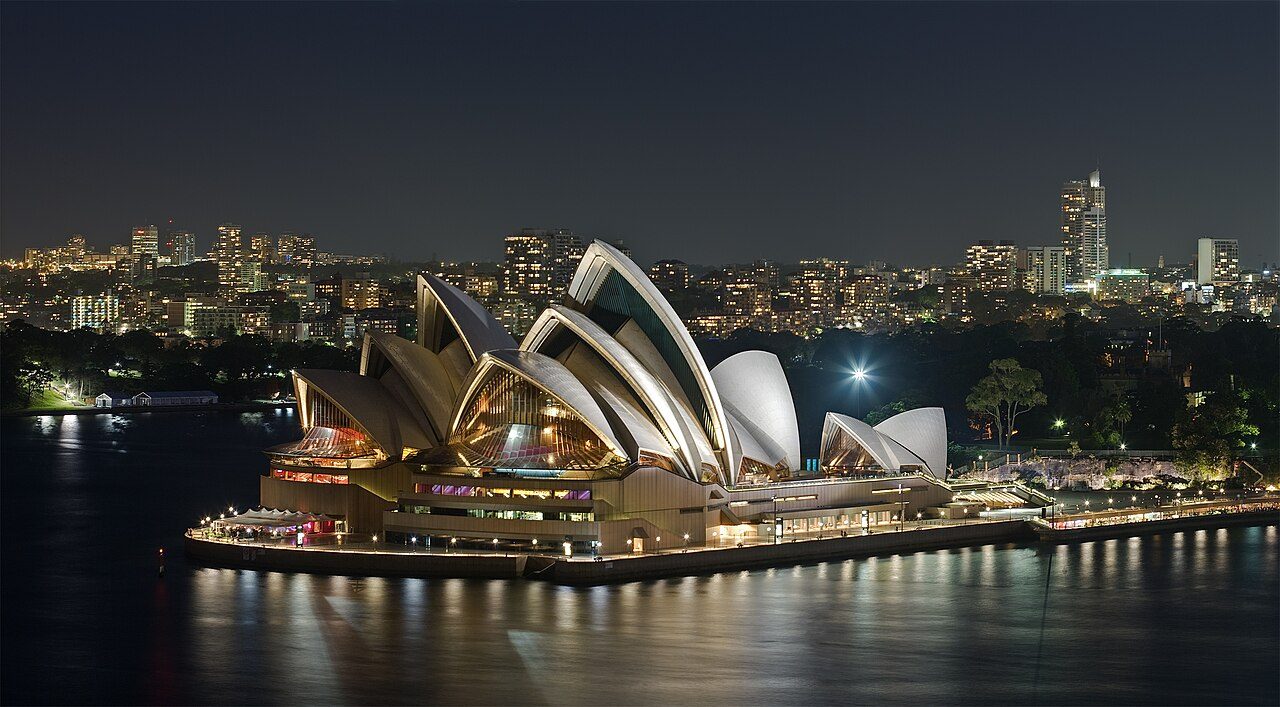
At a Glance
- The competition
- Won in 1957 by the 38-year-old Danish architect Jørn Utzon, from 233 entries; judge Eero Saarinen rescued the design from the rejected pile
- Construction
- Began 2 March 1959 on Bennelong Point, Sydney Harbour; the shell geometry was solved by deriving every shell from the surface of a single sphere
- The rupture
- Utzon resigned in 1966 after clashes with the New South Wales government; an Australian team under Peter Hall completed the interiors
- The cost
- A$102 million against an original estimate of A$7 million — paid off by 1975, largely from a state lottery created to fund the building
- Opened
- 20 October 1973 by Queen Elizabeth II, before a crowd estimated at a million people
- The honours
- Utzon received the Pritzker Prize in 2003; the building was inscribed as a UNESCO World Heritage Site in 2007, in its designer's lifetime
Events on this day
- 1740Maria Theresa succeeds to the Habsburg lands on the death of her father, Charles VI; the War of the Austrian Succession follows.
- 1803The U.S. Senate ratifies the Louisiana Purchase treaty with France, doubling the territory of the United States.
- 1827At Navarino Bay, a British, French and Russian fleet destroys the Ottoman-Egyptian fleet — the decisive stroke for Greek independence.
- 1883Peru and Chile sign the Treaty of Ancón, ending the War of the Pacific; Peru cedes the province of Tarapacá to Chile.
- 1944Soviet and Yugoslav Partisan forces liberate Belgrade from German occupation.
- 1944General Douglas MacArthur lands at Leyte in the Philippines, fulfilling his 'I shall return' pledge.
- 1968Dick Fosbury wins Olympic high-jump gold in Mexico City using his revolutionary backwards technique — the 'Fosbury flop'.
- 1968Jacqueline Kennedy marries the Greek shipping magnate Aristotle Onassis, five years after President Kennedy's assassination.
- 1973The Sydney Opera House is opened by Queen Elizabeth II — the featured story above.
- 1973In the 'Saturday Night Massacre', President Nixon has Watergate prosecutor Archibald Cox fired; his attorney general and deputy resign rather than comply.
- 1977A plane crash in Mississippi kills three members of the rock band Lynyrd Skynyrd, including singer Ronnie Van Zant.
- 1984The Monterey Bay Aquarium opens on California's Cannery Row, in a former sardine cannery.
- 2011Libya's deposed dictator Muammar Gaddafi is captured and killed by rebel fighters near his home town of Sirte.
- 2020NASA's OSIRIS-REx spacecraft touches down on the asteroid Bennu and collects a sample of its surface.
Born on this day
- 1854Arthur Rimbaud — French poet who wrote his visionary work as a teenager and then abandoned literature altogether.
- 1859John Dewey — American philosopher and educational reformer, a founder of pragmatism.
- 1882Bela Lugosi — Hungarian-American actor whose Dracula defined the vampire for the cinema age.
- 1891James Chadwick — English physicist who discovered the neutron and won the Nobel Prize.
- 1931Mickey Mantle — American baseball slugger, the switch-hitting heart of the New York Yankees.
- 1942Christiane Nüsslein-Volhard — German developmental geneticist and Nobel laureate.
- 1950Tom Petty — American rock musician, frontman of the Heartbreakers.
- 1958Viggo Mortensen — Danish-American actor, Aragorn in The Lord of the Rings films.
- 1971Snoop Dogg — American rapper, born Calvin Broadus, a defining voice of West Coast hip-hop.
Died on this day
- 1740Charles VI — Holy Roman emperor, whose death without a son triggers the War of the Austrian Succession.
- 1890Richard Francis Burton — English explorer, linguist and translator of the Arabian Nights.
- 1964Herbert Hoover — 31st president of the United States, the engineer-president blamed for the Great Depression's onset.
- 1994Burt Lancaster — American actor of Elmer Gantry and Birdman of Alcatraz.
- 2014Oscar de la Renta — Dominican fashion designer who dressed first ladies and film stars for half a century.
The featured story: the Sydney Opera House opens, 20 October 1973
In 1956 New South Wales announced an international competition for an opera house on Bennelong Point, a promontory in Sydney Harbour named for a Wangal man of the Eora nation. Two hundred and thirty-three entries arrived. The young Danish architect Jørn Utzon's submission — a sketch, really, of great white shells or sails rising from a platform — had reportedly been set aside by the assessors when the Finnish-American architect Eero Saarinen arrived late, pulled it from the reject pile, and argued it into first place. Announced as winner in January 1957, the design was a masterpiece nobody yet knew how to build: the shells' geometry had no precedent, and construction, begun in March 1959, had to invent its mathematics as it went.
The breakthrough was Utzon's own: in 1961 he realised that every shell could be cut from the surface of one enormous sphere, turning an impossible sculpture into repeatable, mass-producible ribs. But costs climbed relentlessly, relations with the state government collapsed, payments were withheld, and in February 1966 Utzon resigned and left Australia, never to return. A team of Australian architects under Peter Hall completed the building — redesigning the interiors wholesale — while protests demanded, in vain, that Utzon be brought back. The final bill was A$102 million, about fourteen times the original estimate, raised largely by a dedicated state lottery.
On 20 October 1973 the building was formally opened by Queen Elizabeth II, before crowds estimated at a million, with aircraft overhead, Aboriginal actor Ben Blakeney — a descendant of Bennelong himself — delivering a prologue from the top of the tallest shell, and Beethoven's Ninth Symphony in the Concert Hall. The first opera, Prokofiev's War and Peace, had been staged in the Opera Theatre a few weeks earlier. Utzon was invited but declined, not wishing his presence to reopen the controversy; the premier named him in his speech, though the Queen's did not.
Time settled the argument. The Opera House became the defining image of Sydney and of modern Australia — a building so famous that its silhouette serves as a national logo. In 1999 Utzon was reconciled with the project and appointed its design consultant for future changes; in 2003 he received the Pritzker Prize, architecture's highest honour; and in 2007, a year before his death, UNESCO inscribed the building on the World Heritage List — one of the youngest sites ever listed, and a rare honour paid to a work whose architect was still alive to receive it.
Why this date matters
October 20 is a day of completions arrived at the hard way. A harbour opera house opens fourteen years late and ten times over budget and becomes a nation's emblem; a purchase treaty doubles a country at a stroke; a liberated capital, a returned general, a dictator run to ground. Its American entries share the theme of systems reaching their limit: a president fires the man investigating him and loses his two senior law officers in one night. The date suggests that finishing things — buildings, purchases, wars, presidencies — is rarely tidy, and that posterity judges the result, not the mess.
Sources
- Encyclopaedia Britannica — On This Day: October 20
- HISTORY — What Happened on October 20
- HISTORY — Sydney Opera House opens
- Wikimedia — On This Day feed: October 20
The facts on this page were checked against these sources on 19 November 2026. The History Trail's permanent pages are researched and written for this site; the live profiles elsewhere on The History Trail are assembled automatically from Wikipedia and Wikidata.
About the Author
Researched and written by the The History Trail Editorial Team — the accountable editorial function behind this site's permanent story pages. The team works from the published sources cited on each page; it does not invent historians, reviewers or credentials, and it corrects errors openly.
Fact Check
Every load-bearing fact on this page traces to one of the sources listed above, and significant claims link to their source in the text. Our checking method is described on the methodology page; errors can be reported via the corrections page.
Sources & Citations
Cite this page as: The History Trail Editorial Team, The History Trail — this article's title, publication and update dates are shown beneath its headline. The full source list appears under Sources above; the site's source standards are on the sources page.