
On This Day
October 19 in History
On 19 October 1781, at Yorktown in Virginia, the British army of Lord Cornwallis marched out and laid down its arms before the allied American and French forces of George Washington and the Comte de Rochambeau — the surrender that effectively ended the American Revolutionary War and secured the independence of the United States. October 19 is also the day of the Black Monday stock-market crash of 1987, and the day Jonathan Swift died.
Choose another date: open the On This Day calendar to browse events, births and deaths for any day of the year.
At a Glance
- The trap
- Cornwallis fortified Yorktown on the Virginia coast; a French fleet under de Grasse sealed the Chesapeake while Washington and Rochambeau marched south from New York
- The besiegers
- Some 17,000 American and French troops, against about 8,000 British and German defenders
- The siege
- 28 September – 19 October 1781; the storming of two British redoubts on 14 October made the position hopeless
- The surrender
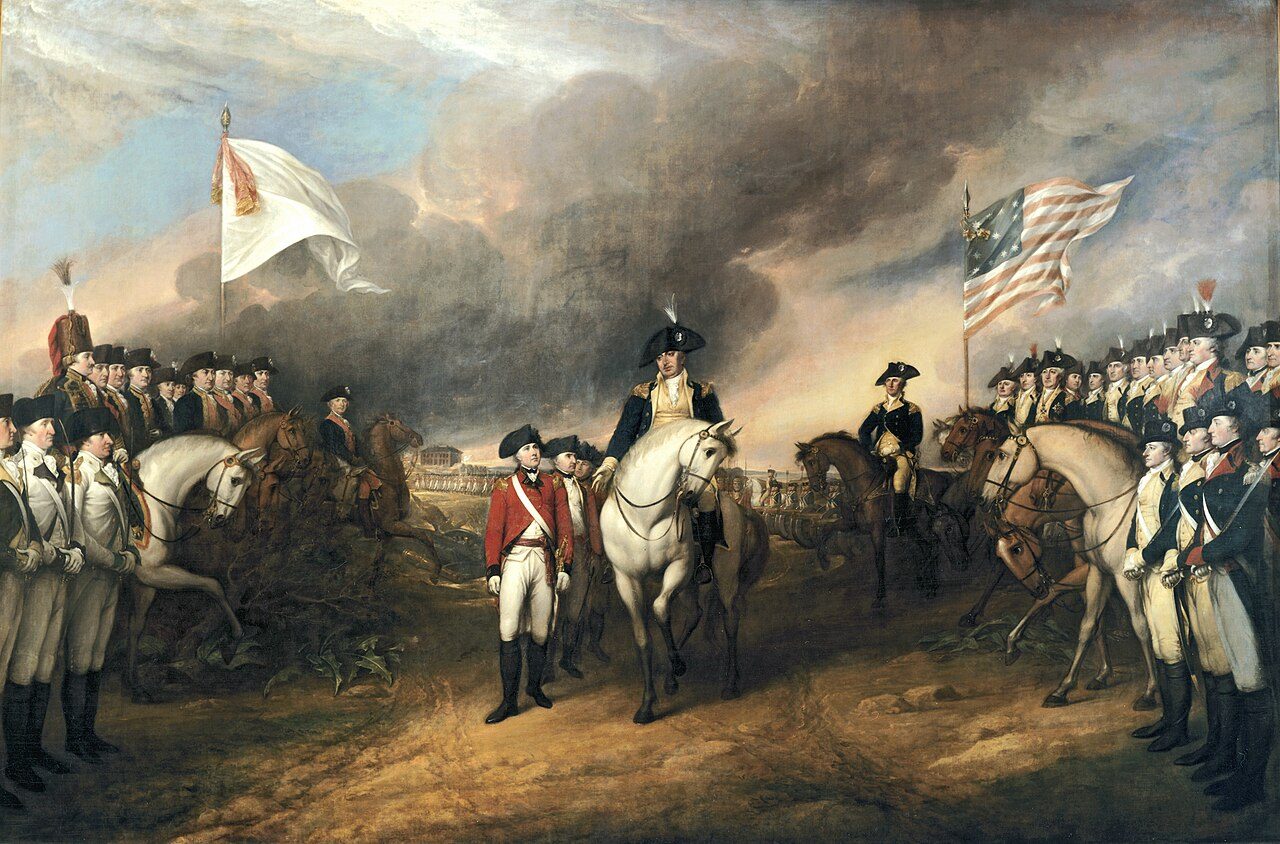
- 19 October 1781 — Cornwallis, pleading illness, stayed away; his deputy Charles O'Hara offered the sword, and Washington directed him to Benjamin Lincoln
- The scale
- More than 7,000 soldiers surrendered — about a third of British forces in North America
- The settlement
- Peace negotiations followed; the Treaty of Paris formally ended the war on 3 September 1783
Events on this day
- 1781Lord Cornwallis surrenders his army at Yorktown to Washington and Rochambeau — the featured story above.
- 1789John Jay takes the oath as the first chief justice of the United States.
- 1812Napoleon begins his retreat from Moscow, abandoning the city his Grande Armée had occupied for five weeks; the retreat becomes a catastrophe.
- 1814The young Franz Schubert composes 'Gretchen am Spinnrade', his first masterpiece of song, from Goethe's Faust.
- 1914The First Battle of Ypres begins in Flanders, opening the last mobile phase of the war in the west before the trenches set hard.
- 1943At Rutgers University, Albert Schatz isolates streptomycin, the first antibiotic effective against tuberculosis.
- 1944American forces land on Leyte in the Philippines, beginning the liberation of the archipelago; MacArthur wades ashore the following day.
- 1952French doctor Alain Bombard sets out alone from the Canary Islands in an inflatable raft, to prove shipwrecked sailors can survive on the sea; he reaches Barbados 65 days later.
- 1987Black Monday: stock markets crash worldwide; the Dow Jones falls 508 points, 22.6 per cent, still its largest one-day percentage drop.
- 2003Mother Teresa is beatified in Rome by Pope John Paul II, six years after her death.
- 2005The trial of Saddam Hussein opens in Baghdad, the deposed Iraqi dictator facing charges over the killing of 148 men and boys at Dujail.
Born on this day
- 1784Leigh Hunt — English poet and essayist, friend and champion of Keats and Shelley.
- 1862Auguste Lumière — French inventor who, with his brother Louis, pioneered motion pictures.
- 1931John le Carré — British intelligence officer turned novelist, the master of the espionage novel.
- 1945John Lithgow — American actor of stage and screen, from The World According to Garp to The Crown.
- 1962Evander Holyfield — American boxer, the only four-time world heavyweight champion.
Died on this day
- 1745Jonathan Swift — Irish satirist, dean of St Patrick's, Dublin, and author of Gulliver's Travels.
- 1813Józef Poniatowski — Polish prince and marshal of France, drowned covering Napoleon's retreat after Leipzig.
- 1937Ernest Rutherford — New Zealand physicist, the father of nuclear physics, who split the atom at Manchester.
- 1983Maurice Bishop — prime minister of Grenada, executed by a rival faction days before the U.S. invasion of the island.
The featured story: Cornwallis surrenders at Yorktown, 19 October 1781
Yorktown was won first at sea. In the summer of 1781 Lord Cornwallis, having marched his army through the Carolinas into Virginia, dug in at Yorktown on a tobacco port of the York River, expecting the Royal Navy to supply and, if needed, rescue him. Instead the French admiral de Grasse sailed from the Caribbean with 28 ships of the line, beat off the British fleet at the Battle of the Chesapeake Capes on 5 September, and closed the sea door. George Washington, who had been threatening New York, seized the moment: with the French army of the Comte de Rochambeau he force-marched some 17,000 men south — a deception and a logistical feat — and by 28 September the allies had Cornwallis surrounded on land as completely as de Grasse did by water.
The siege that followed was methodical, French-engineered and merciless. Allied guns opened on 9 October — Washington himself fired the first American shot, by tradition — and the parallels crept closer night by night. On 14 October, French troops stormed Redoubt 9 while Alexander Hamilton led Americans into Redoubt 10 with unloaded muskets and bayonets, in silence. A desperate British sortie failed; a storm wrecked Cornwallis's attempt to ferry his army across the river to Gloucester; his supplies of food and ammunition were spent. On 17 October — the fourth anniversary, to the day, of Saratoga — a drummer appeared on the British parapet beating a parley.
The Articles of Capitulation were negotiated at the Moore House and signed on 19 October. That afternoon the British garrison marched out between lines of French troops in white and Americans in homespun, colours cased, and grounded its arms — more than 7,000 men, a third of Britain's forces in North America. Cornwallis pleaded illness and did not attend. His deputy, Brigadier Charles O'Hara, tried first to surrender his sword to Rochambeau, who pointed him to Washington; Washington in turn directed him to his own deputy, Benjamin Lincoln — the American general who had been forced to surrender Charleston the year before, and who now accepted the sword of Yorktown.
Fighting sputtered on elsewhere, but everyone understood: the war was decided. In London the news brought down Lord North's government — 'Oh God, it is all over,' he is said to have repeated — and peace negotiations opened in Paris. The Treaty of Paris, signed on 3 September 1783, recognised the independence of the United States. The National Park Service, which preserves the battlefield, calls the surrender the climax of the last major operation of the war: the day the Revolution stopped being a rebellion and became a fact.
Why this date matters
October 19 is the day sieges end. At Yorktown a surrounded army marches out and a new nation becomes real; at Moscow, on the same date in 1812, the greatest army in Europe begins the retreat that destroys it; in 1987 the siege is financial, and the market's walls fall in a single session. Even the quieter entries share the pattern of long pressure suddenly released — an antibiotic isolated after years of searching, a doctor deliberately casting himself adrift to prove survival possible. It is a date for the moment when endurance, one way or the other, runs out.
Sources
- Encyclopaedia Britannica — On This Day: October 19
- Library of Congress — Today in History: October 19
- National Park Service — Chronology of the Siege of Yorktown
- Federal Reserve History — Stock Market Crash of 1987
- Wikimedia — On This Day feed: October 19
The facts on this page were checked against these sources on 19 November 2026. The History Trail's permanent pages are researched and written for this site; the live profiles elsewhere on The History Trail are assembled automatically from Wikipedia and Wikidata.
About the Author
Researched and written by the The History Trail Editorial Team — the accountable editorial function behind this site's permanent story pages. The team works from the published sources cited on each page; it does not invent historians, reviewers or credentials, and it corrects errors openly.
Fact Check
Every load-bearing fact on this page traces to one of the sources listed above, and significant claims link to their source in the text. Our checking method is described on the methodology page; errors can be reported via the corrections page.
Sources & Citations
Cite this page as: The History Trail Editorial Team, The History Trail — this article's title, publication and update dates are shown beneath its headline. The full source list appears under Sources above; the site's source standards are on the sources page.