
On This Day
November 5 in History
In the early hours of 5 November 1605, searchers found Guy Fawkes in the cellar beneath the House of Lords, guarding 36 barrels of gunpowder meant to kill King James I and his Parliament at that day's State Opening. The Gunpowder Plot's failure is still marked with bonfires across Britain. November 5 is also the day Susan B. Anthony cast her illegal vote, Akbar's throne was secured at Panipat, and India launched its first Mars mission.
Choose another date: open the On This Day calendar to browse events, births and deaths for any day of the year.
At a Glance
- The leader
- Robert Catesby, a Catholic gentleman radicalised by persecution — not Guy Fawkes, who was recruited for his explosives experience
- The store
- 36 barrels of gunpowder hidden under firewood and iron in an undercroft rented beneath the House of Lords
- The warning
- An anonymous letter to Lord Monteagle, 26 October 1605, hints at 'a terrible blow' and triggers the searches
- The arrest
- Shortly after midnight, 4–5 November: Fawkes found with lantern, matches and touchwood beside the barrels
- The end
- Eight surviving plotters tried on 27 January 1606 and executed; Fawkes dies last, on 31 January
- The remembrance
- An Act orders annual thanksgiving on 5 November — today's Bonfire Night; Parliament's cellars are still ceremonially searched
Events on this day
- 1556At the Second Battle of Panipat, the Mughal army defeats Hemu's forces, securing the throne of the young emperor Akbar in India.
- 1605Guy Fawkes is arrested in the cellar beneath the House of Lords with 36 barrels of gunpowder — the featured story above.
- 1838The Federal Republic of Central America begins to break apart as Honduras withdraws from the federation.
- 1872Susan B. Anthony votes in the U.S. presidential election in Rochester, New York, and is arrested a fortnight later for voting illegally.
- 1912Woodrow Wilson is elected president of the United States, defeating Taft and Theodore Roosevelt in a three-way race.
- 1914Britain and France formally declare war on the Ottoman Empire, widening the First World War into the Middle East.
- 1940Franklin D. Roosevelt wins an unprecedented third term as president of the United States.
- 1968Richard Nixon narrowly defeats Hubert Humphrey to win the presidency amid the Vietnam War and a year of assassinations.
- 1994George Foreman, aged 45, knocks out Michael Moorer to become the oldest heavyweight boxing champion in history.
- 2007Hollywood's film and television writers go on strike, shutting down productions across the industry for 100 days.
- 2009An Army major kills 13 people and wounds more than 30 at Fort Hood, Texas, in the deadliest shooting on a U.S. military base.
- 2013India launches its Mars Orbiter Mission, Mangalyaan, which reaches Mars orbit on its first attempt the following year.
Born on this day
- 1494Hans Sachs — Nuremberg shoemaker and Meistersinger, the most famous German poet of the Reformation century.
- 1855Eugene V. Debs — American labour leader and five-time Socialist candidate for president.
- 1911Roy Rogers — American singer and actor, the 'King of the Cowboys' of film and television.
- 1913Vivien Leigh — British actor who won Academy Awards for Gone with the Wind and A Streetcar Named Desire.
- 1943Sam Shepard — American playwright and actor, chronicler of the American West's broken families.
- 1959Bryan Adams — Canadian rock singer-songwriter and photographer.
Died on this day
- 1807Angelica Kauffman — Swiss painter, a founding member of London's Royal Academy of Arts.
- 1879James Clerk Maxwell — Scottish physicist whose equations unified electricity, magnetism and light.
- 1989Vladimir Horowitz — Ukrainian-born pianist, among the most celebrated keyboard virtuosos of the 20th century.
- 2005John Fowles — English novelist of The Magus and The French Lieutenant's Woman.
The featured story: the Gunpowder Plot, 5 November 1605
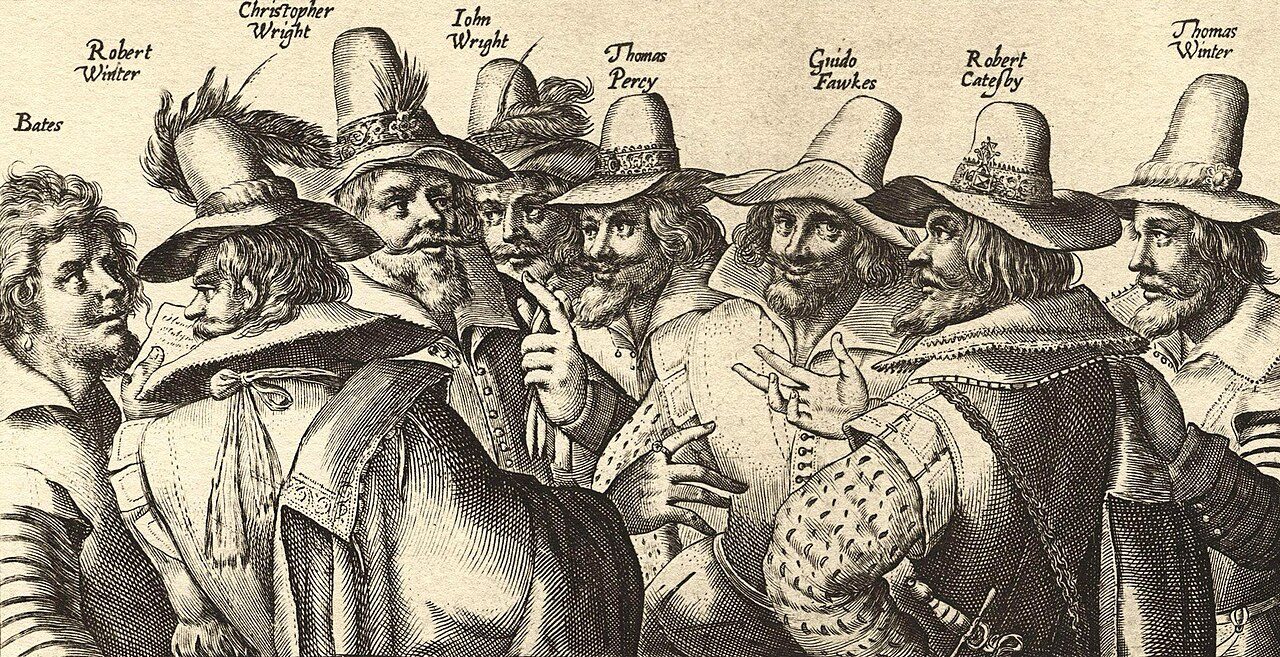
The plot to blow up Parliament was born of persecution. England's Roman Catholics, fined for refusing Anglican worship and barred from public life, had hoped the new king, James I, would soften the laws; instead the penalties tightened. In May 1604 a Warwickshire gentleman, Robert Catesby, put a desperate plan to four companions — among them Thomas Percy and a Yorkshire soldier of fortune named Guy Fawkes, who had spent a decade fighting for Catholic Spain in the Netherlands and knew gunpowder. They would kill the king, his heir and the assembled Protestant ruling class in a single explosion at the State Opening of Parliament, and raise a Catholic rising in the Midlands.
The plotters first tried to tunnel toward the House of Lords from a neighbouring house; then, in 1605, fortune handed them something better — a cellar, an undercroft directly beneath the Lords' chamber, came up for rent. Fawkes, posing as Percy's servant under the name John Johnson, moved in as caretaker. Barrel by barrel, hidden under firewood and iron bars, 36 barrels of gunpowder were stored there — enough, modern estimates suggest, to reduce the whole Palace of Westminster to rubble. Plague kept postponing Parliament's opening; at last it was fixed for 5 November 1605.
What undid them was a warning. On 26 October an anonymous letter reached Lord Monteagle, a Catholic peer, telling him to absent himself from Parliament because it would receive 'a terrible blow'. Monteagle took the letter to the king's ministers; James himself is said to have grasped its meaning. The cellars were searched once on 4 November and Fawkes was seen and questioned; a second search, shortly after midnight, found him in the dark in cloak, hat, boots and spurs, with a lantern, slow matches and touchwood in his pockets — and the barrels behind the fuel. He gave his name as John Johnson and, even brought before the king, said his purpose had been 'to blow you Scotch beggars back to your native mountains'.
Under torture in the Tower, Fawkes broke and named the others. Catesby and Percy were shot dead resisting arrest on 8 November; the surviving plotters were tried in Westminster Hall on 27 January 1606 and hanged, drawn and quartered over the following days, Fawkes last, on 31 January. Parliament ordered an annual public thanksgiving for the deliverance every 5 November — the origin of Bonfire Night, when Britain still burns Fawkes in effigy — and the cellars of Parliament are ceremonially searched by the Yeomen of the Guard before every State Opening to this day.
Why this date matters
November 5 is the one date in the British calendar kept by fire. Its featured event failed completely — the king lived, the plotters died, Catholic emancipation was set back for two centuries — yet the failure is what England chose to remember, with bonfires, fireworks and a rhyme schoolchildren still chant. The day's other entries share the theme of entrenched orders challenged at the ballot box and beyond: Susan B. Anthony's illegal vote, three American presidential elections, and India quietly launching itself toward Mars. Remember, remember is the day's own instruction.
Sources
- Encyclopaedia Britannica — On This Day: November 5
- HISTORY — What Happened on November 5
- Royal Museums Greenwich — Gunpowder Plot: what is the history behind Bonfire Night?
- Wikimedia — On This Day feed: November 5
The facts on this page were checked against these sources on 19 November 2026. The History Trail's permanent pages are researched and written for this site; the live profiles elsewhere on The History Trail are assembled automatically from Wikipedia and Wikidata.
About the Author
Researched and written by the The History Trail Editorial Team — the accountable editorial function behind this site's permanent story pages. The team works from the published sources cited on each page; it does not invent historians, reviewers or credentials, and it corrects errors openly.
Fact Check
Every load-bearing fact on this page traces to one of the sources listed above, and significant claims link to their source in the text. Our checking method is described on the methodology page; errors can be reported via the corrections page.
Sources & Citations
Cite this page as: The History Trail Editorial Team, The History Trail — this article's title, publication and update dates are shown beneath its headline. The full source list appears under Sources above; the site's source standards are on the sources page.