
On This Day
May 18 in History
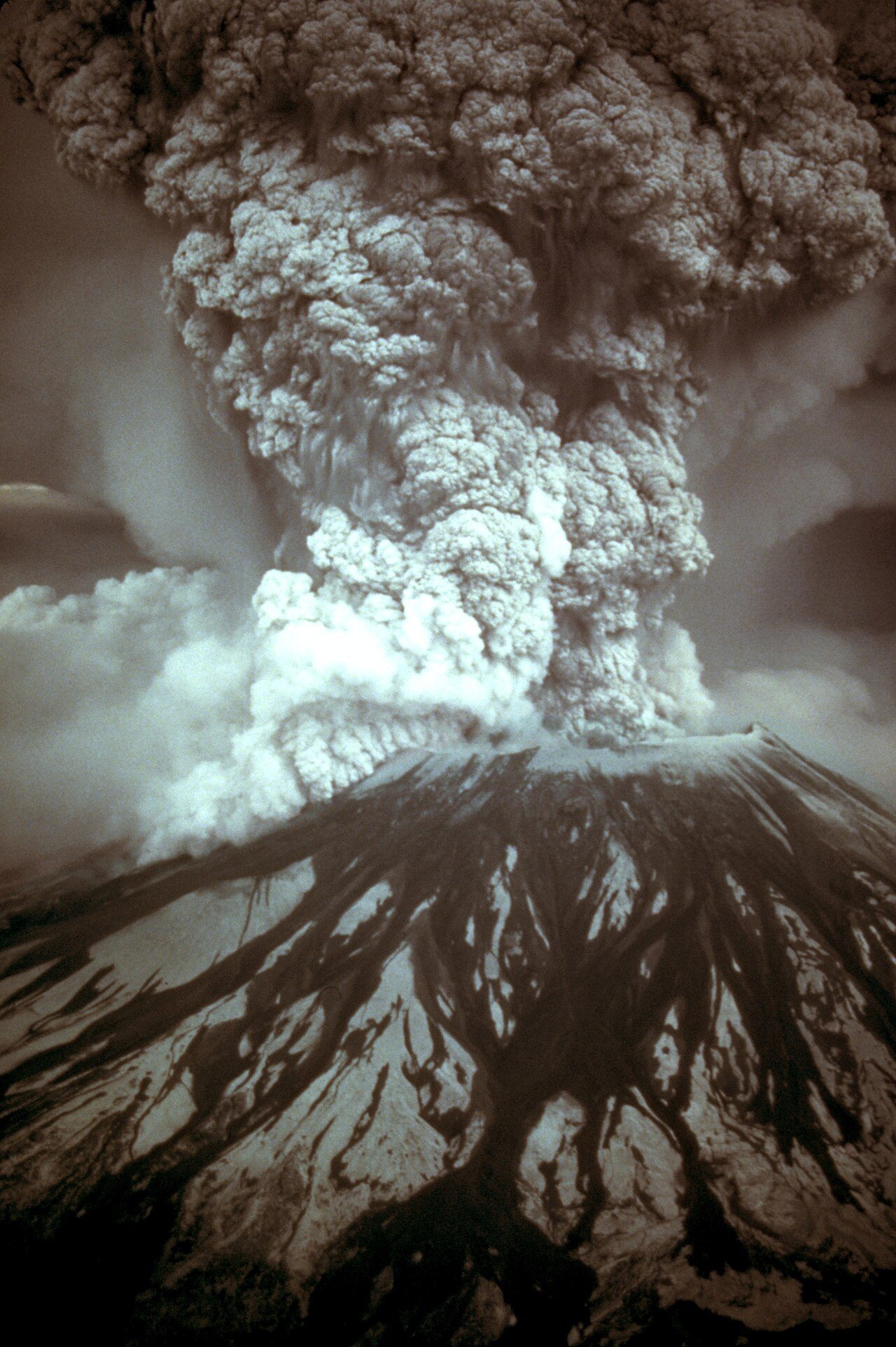
At 8:32 a.m. on 18 May 1980, a magnitude 5.1 earthquake shook Mount St. Helens in Washington state and the mountain's north face slid away, unleashing the deadliest volcanic eruption in American history: fifty-seven people died and 230 square miles of forest were flattened. May 18 is also the day of the Plessy v. Ferguson decision in 1896, the launch of Apollo 10, and the birth of Pope John Paul II.
Choose another date: open the On This Day calendar to browse events, births and deaths for any day of the year.
At a Glance
- The trigger
- 8:32 a.m. PDT, 18 May 1980 — a magnitude 5.1 earthquake collapses the bulging north flank
- The landslide
- Some 2.8 cubic kilometres of rock — the largest landslide in recorded history
- The blast
- A lateral explosion flattens 230 square miles of forest; the ash column reaches 80,000 feet
- The toll
- 57 people killed, including volcanologist David Johnston and lodge keeper Harry Truman
- The mountain
- The summit falls from 9,677 to 8,363 feet; a crater two miles wide is left behind
- The legacy
- Modern volcano monitoring is transformed; the national volcanic monument is created in 1982
Events on this day
- 1652Rhode Island passes the first law in the American colonies limiting slavery, restricting bondage to ten years — though it is soon ignored in practice.
- 1804The French Senate proclaims Napoleon Bonaparte Emperor of the French; he crowns himself Napoleon I that December.
- 1860Abraham Lincoln wins the Republican presidential nomination in Chicago, on the third ballot, over William H. Seward.
- 1896The U.S. Supreme Court decides Plessy v. Ferguson, upholding 'separate but equal' racial segregation — the doctrine Brown will destroy fifty-eight years later, almost to the day.
- 1927A school board treasurer in Bath Township, Michigan, murders his wife and blows up the village school, killing forty-four people, most of them children — America's deadliest school massacre.
- 1953Jacqueline Cochran becomes the first woman to break the sound barrier, flying a Canadian F-86 Sabre over California.
- 1969Apollo 10 launches, the full dress rehearsal for the Moon landing, whose lunar module will descend to within nine miles of the surface.
- 1974India detonates its first nuclear device at Pokhran in the Rajasthan desert, in the test codenamed 'Smiling Buddha'.
- 1980Mount St. Helens erupts in Washington state, killing fifty-seven people — the featured story above.
Born on this day
- 1868Nicholas II — the last tsar of Russia, executed with his family in 1918.
- 1872Bertrand Russell — British philosopher, mathematician and Nobel laureate in literature.
- 1909Fred Perry — English tennis champion, the last Briton to win Wimbledon before Andy Murray, seventy-seven years later.
- 1920Karol Wojtyła — Polish priest who became Pope John Paul II, the first non-Italian pope in 455 years.
- 1970Tina Fey — American comedian, writer and creator of 30 Rock.
Died on this day
- 526John I — pope who died in the prison of the Ostrogothic king Theodoric at Ravenna, and was later canonised.
- 1911Gustav Mahler — Austrian composer and conductor, dead in Vienna at 50, his Tenth Symphony unfinished.
- 1981William Saroyan — American novelist and playwright of The Human Comedy, dead at 72.
- 1988Daws Butler — American voice actor, the voice of Yogi Bear and Huckleberry Hound.
- 1995Elizabeth Montgomery — American actress, star of Bewitched, dead at 62.
The featured story: Mount St. Helens erupts, 18 May 1980
At 8:32 on the morning of Sunday 18 May 1980, an earthquake of magnitude 5.1 shook Mount St. Helens in southwestern Washington, and the entire north face of the mountain — some 2.8 cubic kilometres of rock, the largest landslide ever recorded — simply slid away. The collapse uncorked the volcano. A lateral blast of superheated gas and shattered rock raced north at more than 300 miles an hour, flattening 230 square miles of forest in minutes, and a column of ash climbed to 80,000 feet. By nightfall the mountain was 1,300 feet shorter, fifty-seven people were dead, and ash was falling on cities hundreds of miles away.
The eruption had announced itself for two months. Earthquakes began under the mountain on 20 March 1980, after 123 quiet years; a week later steam explosions opened a new crater, and a bulge on the north flank began growing at up to five feet a day as magma pushed up inside. The U.S. Geological Survey monitored the mountain around the clock, and a volcanologist named David Johnston, manning an observation post on a ridge six miles away, had warned that St. Helens was a powder keg. His post, Coldwater II, sat squarely in the path the blast would take. Johnston's last radio message that morning — 'Vancouver! Vancouver! This is it!' — was the first report of the eruption.
Among the dead were Johnston, photographers who had camped to watch the mountain, loggers, campers, and Harry Truman, the 84-year-old lodge keeper at Spirit Lake who had refused all orders to leave his home of fifty years and become a folk hero for it; the lake itself was buried under hundreds of feet of debris and displaced bodily uphill. Mudflows of melted snow and ash choked the Toutle and Cowlitz rivers, destroyed bridges, highways and hundreds of homes, and carried wreckage to the Columbia River, closing its shipping channel. Ash closed airports and highways across the Northwest and eventually circled the globe.
St. Helens changed the science that studied it. It was the first eruption in the continental United States to be monitored with modern instruments from unrest to climax, and its lateral blast rewrote assumptions about how volcanoes kill — sideways, not upward. The disaster drove investment in volcano monitoring worldwide and created, in 1982, the Mount St. Helens National Volcanic Monument. The blasted landscape then became a laboratory of return: plants, elk and whole ecosystems recolonised the ash within years, faster than ecologists predicted. The mountain rumbled again in 2004, and scientists, this time, were ready — the clearest measure of what 18 May 1980 had taught.
Why this date matters
May 18 is a day when the ground gives way — literally, in 1980, and legally on the same date in 1896, when the Supreme Court handed down Plessy and American equality slid for two generations. The pairing is almost too neat: Plessy decided on 18 May, Brown on 17 May fifty-eight years later, the landslide and its repair on consecutive pages of the calendar. The day also shows the instruments of recovery being built: Apollo 10 rehearsing a landing on it, India testing a bomb on it, a pope born on it who would help end an empire without one. May 18 measures how fast things fall, and how slowly they are put back.
Sources
- Encyclopaedia Britannica — On This Day: May 18
- HISTORY — What Happened on May 18
- U.S. Geological Survey — Mount St. Helens
- HISTORY — Supreme Court rules 'separate but equal' constitutional in Plessy v. Ferguson
The facts on this page were checked against these sources on 19 November 2026. The History Trail's permanent pages are researched and written for this site; the live profiles elsewhere on The History Trail are assembled automatically from Wikipedia and Wikidata.
About the Author
Researched and written by the The History Trail Editorial Team — the accountable editorial function behind this site's permanent story pages. The team works from the published sources cited on each page; it does not invent historians, reviewers or credentials, and it corrects errors openly.
Fact Check
Every load-bearing fact on this page traces to one of the sources listed above, and significant claims link to their source in the text. Our checking method is described on the methodology page; errors can be reported via the corrections page.
Sources & Citations
Cite this page as: The History Trail Editorial Team, The History Trail — this article's title, publication and update dates are shown beneath its headline. The full source list appears under Sources above; the site's source standards are on the sources page.