
On This Day
March 6 in History
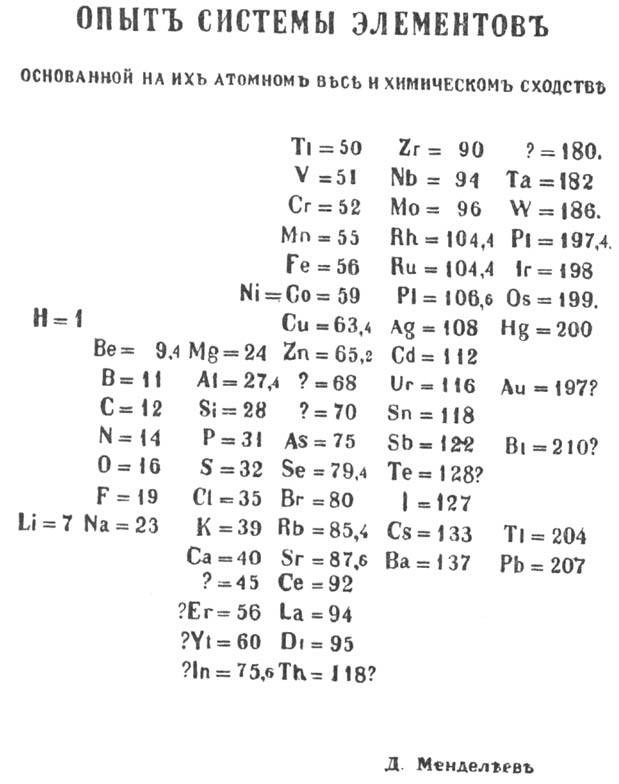
On 6 March 1869 the Russian chemist Dmitri Mendeleev's first periodic table — an arrangement of the known elements by atomic weight that left gaps for elements nobody had yet found — was presented to the Russian Chemical Society in St. Petersburg. It became the organising chart of all chemistry. March 6 is also the day the Alamo fell, the Dred Scott decision was handed down, and Bayer trademarked aspirin.
Choose another date: open the On This Day calendar to browse events, births and deaths for any day of the year.
At a Glance
- The problem
- Some 60 elements were known by 1869, with no agreed system relating their properties
- The paper
- 'The Dependence Between the Properties of the Atomic Weights of the Elements', presented to the Russian Chemical Society on 6 March 1869
- The method
- Elements arranged by atomic weight and grouped by chemical behaviour, producing repeating — periodic — patterns
- The gamble
- Mendeleev left empty spaces for undiscovered elements and predicted their properties in detail
- The proof
- Gallium (1875), scandium (1879) and germanium (1886) were found matching his predictions closely
Events on this day
- 1820President James Monroe signs the Missouri Compromise into law, admitting Missouri as a slave state and Maine as a free one.
- 1836After a 13-day siege, Mexican forces storm the Alamo in San Antonio, killing its Texan defenders, including Davy Crockett and Jim Bowie.
- 1857The U.S. Supreme Court hands down the Dred Scott decision, ruling that African Americans cannot be citizens and Congress cannot ban slavery in the territories.
- 1869Mendeleev's periodic table is presented to the Russian Chemical Society — the featured story above.
- 1899The German company Bayer registers the trademark 'Aspirin' for its acetylsalicylic acid painkiller.
- 1902The Madrid Football Club — later Real Madrid — is founded.
- 1945Dutch resistance fighters ambush the car of SS commander Hanns Albin Rauter near Apeldoorn, triggering savage German reprisals.
- 1951The trial of Julius and Ethel Rosenberg, accused of passing atomic secrets to the Soviet Union, opens in New York.
- 1957Ghana becomes independent of Britain, the first sub-Saharan African colony to win freedom after the Second World War.
- 1981Walter Cronkite signs off the CBS Evening News for the last time, ending an 18-year run as American television's most trusted voice.
- 1987The ferry Herald of Free Enterprise capsizes minutes after leaving Zeebrugge, in one of Europe's worst peacetime ferry disasters.
- 2001Napster begins blocking copyrighted songs on its file-sharing service, complying with a court order that will soon end the original service.
Born on this day
- 1475Michelangelo — Italian sculptor, painter and architect of the Sistine Chapel ceiling and the David.
- 1619Cyrano de Bergerac — French soldier, duellist and writer, later immortalised as Rostand's big-nosed hero.
- 1806Elizabeth Barrett Browning — English poet whose Sonnets from the Portuguese became among the most loved love poems in the language.
- 1885Ring Lardner — American sports writer and satirist of You Know Me Al.
- 1927Gabriel García Márquez — Colombian novelist of One Hundred Years of Solitude and winner of the Nobel Prize in Literature.
- 1937Valentina Tereshkova — Soviet cosmonaut who in 1963 became the first woman in space.
Died on this day
- 1888Louisa May Alcott — American author of Little Women, dead at 55.
- 1973Pearl S. Buck — American novelist of The Good Earth and Nobel laureate, who spent most of her life in China.
- 1982Ayn Rand — Russian-born American novelist of The Fountainhead and Atlas Shrugged, philosopher of Objectivism.
- 1986Georgia O'Keeffe — American painter of vast flowers and New Mexico deserts, dead at 98.
- 2016Nancy Reagan — American actress and First Lady, founder of the 'Just Say No' anti-drug campaign.
The featured story: Mendeleev presents the periodic table, 6 March 1869
Dmitri Mendeleev was writing a textbook, and he had a filing problem. The Principles of Chemistry needed a way to present the sixty-odd known elements that made sense of them as a family rather than a heap. Working — by the famous account — with the elements written on cards that he shuffled like a game of patience, he arranged them by atomic weight and noticed that their chemical behaviour repeated at intervals: elements in each column resembled one another. On 6 March 1869 his paper, 'The Dependence Between the Properties of the Atomic Weights of the Elements', was presented to the Russian Chemical Society in St. Petersburg. Mendeleev was not there himself — the paper was read for him by a colleague, Nikolai Menshutkin.
What separated Mendeleev's table from the several similar schemes other chemists were proposing was nerve. Where his arrangement required an element that did not exist, he left a hole and said so, predicting the missing element's weight, density and chemistry in detail — eka-aluminium, eka-silicon and others, named with the Sanskrit word for 'one beyond'. Where the measured atomic weight of a known element broke his pattern, he said the measurement was wrong, and corrected uranium and others. It was, in effect, a theory with hostages: if the missing elements failed to appear with roughly the properties he promised, the table was a parlour trick.
They appeared. In 1875 the French chemist Lecoq de Boisbaudran found gallium — Mendeleev's eka-aluminium — and when his first measurement of its density disagreed with the prediction, Mendeleev wrote from St. Petersburg to say the sample must be impure; remeasured, it matched. Scandium followed in 1879, matching eka-boron, and germanium in 1886 matched eka-silicon almost property for property. The periodic table stopped being one chemist's filing system and became chemistry's map — a map that later generations would explain with atomic number and electron shells, and extend with elements Mendeleev never dreamed of, without breaking its shape.
The chart on every laboratory wall descends from the paper of 6 March 1869. Mendeleev himself never won the Nobel Prize — he missed it by a single vote in committee, a famous near-thing — but element 101, mendelevium, carries his name into the table he built. Few scientific documents have been so completely vindicated: he predicted things he could not see, in numbers, and the world turned out to contain them.
Why this date matters
March 6 is the calendar's day for systems and the price of them. Mendeleev imposed a system on matter itself in 1869 and was proved right by elements not yet found; the Supreme Court imposed its system on a nation in Dred Scott in 1857 and helped bring on civil war; Monroe's Missouri Compromise of 1820 was a system for postponing that war, signed into law on this date. Ghana escaped an imperial system on it in 1957, and the Alamo's defenders were destroyed by one in 1836. Order, on March 6, is never free and never neutral.
Sources
- Encyclopaedia Britannica — On This Day: March 6
- HISTORY — What Happened on March 6
- Royal Society of Chemistry — Finding the periodic table
- Wikipedia — March 6
The facts on this page were checked against these sources on 19 November 2026. The History Trail's permanent pages are researched and written for this site; the live profiles elsewhere on The History Trail are assembled automatically from Wikipedia and Wikidata.
About the Author
Researched and written by the The History Trail Editorial Team — the accountable editorial function behind this site's permanent story pages. The team works from the published sources cited on each page; it does not invent historians, reviewers or credentials, and it corrects errors openly.
Fact Check
Every load-bearing fact on this page traces to one of the sources listed above, and significant claims link to their source in the text. Our checking method is described on the methodology page; errors can be reported via the corrections page.
Sources & Citations
Cite this page as: The History Trail Editorial Team, The History Trail — this article's title, publication and update dates are shown beneath its headline. The full source list appears under Sources above; the site's source standards are on the sources page.