
On This Day
March 3 in History
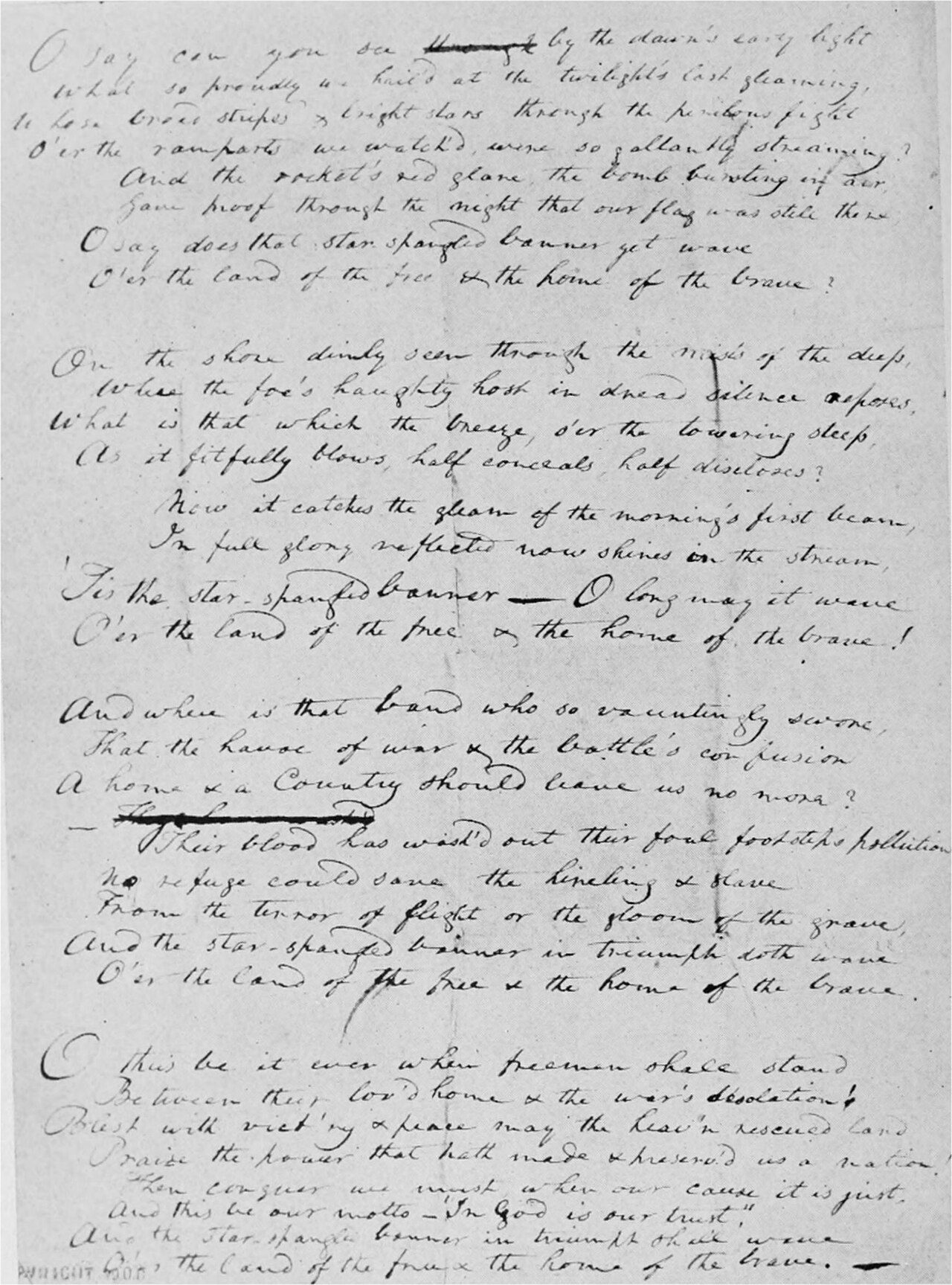
On 3 March 1931 President Herbert Hoover signed the act of Congress that made 'The Star-Spangled Banner' the official national anthem of the United States — 117 years after Francis Scott Key wrote its words watching the bombardment of Fort McHenry. March 3 is also the day Russia freed its serfs, Congress created the Freedmen's Bureau, and John Dillinger walked out of an 'escape-proof' jail.
Choose another date: open the On This Day calendar to browse events, births and deaths for any day of the year.
At a Glance
- The words
- Written by Francis Scott Key on 14 September 1814, after watching Fort McHenry survive a night of British bombardment in the War of 1812
- The tune
- 'To Anacreon in Heaven', by the English composer John Stafford Smith — the song of a London gentlemen's club
- The flag
- The 15-star, 15-stripe banner that inspired Key, sewn by Mary Young Pickersgill, is now the Smithsonian's greatest treasure
- The long wait
- The song was used by the Navy from 1889 and ordered for military occasions by President Wilson in 1916, but had no legal status
- The act
- A congressional resolution adopted and signed by President Hoover on 3 March 1931 made it the national anthem in law
Events on this day
- 1820Congress passes the Missouri Compromise, admitting Missouri as a slave state and Maine as a free state and drawing a line for slavery in the territories.
- 1845Congress overrides President John Tyler's veto, the first veto override in American history, on his last full day in office.
- 1861Tsar Alexander II issues the emancipation manifesto freeing Russia's serfs — some 23 million people.
- 1863Congress passes the Civil War conscription act, creating the first wartime draft of American citizens.
- 1865President Lincoln signs the bill creating the Freedmen's Bureau to aid formerly enslaved people in the South.
- 1875The first organised indoor ice hockey game is played at the Victoria Skating Rink in Montreal — and ends in a brawl.
- 1879Congress creates the United States Geological Survey, which will map and study the American West.
- 1915D. W. Griffith's The Birth of a Nation opens in New York, a technical landmark and a racist epic that helps revive the Ku Klux Klan.
- 1918Russia signs the Treaty of Brest-Litovsk with the Central Powers, ending its part in the First World War at a huge cost in territory.
- 1931'The Star-Spangled Banner' becomes the official national anthem of the United States — the featured story above.
- 1934Bank robber John Dillinger escapes from the 'escape-proof' jail at Crown Point, Indiana, reportedly with a wooden gun blackened with shoe polish.
- 1991Los Angeles police officers are filmed beating motorist Rodney King after a car chase; their later acquittal sparks the 1992 Los Angeles riots.
- 2005Steve Fossett lands in Kansas to complete the first solo nonstop flight around the world without refuelling.
Born on this day
- 1847Alexander Graham Bell — Scottish-born inventor of the telephone, patented three days after his 29th birthday.
- 1911Jean Harlow — American film star, the original 'Blonde Bombshell' of 1930s Hollywood.
- 1920James Doohan — Canadian actor who played chief engineer Scotty in Star Trek, and a decorated D-Day veteran.
- 1945George Miller — Australian director of the Mad Max films and Happy Feet.
- 1962Jackie Joyner-Kersee — American heptathlete, the first to score more than 7,000 points in the event and a double Olympic champion.
Died on this day
- 1703Robert Hooke — English scientist of universal curiosity, author of Micrographia and formulator of Hooke's law of elasticity.
- 1959Lou Costello — American comedian, dead at 52, three years after the end of Abbott and Costello.
- 1987Danny Kaye — American actor, singer and comedian of The Secret Life of Walter Mitty and White Christmas.
- 1996Marguerite Duras — French writer and filmmaker, author of The Lover and the screenplay of Hiroshima mon amour.
The featured story: 'The Star-Spangled Banner' becomes the national anthem, 3 March 1931
The song was born in a single night of war. On 13–14 September 1814, during the War of 1812, a Maryland lawyer named Francis Scott Key was detained aboard a British vessel in Baltimore Harbor while negotiating a prisoner's release, and from the deck he watched the Royal Navy bombard Fort McHenry through the night. At dawn the fort's enormous garrison flag — 30 by 42 feet, sewn by the Baltimore flagmaker Mary Young Pickersgill — was still flying. Key began a poem on the back of a letter: 'O say can you see, by the dawn's early light…' Within weeks it was in print, set to a tune Americans already knew, 'To Anacreon in Heaven', composed decades earlier by John Stafford Smith for a London club of amateur musicians.
For more than a century the song lived without any official standing. It was sung at patriotic occasions, played at the raising of flags, and gradually pushed aside its rivals — 'Hail, Columbia', 'My Country, 'Tis of Thee', 'America the Beautiful' — in popular affection, if not in law. The Navy adopted it for ceremonies in 1889; President Woodrow Wilson ordered it used on military occasions in 1916. But the United States, well into the twentieth century, had no national anthem in law, a gap that veterans' organisations and Maryland's congressmen campaigned for years to close. Petitions bearing millions of signatures reached Congress, and in 1930 the House and Senate passed the resolution the campaigners wanted.
On 3 March 1931 President Herbert Hoover signed it. The act is a single sentence: the composition known as 'The Star-Spangled Banner' 'is designated as and established for' the national anthem of the United States of America. The song's defenders had won despite lively objections — that its range of an octave and a fifth was too hard for ordinary voices to sing, that its lyrics celebrated war, that its tune was English and had begun life in praise of drink. All three objections were true, and none of them mattered against the weight of 117 years of use.
The flag that inspired the song outlasted the argument. Pickersgill's banner, kept by the family of the fort's commander, came to the Smithsonian in 1907 and is now the centrepiece of the National Museum of American History, conserved stitch by stitch. The anthem itself remains slightly unfinished business: Key wrote four verses, of which the first alone is sung, and the third — with its reference to 'the hireling and slave' — is left in a obscurity that modern scholarship continues to argue over. But since 3 March 1931 its position has never again been in doubt.
Why this date matters
March 3 is a day of emancipation in two empires at once: on it in 1861 Alexander II freed Russia's 23 million serfs, and on it in 1865 the United States created the Freedmen's Bureau for its own newly freed people — while its 1863 draft act and 1820 Missouri Compromise show the same republic still arming and compromising over the freedom it had not yet delivered. The date also loves a symbol made official: a song became an anthem on it in 1931, and a science agency, the Geological Survey, was founded on it in 1879. Its jailbreaks and beatings — Dillinger in 1934, Rodney King in 1991 — are the counterpoint: the state escaping its own rules.
Sources
- Encyclopaedia Britannica — On This Day: March 3
- HISTORY — What Happened on March 3
- Smithsonian Institution — The Star-Spangled Banner (National Museum of American History)
- Wikipedia — The Star-Spangled Banner
The facts on this page were checked against these sources on 19 November 2026. The History Trail's permanent pages are researched and written for this site; the live profiles elsewhere on The History Trail are assembled automatically from Wikipedia and Wikidata.
About the Author
Researched and written by the The History Trail Editorial Team — the accountable editorial function behind this site's permanent story pages. The team works from the published sources cited on each page; it does not invent historians, reviewers or credentials, and it corrects errors openly.
Fact Check
Every load-bearing fact on this page traces to one of the sources listed above, and significant claims link to their source in the text. Our checking method is described on the methodology page; errors can be reported via the corrections page.
Sources & Citations
Cite this page as: The History Trail Editorial Team, The History Trail — this article's title, publication and update dates are shown beneath its headline. The full source list appears under Sources above; the site's source standards are on the sources page.