
On This Day
March 2 in History
On 2 March 1962, in a converted hockey arena in Hershey, Pennsylvania, Wilt Chamberlain of the Philadelphia Warriors scored 100 points against the New York Knicks — a single-game record that has survived more than six decades of basketball and may never be broken. March 2 is also the day Texas declared independence, Congress abolished the slave trade's importation, and Pioneer 10 set off for Jupiter.
Choose another date: open the On This Day calendar to browse events, births and deaths for any day of the year.
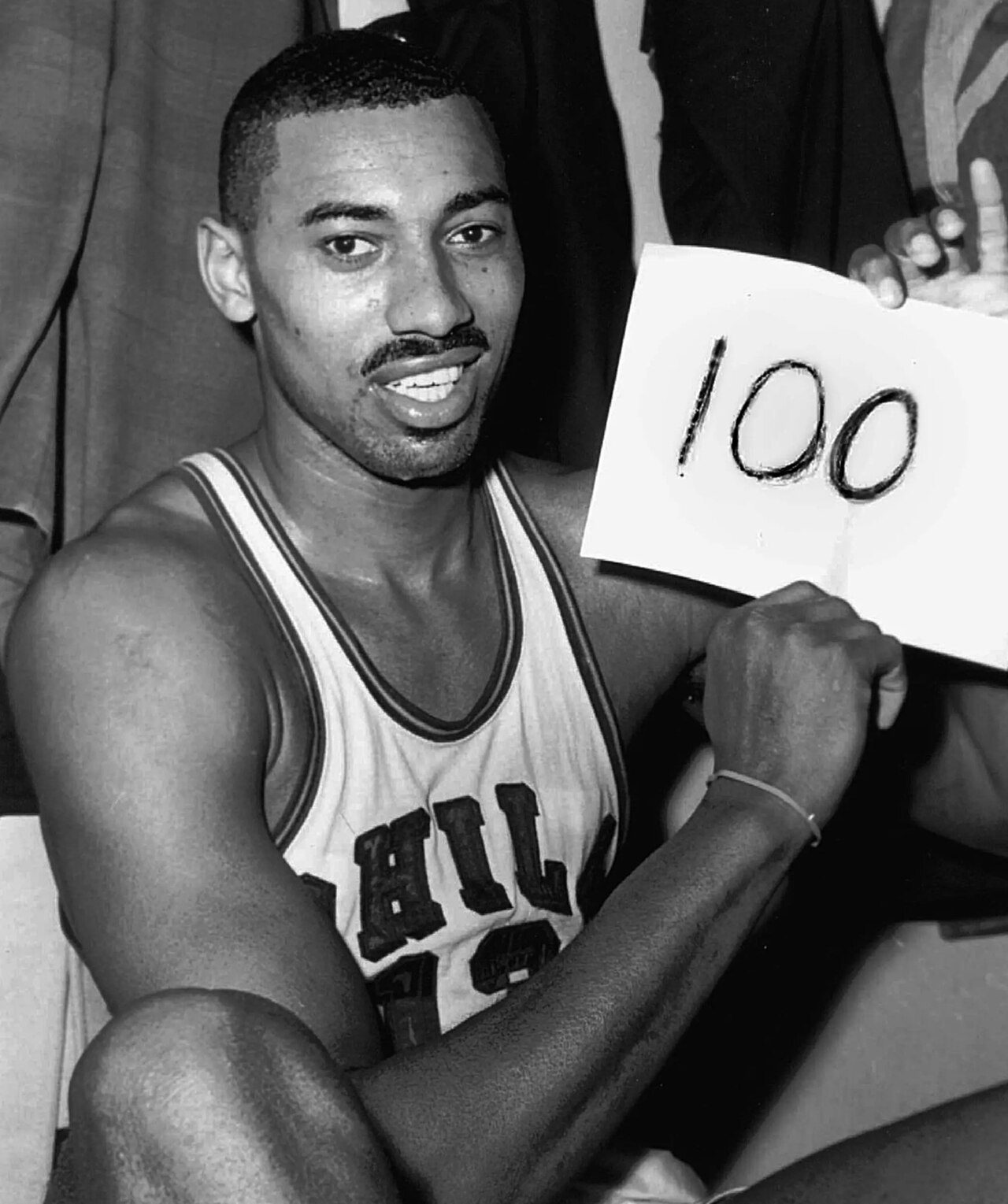
At a Glance
- The game
- Philadelphia Warriors vs New York Knicks at Hershey Sports Arena, Hershey, Pennsylvania — a Warriors 'home' game played away from home
- The score
- Warriors 169, Knicks 147; Chamberlain's 100 came from 36 field goals and 28 of 32 free throws
- The old record
- 78 points — set by Chamberlain himself earlier the same season
- The crowd
- An estimated 4,124 spectators; the game was not televised and no film of it survives
- The quarter splits
- 23 points in the first quarter, 41 by half-time, 69 by the end of the third
- The record since
- Still the NBA single-game scoring record; the nearest approach is Kobe Bryant's 81 points in 2006
Events on this day
- 1776George Washington's artillery opens its bombardment of British-held Boston, beginning the end of the siege of the city.
- 1807Congress passes the act prohibiting the importation of enslaved people into the United States, to take effect on 1 January 1808.
- 1836A convention at Washington-on-the-Brazos declares Texas independent of Mexico.
- 1861Texas becomes the seventh state to secede from the Union, its referendum result taking effect.
- 1917President Wilson signs the Jones-Shafroth Act, granting U.S. citizenship to the people of Puerto Rico.
- 1929President Coolidge signs the Jones Act, sharply increasing Prohibition penalties in the law's last years.
- 1933King Kong premieres in New York, introducing cinema's most famous giant ape.
- 1943The Battle of the Bismarck Sea begins, as Allied aircraft attack a Japanese convoy bound for New Guinea.
- 1955Fifteen-year-old Claudette Colvin refuses to give up her seat on a segregated bus in Montgomery, Alabama — nine months before Rosa Parks.
- 1962Wilt Chamberlain scores 100 points in a single game for the Philadelphia Warriors against the New York Knicks — the featured story above.
- 1969Soviet and Chinese troops clash on the Ussuri River border, the most dangerous confrontation of the Sino-Soviet split.
- 1972NASA launches Pioneer 10, the first probe sent to the outer planets; it will make the first close flyby of Jupiter.
Born on this day
- 1900Kurt Weill — German-American composer of The Threepenny Opera and its 'Mack the Knife'.
- 1904Dr. Seuss (Theodor Geisel) — American author and illustrator of The Cat in the Hat and Green Eggs and Ham.
- 1906Lou Costello — American comedian, the excitable half of Abbott and Costello.
- 1931Mikhail Gorbachev — the last leader of the Soviet Union, whose reforms of glasnost and perestroika ended the Cold War.
- 1942Lou Reed — American singer-songwriter of the Velvet Underground and 'Walk on the Wild Side'.
- 1962Jon Bon Jovi — American singer who founded the rock band Bon Jovi.
- 1968Daniel Craig — English actor, the sixth screen James Bond.
Died on this day
- 1930D. H. Lawrence — English novelist of Sons and Lovers and Lady Chatterley's Lover, dead in France at 44.
- 1949Sarojini Naidu — Indian poet and independence leader, the first Indian woman to preside over the Indian National Congress.
- 1991Serge Gainsbourg — French singer-songwriter and provocateur, dead in Paris at 62.
- 1999Dusty Springfield — British singer whose voice defined 'Son of a Preacher Man', dead at 59.
- 2003Hank Ballard — American R&B singer who wrote and first recorded 'The Twist'.
- 2021Bunny Wailer — Jamaican reggae musician, a founding member of the Wailers with Bob Marley and Peter Tosh.
The featured story: Wilt Chamberlain scores 100 points, 2 March 1962
It happened almost out of sight. The Philadelphia Warriors played some of their home games that season in Hershey, Pennsylvania, a chocolate town with a hockey arena, and on the night of 2 March 1962 an estimated 4,124 people were in the Hershey Sports Arena to see them play the New York Knicks. There were no television cameras and no film crew; most of the sporting world's attention was elsewhere. Wilt Chamberlain, the Warriors' 7-foot-1 centre, had already scored 78 points in a game that December, breaking the league record, and had spent the season doing things no basketball player had done. Nobody in the building expected the record to fall by 22 points.
Chamberlain scored 23 points in the first quarter and 41 by half-time. In the third quarter he added 28 more, and the arena's announcer began updating the crowd on the running total after every basket. The Knicks, losing heavily, took to fouling other Warriors to keep the ball out of Chamberlain's hands; the Warriors fouled back to stop the clock and get possession again, then fed their centre on every play. The strangest part of the night was the free throws. Chamberlain was a notoriously poor free-throw shooter — barely one in two across his career — but shooting underhand, he made 28 of 32 that night, a performance from the line he never repeated.
He reached 100 with 46 seconds left, on a short shot in a crowd of defenders, and the game briefly dissolved as spectators poured onto the court. The final score was 169–147, and Chamberlain's line — 36 field goals, 28 free throws — has stood in the record book ever since. In the dressing room, the Warriors' statistician Harvey Pollack wrote '100' on a sheet of paper and handed it to Chamberlain; the Associated Press photographer Paul Vathis, who had come as a spectator and fetched his camera at half-time, took the picture that became the game's defining image.
No player has come within 18 points of the record since: Kobe Bryant's 81 in 2006 is the closest approach in more than sixty years. The game endures partly through its absence of evidence — a mythic performance attested by a box score, a radio recording of the fourth quarter, and one photograph of a tired giant holding a number. Chamberlain averaged 50.4 points per game that season, another record, but it is the single night in Hershey, on 2 March 1962, that fixed his legend.
Why this date matters
March 2 is a day of thresholds crossed alone. Texas declared itself a country on it in 1836; Claudette Colvin, fifteen years old, refused a bus driver's order on it in 1955, nine months before Rosa Parks did the same; Pioneer 10 left for the outer dark on it in 1972. And its defining moment is a solitary statistic: one man scoring 100 points in a game almost nobody saw, a record that has now outlived everyone who played in it. The date seems to specialise in people going first, and going further than anyone thought possible.
Sources
- Encyclopaedia Britannica — On This Day: March 2
- HISTORY — What Happened on March 2
- ESPN — The Warriors' Philadelphia legacy: Wilt's 100 points and one iconic photo
- SportsCasting — The Most Iconic Photo of Wilt Chamberlain Was Taken By an Off-Duty Pulitzer Prize Winner
The facts on this page were checked against these sources on 19 November 2026. The History Trail's permanent pages are researched and written for this site; the live profiles elsewhere on The History Trail are assembled automatically from Wikipedia and Wikidata.
About the Author
Researched and written by the The History Trail Editorial Team — the accountable editorial function behind this site's permanent story pages. The team works from the published sources cited on each page; it does not invent historians, reviewers or credentials, and it corrects errors openly.
Fact Check
Every load-bearing fact on this page traces to one of the sources listed above, and significant claims link to their source in the text. Our checking method is described on the methodology page; errors can be reported via the corrections page.
Sources & Citations
Cite this page as: The History Trail Editorial Team, The History Trail — this article's title, publication and update dates are shown beneath its headline. The full source list appears under Sources above; the site's source standards are on the sources page.