
On This Day
July 12 in History
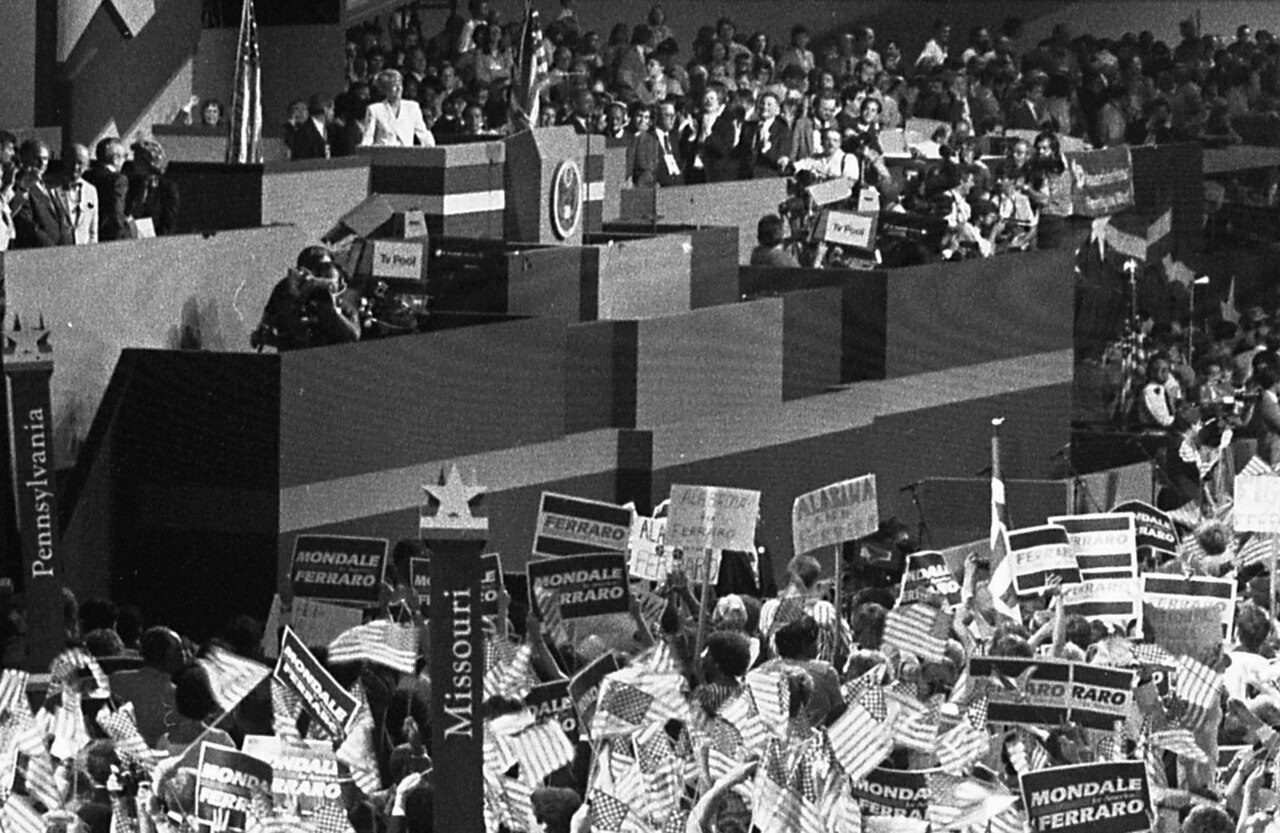
On 12 July 1984 Walter Mondale announced that Representative Geraldine Ferraro of New York would be his running mate — the first woman ever placed on a major-party presidential ticket in the United States. July 12 is also the day the Medal of Honor was created, Henry VIII married his sixth wife, and Alexander Hamilton died of the wound he had received the day before.
Choose another date: open the On This Day calendar to browse events, births and deaths for any day of the year.
At a Glance
- The announcement
- 12 July 1984, at the Minnesota State Capitol in St Paul
- The choice
- Representative Geraldine Ferraro of Queens, New York, a three-term member of the US House of Representatives
- The first
- The first woman nominated for the vice presidency by a major American political party, and the first Italian American on a major-party national ticket
- The ticket
- Former vice president Walter Mondale, the Democratic presidential nominee, trailed President Ronald Reagan badly in the polls
- The convention
- Ferraro was formally nominated and accepted at the Democratic National Convention in San Francisco on 19 July 1984
- The result
- Mondale and Ferraro lost the November election to Reagan and George H. W. Bush, carrying only Minnesota and Washington, D.C.
Events on this day
- 1543Henry VIII marries Catherine Parr, his sixth and final wife, at Hampton Court; she outlives him.
- 1776Captain James Cook sets sail from England on his third and final Pacific voyage, aboard HMS Resolution.
- 1804Alexander Hamilton dies in New York of the wound inflicted by Aaron Burr in their duel at Weehawken the previous day.
- 1861James Butler 'Wild Bill' Hickok fights the gunfight at Rock Creek Station, Nebraska, that begins his legend, killing David McCanles and two others.
- 1862President Abraham Lincoln signs the law creating the US Army Medal of Honor, America's highest military decoration.
- 1920Soviet Russia signs a peace treaty recognising the independence of Lithuania.
- 1962The Rolling Stones play their first concert, at the Marquee Club in London.
- 1975São Tomé and Príncipe becomes independent from Portugal.
- 1979'Disco Demolition Night' at Chicago's Comiskey Park turns into a riot that forces the White Sox to forfeit the second game of a doubleheader.
- 1984Walter Mondale names Geraldine Ferraro as his running mate, the first woman on a major-party US presidential ticket — the featured story above.
Born on this day
- 100 BCJulius Caesar — Roman general and dictator whose conquests and reforms reshaped the Roman world; his birth is traditionally dated to 12 or 13 July.
- 1817Henry David Thoreau — American philosopher and author of Walden, the classic account of his two years at Walden Pond.
- 1884Amedeo Modigliani — Italian painter and sculptor famed for his elongated portraits and nudes.
- 1895Buckminster Fuller — American architect and inventor of the geodesic dome and the Dymaxion car.
- 1904Pablo Neruda — Chilean poet and diplomat, winner of the Nobel Prize in Literature in 1971.
- 1997Malala Yousafzai — Pakistani education campaigner who survived a Taliban assassination attempt and became the youngest Nobel Peace Prize laureate.
Died on this day
- 1536Desiderius Erasmus — Dutch humanist scholar of the northern Renaissance, editor of the Greek New Testament, dead in Basel.
- 1804Alexander Hamilton — first US secretary of the treasury, dead at Weehawken's remove in New York a day after his duel with Aaron Burr.
- 1935Alfred Dreyfus — French officer whose wrongful conviction for treason split France in the Dreyfus affair; he was fully exonerated in 1906.
- 1979Minnie Riperton — American singer with a five-octave range, famed for 'Lovin' You', dead of cancer at 31.
The featured story: Geraldine Ferraro is named Walter Mondale's running mate, 12 July 1984
By the summer of 1984, Walter Mondale's campaign needed something to change the story. The former vice president had secured the Democratic nomination, but President Ronald Reagan was popular, the economy was recovering, and Mondale trailed badly. His search for a running mate was conducted in public and broke every convention: among those seriously considered were women and Black and Hispanic politicians, categories no major-party ticket had ever included. On 12 July 1984, at the State Capitol in his home state of Minnesota, Mondale ended the suspense: 'I looked for the best vice president,' he said, 'and I found her in Gerry Ferraro.'
Geraldine Ferraro was 48, a former schoolteacher and prosecutor from Queens who had won three terms in the House of Representatives, where she had chaired the Democratic platform committee and built a reputation as a tough, quick-witted advocate for working families and women's rights. She was the daughter of an Italian immigrant who had died when she was eight; her mother had worked as a crochet beader to put her through school and law school at night. Her selection made her the first woman on a major-party national ticket in American history, and the first Italian American.
A week later, at the Democratic convention in San Francisco, Ferraro accepted the nomination in one of the most emotional moments of modern convention politics, telling the hall that the message of the choice was that 'the daughter of an immigrant from Italy has been chosen to run for vice president in the new land my father came to love.' For a few weeks the ticket surged in attention and narrowed the polls, and Ferraro drew enormous, enthusiastic crowds.
The campaign then ran into hard weather: weeks of scrutiny of her husband's business finances and tax returns, and a public dispute with Catholic Church leaders over abortion, consumed the autumn. In November, Reagan and Vice President George H. W. Bush won in a landslide, carrying 49 states; Mondale and Ferraro took only his home state of Minnesota and the District of Columbia. Ferraro later served as US ambassador to the UN Human Rights Commission. No woman joined a major-party ticket again for 24 years, until Sarah Palin in 2008 — and no woman won the vice presidency until Kamala Harris in 2020. The barrier Ferraro cracked in 1984 was real, even if the election was lost.
Why this date matters
July 12 is a day of thresholds crossed in public. A king takes his last wife, a sea captain leaves on the voyage that will kill him, a republic invents its highest medal for courage, and a gunfighter's legend begins in a Nebraska station yard. Its modern centrepiece is a threshold of a different kind: the afternoon a presidential candidate announced that the best vice president he could find was a woman, and American politics quietly rearranged itself around the fact. Even the day's saddest entry is a threshold — Hamilton dying, a day after the duel, as the young republic watched its code of honour kill one of its founders.
Sources
- Encyclopaedia Britannica — On This Day: July 12
- HISTORY — What Happened on July 12
- HISTORY — Geraldine Ferraro named vice presidential candidate
- Wikimedia Commons — Geraldine Ferraro at the 1984 Democratic National Convention (1)

The facts on this page were checked against these sources on 19 November 2026. The History Trail's permanent pages are researched and written for this site; the live profiles elsewhere on The History Trail are assembled automatically from Wikipedia and Wikidata.
About the Author
Researched and written by the The History Trail Editorial Team — the accountable editorial function behind this site's permanent story pages. The team works from the published sources cited on each page; it does not invent historians, reviewers or credentials, and it corrects errors openly.
Fact Check
Every load-bearing fact on this page traces to one of the sources listed above, and significant claims link to their source in the text. Our checking method is described on the methodology page; errors can be reported via the corrections page.
Sources & Citations
Cite this page as: The History Trail Editorial Team, The History Trail — this article's title, publication and update dates are shown beneath its headline. The full source list appears under Sources above; the site's source standards are on the sources page.