
On This Day
January 17 in History
On 17 January 1961, three days before leaving office, President Dwight D. Eisenhower used his televised farewell address to warn Americans to 'guard against the acquisition of unwarranted influence… by the military-industrial complex' — a phrase that has never left the language. January 17 is also the day Hawaii's monarchy was overthrown, Scott reached the South Pole, and two great earthquakes struck California and Japan.
Choose another date: open the On This Day calendar to browse events, births and deaths for any day of the year.
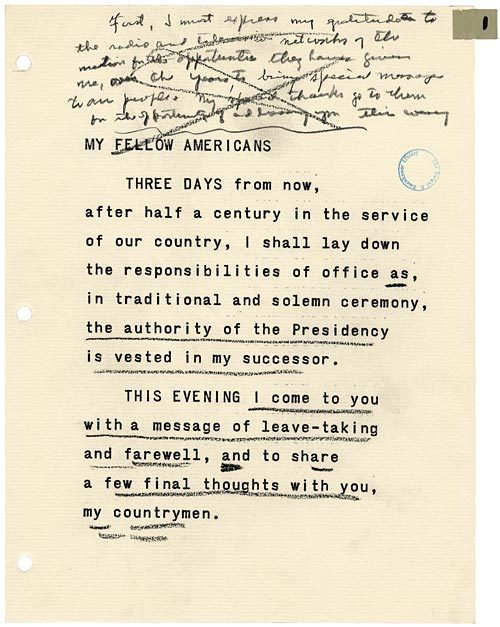
At a Glance
- Delivered
- 17 January 1961, televised from the Oval Office, three days before Kennedy's inauguration
- The speaker
- Dwight D. Eisenhower, 34th president, after half a century of service as soldier and statesman
- The warning
- To guard against 'the acquisition of unwarranted influence, whether sought or unsought, by the military-industrial complex'
- The scale he cited
- A defence establishment of some 3.5 million people, spending more than the net income of all U.S. corporations
- The length
- Under ten minutes — one of the shortest, and most quoted, farewells in presidential history
Events on this day
- 1377The papal court returns to Rome from Avignon, ending the seventy-year 'Babylonian captivity' of the papacy.
- 1773Captain James Cook's ship Resolution becomes the first vessel known to cross the Antarctic Circle.
- 1893Hawaii's monarchy is overthrown as a committee of American and European businessmen forces Queen Liliuokalani to yield power.
- 1912Captain Robert Falcon Scott reaches the South Pole, a month after Roald Amundsen; Scott and his companions die on the return journey.
- 1945Soviet forces liberate Warsaw from German occupation, entering a city the Nazis had systematically destroyed.
- 1946The UN Security Council holds its first meeting, in London — the new world organisation begins work.
- 1953Chevrolet unveils the Corvette, the fibreglass two-seater that becomes America's defining sports car.
- 1961President Eisenhower delivers his farewell address, warning of the military-industrial complex — the featured story above.
- 1966A U.S. B-52 collides with its tanker over Palomares, Spain, dropping four hydrogen bombs; three fall on land, one in the sea.
- 1977Gary Gilmore is executed by firing squad in Utah, the first execution in the United States after a ten-year halt.
- 1994The Northridge earthquake strikes Los Angeles before dawn, killing more than 50 people and causing some $20 billion in damage.
- 1995The Great Hanshin earthquake devastates the Japanese city of Kobe, killing an estimated 6,400 people.
Born on this day
- 1706Benjamin Franklin — American printer, scientist, inventor and founding father, the colonies' most famous citizen.
- 1820Anne Brontë — English novelist of The Tenant of Wildfell Hall, the most radical of the Brontë sisters.
- 1863David Lloyd George — British statesman, the Welsh solicitor who led his country through the First World War as prime minister.
- 1899Al Capone — Chicago gangster whose bootlegging empire defined the Prohibition era.
- 1942Muhammad Ali — American boxer and three-time heavyweight champion, 'the Greatest', and a global symbol of conviction.
- 1964Michelle Obama — American lawyer and author, First Lady of the United States from 2009 to 2017.
Died on this day
- 395Theodosius I — the last emperor to rule the whole Roman Empire; after his death it split permanently into East and West.
- 1893Rutherford B. Hayes — 19th president of the United States, whose contested election of 1876 ended Reconstruction.
- 1911Francis Galton — English scientist who founded eugenics and pioneered fingerprinting and statistics.
- 1961Patrice Lumumba — first prime minister of the independent Congo, murdered in custody, a martyr of African independence.
- 2008Bobby Fischer — American chess genius who won the world championship from the Soviets in 1972, dead in Iceland at 64.
The featured story: Eisenhower warns of the military-industrial complex, 17 January 1961
Farewell addresses are usually forgettable. Dwight Eisenhower's, delivered from the Oval Office on the evening of 17 January 1961, three days before he handed power to John F. Kennedy, produced the most durable political phrase of the postwar era. Eisenhower spoke as few presidents could: a five-star general who had commanded D-Day and run NATO, ending fifty years of public service. When a man with that record warned the country about its own military establishment, the country listened — and it has been quoting him ever since.
The warning was precise. America, he said, had been forced by the Cold War to build a permanent armaments industry where none had existed: some three and a half million people were now engaged in the defence establishment, and the country spent on military security more than the net income of all United States corporations. 'In the councils of government,' he concluded, 'we must guard against the acquisition of unwarranted influence, whether sought or unsought, by the military-industrial complex. The potential for the disastrous rise of misplaced power exists and will persist.'
The speech had been in preparation, in one form or another, since 1959 — Eisenhower and his speechwriters, including Malcolm Moos and his brother Milton, worked through many drafts, and the famous phrase itself evolved through them (earlier versions spoke of a 'military-industrial-congressional' complex). The address was not only a warning: it balanced the danger against the need for strength, urged Americans to hold both liberty and security together, and warned equally against a scientific establishment captured by federal money. It ran under ten minutes.
Time has made the phrase a slogan for arguments Eisenhower never quite made — he was no pacifist and had built much of the establishment he described — but that is the fate of great warnings. What endures is the spectacle of a departing commander-in-chief, at the height of his prestige, telling his countrymen that the machinery assembled to defend their democracy could itself become a threat to it, and that only an alert and knowledgeable citizenry could keep it in its proper place.
Why this date matters
January 17 is a day of departures and warnings. A pope came home to Rome in 1377; a queen lost her kingdom in 1893; Scott arrived at the Pole to find he was second, in 1912. Its two earthquakes — Northridge in 1994, Kobe in 1995, a year apart to the day — shook two of the richest cities on earth. And at its centre stands a general-president walking out of office, using his last words to warn his own country about the machine he had spent his life building.
Sources
- Encyclopaedia Britannica — On This Day: January 17
- HISTORY — What Happened on January 17
- National Archives — President Dwight D. Eisenhower's Farewell Address
- On This Day — January 17 (events list)
The facts on this page were checked against these sources on 19 November 2026. The History Trail's permanent pages are researched and written for this site; the live profiles elsewhere on The History Trail are assembled automatically from Wikipedia and Wikidata.
About the Author
Researched and written by the The History Trail Editorial Team — the accountable editorial function behind this site's permanent story pages. The team works from the published sources cited on each page; it does not invent historians, reviewers or credentials, and it corrects errors openly.
Fact Check
Every load-bearing fact on this page traces to one of the sources listed above, and significant claims link to their source in the text. Our checking method is described on the methodology page; errors can be reported via the corrections page.
Sources & Citations
Cite this page as: The History Trail Editorial Team, The History Trail — this article's title, publication and update dates are shown beneath its headline. The full source list appears under Sources above; the site's source standards are on the sources page.