
On This Day
February 4 in History
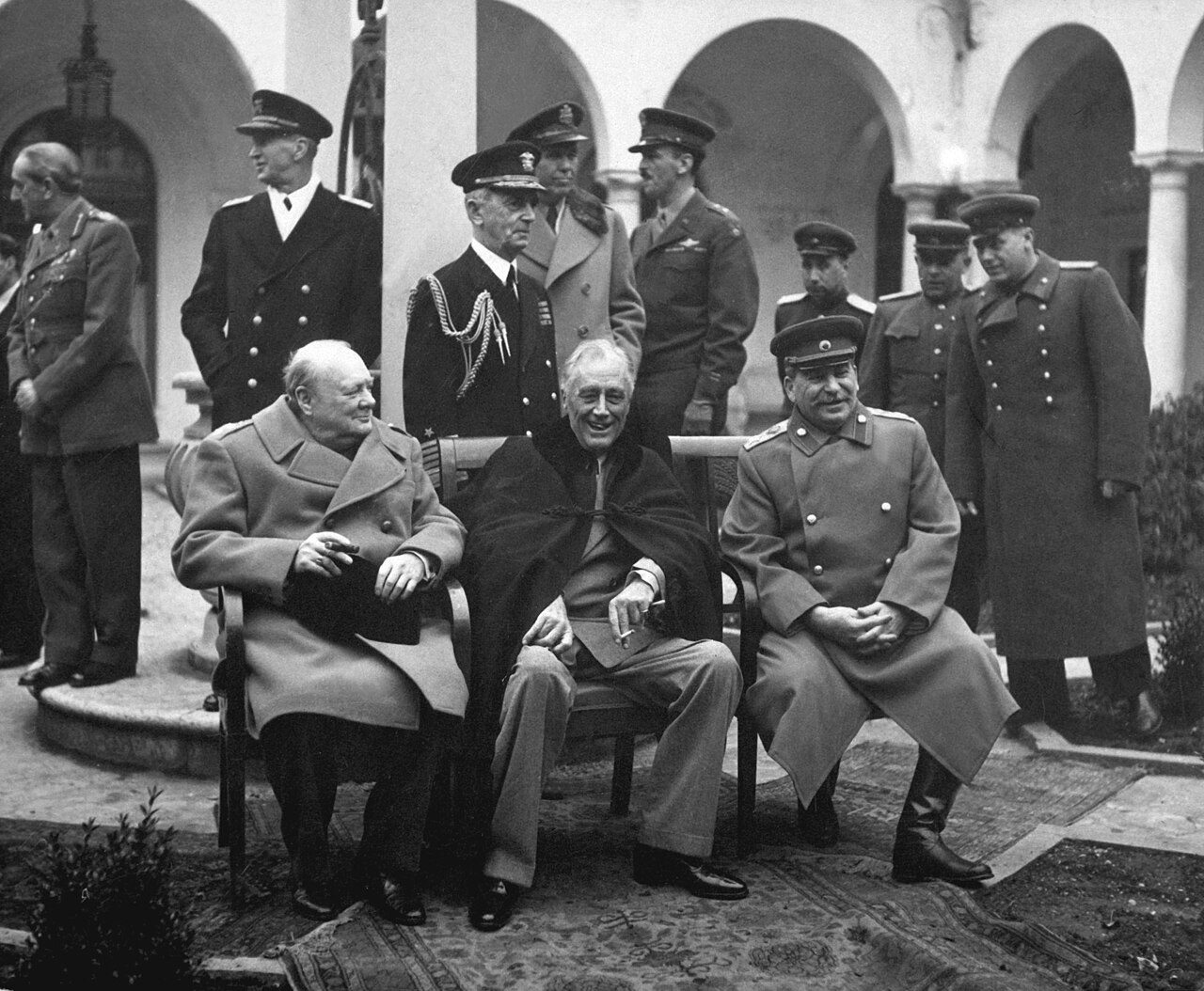
On 4 February 1945 the Yalta Conference opened in Crimea, where Roosevelt, Churchill and Stalin met to plan the defeat of Germany and the shape of the postwar world. February 4 is also the day George Washington was unanimously elected the first American president, Snow White reached cinemas nationwide, and Facebook launched.
Choose another date: open the On This Day calendar to browse events, births and deaths for any day of the year.
At a Glance
- The conference
- Held 4–11 February 1945 at the Livadia Palace and other palaces near Yalta in Crimea
- The leaders
- President Franklin D. Roosevelt, Prime Minister Winston Churchill and Premier Joseph Stalin — the 'Big Three'
- Germany
- The leaders affirmed the division of Germany into occupation zones, adding a fourth zone for France
- The United Nations
- They settled the Security Council voting formula and called the founding UN conference for April 1945 in San Francisco
- Poland
- The hardest question: a Soviet-backed provisional government was accepted as the nucleus of a new Polish government, pending promised free elections
- The Pacific
- Stalin secretly agreed to enter the war against Japan within three months of Germany's defeat
Events on this day
- 1789George Washington is unanimously elected the first president of the United States, winning all 69 electoral votes cast.
- 1826James Fenimore Cooper's The Last of the Mohicans is published, one of the first distinctively American novels.
- 1846Members of the Church of Jesus Christ of Latter-day Saints begin their exodus from Nauvoo, Illinois, the migration that eventually reaches Utah.
- 1861Delegates from six seceded Southern states meet in Montgomery, Alabama, to establish the Confederate States of America.
- 1915Germany declares the waters around the British Isles a war zone in which merchant ships may be sunk without warning.
- 1922The Ford Motor Company buys the failing Lincoln Motor Company for $8 million, gaining its luxury car brand.
- 1938Walt Disney's Snow White and the Seven Dwarfs opens in cinemas across the United States, proving a full-length animated feature can triumph.
- 1945The Yalta Conference opens in Crimea, where Roosevelt, Churchill and Stalin plan the postwar world — the featured story above.
- 1948Ceylon, later Sri Lanka, gains independence from Britain.
- 1974Newspaper heiress Patricia Hearst is kidnapped from her Berkeley apartment by the Symbionese Liberation Army.
- 2004Harvard student Mark Zuckerberg launches The Facebook, a social network for Harvard students that grows into a global platform.
- 2007Tony Dungy of the Indianapolis Colts becomes the first Black head coach to win a Super Bowl.
Born on this day
- 1902Charles Lindbergh — American aviator who made the first solo nonstop transatlantic flight in 1927.
- 1906Dietrich Bonhoeffer — German theologian and anti-Nazi dissident, executed in 1945 for his part in resistance circles.
- 1913Rosa Parks — American civil rights activist whose refusal to give up her bus seat in 1955 ignited the Montgomery bus boycott.
- 1921Betty Friedan — American writer whose book The Feminine Mystique (1963) helped launch modern feminism.
- 1948Alice Cooper — American rock singer, the godfather of shock rock.
- 1973Oscar De La Hoya — American boxer, Olympic gold medallist and world champion at six weights.
Died on this day
- 1983Karen Carpenter — American singer of the Carpenters, dead at 32 from heart failure caused by anorexia nervosa.
- 2012Florence Green — the last known surviving veteran of the First World War, dead in England at 110.
- 2020Daniel arap Moi — Kenya's second president, who ruled the country from 1978 to 2002, dead at 95.
- 1987Liberace — American pianist and showman, the flamboyant 'Mr Showmanship' of Las Vegas, dead at 67.
The featured story: the Yalta Conference opens, 4 February 1945
By February 1945 the Second World War in Europe was won but not yet finished. Soviet armies stood on the Oder, within reach of Berlin; Western Allied forces were recovering from the Battle of the Bulge and preparing to cross the Rhine. On 4 February the leaders of the three great Allied powers — Franklin D. Roosevelt, Winston Churchill and Joseph Stalin — sat down together at the Livadia Palace, the former summer residence of the tsars near Yalta in Crimea. Roosevelt, visibly frail two months before his death, had travelled some 14,000 kilometres by ship and plane to meet on Stalin's home ground, because the Soviet leader refused to leave territory his armies controlled.
The agenda was the future of the world. On Germany the three largely confirmed what their officials had prepared: the Reich would be dismembered into occupation zones — American, British and Soviet, with a fourth carved out for France — its war industry eliminated or controlled, its major criminals tried, and reparations assessed by a commission in Moscow. On the projected United Nations, Stalin accepted a compromise voting formula for the Security Council and dropped his demand that all sixteen Soviet republics receive seats; a founding conference was summoned to San Francisco for April. In secret, Stalin also promised to bring the Soviet Union into the war against Japan within two to three months of Germany's surrender, in return for territorial concessions in Asia.
Poland was the wound that would not close. The Red Army had liberated — and occupied — the whole country, and a Soviet-sponsored committee already governed from Lublin. Churchill and Roosevelt, abandoning the Polish government-in-exile in London, agreed that the Lublin body should form the nucleus of a broader provisional government, in exchange for Stalin's signature on a Declaration on Liberated Europe promising democratic governments and free elections. The words were solemn; the enforcement was absent. Within two years Poland and most of Eastern Europe had communist governments installed under Soviet power, and 'Yalta' had become, in Western political argument, a synonym for a continent betrayed — though historians still debate what else, with the Red Army in possession, the Western leaders could realistically have obtained.
What Yalta unquestionably did was set the operating system of the postwar world: four-power occupation of Germany, a United Nations with great-power vetoes, Soviet entry into the Pacific war, and a Europe divided in fact long before it was divided in name. The conference ended on 11 February with a communique of unity. The Cold War that followed was not made at Yalta alone, but its map was first sketched there, around a table in a tsar's palace by the Black Sea.
Why this date matters
February 4 is a day for founding things and dividing them. Washington's unanimous election in 1789 founded the American presidency; the Confederacy was founded, fatefully, in 1861; Ceylon became independent in 1948 and Facebook was founded in a Harvard dormitory in 2004. Against those beginnings stands the day's giant event: at Yalta in 1945 three men divided a continent with the best and worst of intentions. It is also, fittingly, the birthday of Rosa Parks and Betty Friedan — two women who would spend their lives challenging the orders that powerful men had drawn up.
Sources
- Encyclopaedia Britannica — On This Day: February 4
- HISTORY — What Happened on February 4
- Encyclopaedia Britannica — Yalta Conference
- HISTORY — Singer-songwriter Karen Carpenter dies
The facts on this page were checked against these sources on 19 November 2026. The History Trail's permanent pages are researched and written for this site; the live profiles elsewhere on The History Trail are assembled automatically from Wikipedia and Wikidata.
About the Author
Researched and written by the The History Trail Editorial Team — the accountable editorial function behind this site's permanent story pages. The team works from the published sources cited on each page; it does not invent historians, reviewers or credentials, and it corrects errors openly.
Fact Check
Every load-bearing fact on this page traces to one of the sources listed above, and significant claims link to their source in the text. Our checking method is described on the methodology page; errors can be reported via the corrections page.
Sources & Citations
Cite this page as: The History Trail Editorial Team, The History Trail — this article's title, publication and update dates are shown beneath its headline. The full source list appears under Sources above; the site's source standards are on the sources page.