
On This Day
February 21 in History
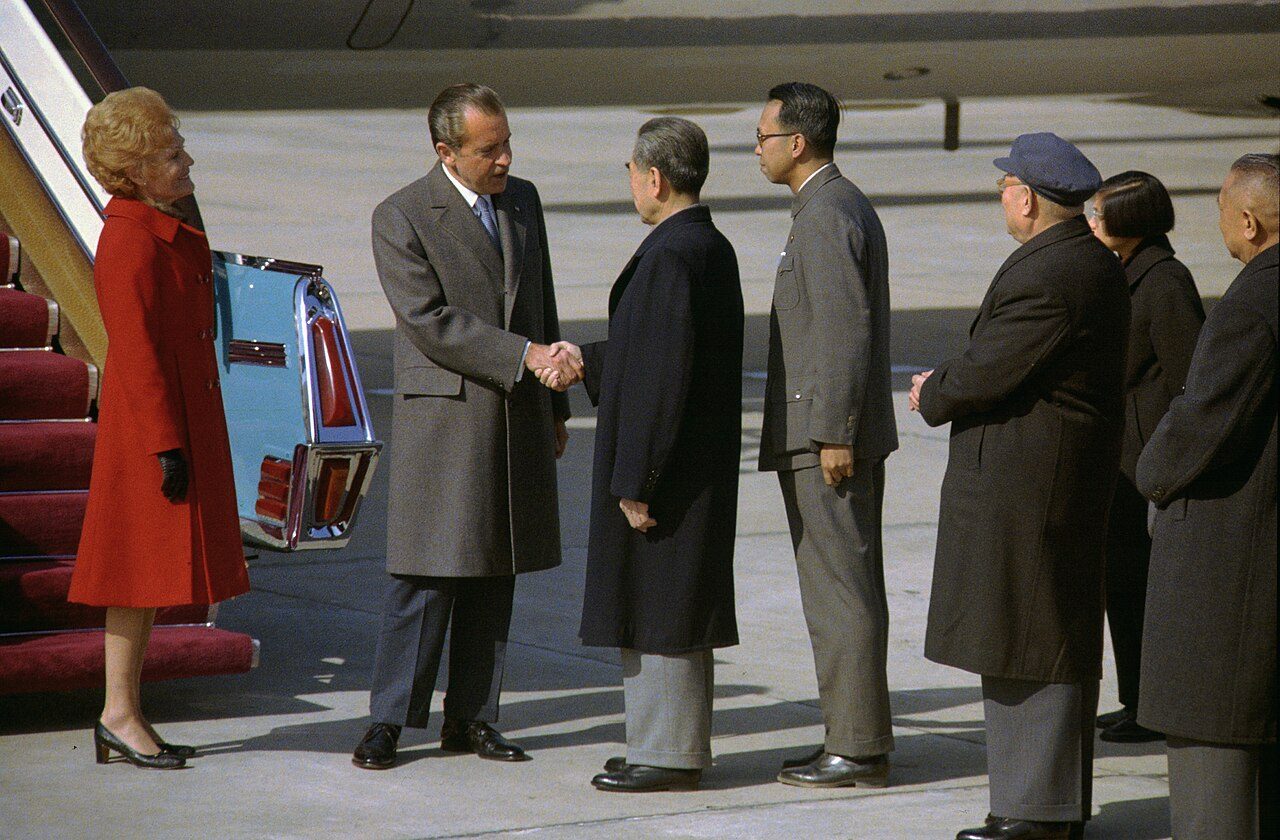
On 21 February 1972 Richard Nixon stepped off Air Force One in Beijing to shake hands with Premier Zhou Enlai, becoming the first American president to visit mainland China while in office and opening a relationship that reshaped the Cold War. February 21 is also the day the Communist Manifesto was published, the Battle of Verdun began, and Malcolm X was assassinated in New York.
Choose another date: open the On This Day calendar to browse events, births and deaths for any day of the year.
At a Glance
- Arrival
- 21 February 1972, Beijing — the first visit to mainland China by a sitting U.S. president
- The handshake
- Nixon shook hands with Premier Zhou Enlai at the foot of the Air Force One stairs, in a photograph by White House photographer Byron Schumaker
- First day
- Nixon met Chairman Mao Zedong on the day he arrived
- The visit
- 21–28 February 1972, a week of talks in Beijing, Hangzhou and Shanghai
- The outcome
- The Shanghai Communiqué, in which both sides pledged to work toward normal relations
- The road there
- Prepared by Henry Kissinger's secret trip to Beijing in July 1971, after a quarter-century of hostility since 1949
Events on this day
- 1804Richard Trevithick's steam locomotive hauls ten tons of iron and some seventy men along the tramroad at Penydarren in Wales, the first railway journey by a steam locomotive.
- 1848The Communist Manifesto, by Karl Marx and Friedrich Engels, is published in London.
- 1885The Washington Monument is dedicated in Washington, D.C., honouring the first president of the United States.
- 1916The Battle of Verdun begins with a massive German bombardment of French positions; it will grind on for ten months and become the longest battle of the First World War.
- 1925The first issue of The New Yorker magazine is published in New York City.
- 1948NASCAR, the National Association for Stock Car Auto Racing, is incorporated in the United States.
- 1965Malcolm X, the American Muslim minister and civil rights leader, is assassinated while speaking at the Audubon Ballroom in New York City.
- 1970Henry Kissinger begins secret peace talks with North Vietnam's Le Duc Tho at a villa outside Paris.
- 1972President Richard Nixon arrives in Beijing, the first U.S. president to visit mainland China in office — the featured story above.
Born on this day
- 1903Anaïs Nin — French-born American writer celebrated for her diaries and experimental fiction.
- 1907W. H. Auden — Anglo-American poet whose work defined English-language poetry between the wars.
- 1924Robert Mugabe — Zimbabwean leader who governed his country from independence in 1980 until 2017.
- 1946Alan Rickman — English actor known for roles from Hans Gruber in Die Hard to Severus Snape in the Harry Potter films.
Died on this day
- 1677Baruch Spinoza — Dutch philosopher of Portuguese-Jewish origin, whose Ethics reshaped Western philosophy; he died at The Hague aged 44.
- 1926Heike Kamerlingh Onnes — Dutch physicist who liquefied helium and discovered superconductivity.
- 2018Billy Graham — American evangelist who preached in person to more people than anyone in the history of Christianity.
The featured story: President Nixon arrives in China, 21 February 1972
For more than two decades before February 1972, the United States and the People's Republic of China had treated each other as enemies. American and Chinese soldiers had fought in Korea; Washington recognised the government on Taiwan, not the one in Beijing, as the legitimate China; and official contact between the two countries was close to zero. Yet by the early 1970s both sides had reasons to move. China, isolated and fearful of the Soviet Union after border clashes in 1969, wanted a counterweight to Moscow. The Nixon administration, seeking leverage in the Cold War and a path out of Vietnam, wanted the same thing in reverse. The thaw began in public with an American table-tennis team's visit to China in 1971, and in secret with national security adviser Henry Kissinger's clandestine flight to Beijing that July to arrange a presidential visit.
On the morning of 21 February 1972, Air Force One landed in Beijing and Richard Nixon walked down the steps to shake the hand of Premier Zhou Enlai — the first act of the visit, and a deliberate one, staged at the foot of the aircraft stairs and captured by White House photographer Byron Schumaker. Later the same day Nixon was taken to meet Chairman Mao Zedong, the ailing founder of the People's Republic, in a meeting that confirmed the opening had the blessing of the one man whose word in China was final. Nixon was the first president of the United States to visit mainland China while in office, and both governments understood that the pictures mattered almost as much as the talks: the handshake was broadcast to American breakfast-time television and printed on front pages everywhere.
The week that followed mixed ceremony with hard bargaining. Nixon toured the Great Wall and the Forbidden City, attended banquets in the Great Hall of the People, and travelled on to Hangzhou and Shanghai, while Kissinger and Zhou worked through the hardest question between the two countries: Taiwan. The result, issued at the end of the visit on 27 February, was the Shanghai Communiqué, an unusual document in which each side stated its own position on Taiwan plainly and both pledged to work toward the full normalisation of relations. It did not settle the dispute; it built a framework in which the dispute could be managed while trade, exchanges and strategic cooperation began.
The visit changed the geometry of the Cold War at a stroke. The Soviet Union, now facing a Washington–Beijing alignment, had new reason to negotiate with the United States, and the opening Nixon began in 1972 led, seven years later, to full diplomatic relations between the two countries in 1979. Trade and cultural contact that had been frozen for a generation began to flow. What happened on 21 February was not a treaty or a surrender but a door being opened by two governments that had spent twenty-three years pretending the other did not exist — and it remains the defining act of Nixon's presidency.
Why this date matters
February 21 keeps producing documents and gestures that reorder the world. In 1804 a steam engine in Wales showed that machines could haul loads on rails; in 1848 two young radicals in London published a pamphlet that would haunt the next century and a half; in 1916 the century's most attritional battle opened at Verdun; and in 1972 a handshake at the foot of an aircraft ended a generation of silence between the world's most populous country and its most powerful one. The day also carries loss — Malcolm X was shot dead on it in 1965 — but its signature is the beginning of things: manifestos, magazines, racing empires, and one very deliberate handshake.
Sources
- Encyclopaedia Britannica — On This Day: February 21
- HISTORY — This Day in History: February 21
- Office of the Historian, U.S. Department of State — Rapprochement with China, 1972
- National Archives — Nixon in China: Audiovisual Records from the Richard Nixon Presidential Library and Museum
- Guinness World Records — First steam locomotive to run on rails
The facts on this page were checked against these sources on 19 November 2026. The History Trail's permanent pages are researched and written for this site; the live profiles elsewhere on The History Trail are assembled automatically from Wikipedia and Wikidata.
About the Author
Researched and written by the The History Trail Editorial Team — the accountable editorial function behind this site's permanent story pages. The team works from the published sources cited on each page; it does not invent historians, reviewers or credentials, and it corrects errors openly.
Fact Check
Every load-bearing fact on this page traces to one of the sources listed above, and significant claims link to their source in the text. Our checking method is described on the methodology page; errors can be reported via the corrections page.
Sources & Citations
Cite this page as: The History Trail Editorial Team, The History Trail — this article's title, publication and update dates are shown beneath its headline. The full source list appears under Sources above; the site's source standards are on the sources page.