
On This Day
April 24 in History
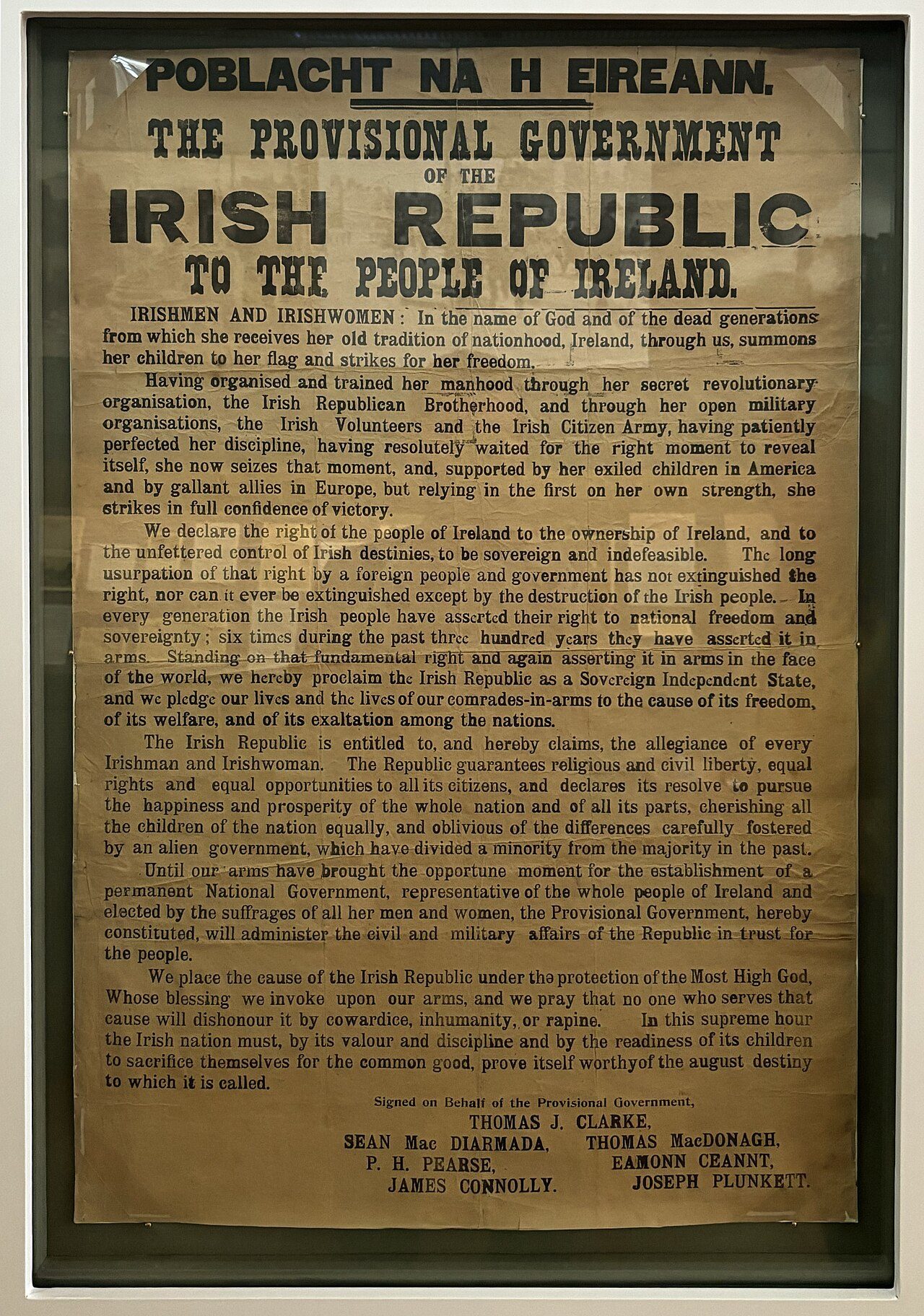
On Easter Monday, 24 April 1916, some 1,200 Irish republicans seized the General Post Office and other strongpoints across Dublin, and Patrick Pearse read out the Proclamation of the Irish Republic — the opening act of the Easter Rising, the rebellion that set Ireland on the road to independence. April 24 is also the day the Library of Congress was founded, 'La Marseillaise' was composed, and the failed Iran hostage rescue mission ended in the desert.
Choose another date: open the On This Day calendar to browse events, births and deaths for any day of the year.
At a Glance
- The date
- Easter Monday, 24 April 1916, beginning around noon in Dublin
- The forces
- About 1,200–2,500 Irish Volunteers, Irish Citizen Army members and allies against the British garrison of Ireland
- The headquarters
- The General Post Office on Sackville Street (now O'Connell Street), Dublin
- The proclamation
- Signed by seven men — Pearse, Clarke, Mac Diarmada, MacDonagh, Ceannt, Connolly and Plunkett — and read by Pearse outside the GPO
- The week
- Six days of fighting; Pearse surrendered unconditionally on Saturday 29 April
- The aftermath
- Sixteen leaders were executed in May; public opinion swung behind the rebels, and the independence struggle resumed in 1919
Events on this day
- 1792French army officer Claude-Joseph Rouget de Lisle composes 'La Marseillaise' overnight in Strasbourg; it becomes France's national anthem.
- 1800President John Adams signs the act founding the Library of Congress, with $5,000 for 'such books as may be necessary for the use of Congress'.
- 1877Russia declares war on the Ottoman Empire; the last Russo-Turkish War ends with Romania, Serbia and Montenegro independent of Turkish rule.
- 1898Spain declares war on the United States over Cuba, a day before Washington's own declaration opens the Spanish-American War.
- 1916Irish republicans seize strongpoints across Dublin and proclaim the Irish Republic — the Easter Rising, the featured story above.
- 1949Communist forces cross the Yangtze and occupy Nanjing, the Nationalist capital; the Chinese Civil War is effectively decided.
- 1967Soviet cosmonaut Vladimir Komarov is killed when Soyuz 1's parachute fails on landing — the first person known to die during a space mission.
- 1980The American mission to rescue hostages in Tehran collapses in the Iranian desert; eight U.S. servicemen die when aircraft collide during the withdrawal.
- 1990Gruinard Island, contaminated by wartime anthrax tests, is formally declared safe after a 48-year quarantine and a government clean-up.
- 2005Pope Benedict XVI formally begins his pontificate with an inauguration mass in St Peter's Square.
- 2011WikiLeaks begins publishing the Guantánamo Bay files, hundreds of classified U.S. assessments of detainees held at the camp.
Born on this day
- 1815Anthony Trollope — English novelist of the Barsetshire chronicles, among the most prolific and popular authors of the Victorian age.
- 1904Willem de Kooning — Dutch-born American painter, a leading figure of Abstract Expressionism.
- 1905Robert Penn Warren — American novelist and poet, author of All the King's Men and the first poet laureate of the United States.
- 1942Barbra Streisand — American singer and actor, one of the best-selling recording artists in history.
Died on this day
- 1731Daniel Defoe — English author of Robinson Crusoe and Moll Flanders, dead in London at about 71, hiding from creditors to the end.
- 1967Vladimir Komarov — Soviet cosmonaut, killed this day when Soyuz 1 crashed (see Events).
- 2004Estée Lauder — co-founder of the cosmetics empire that bears her name, dead in New York at 97.
The featured story: the Easter Rising begins, 24 April 1916
The Rising was planned in secret by a small military council of the Irish Republican Brotherhood, who fixed it for Easter while Britain was consumed by the First World War. It nearly collapsed before it began: the German arms ship Aud was intercepted and scuttled, and Eoin MacNeill, chief of staff of the Irish Volunteers, learning of the plot, published a countermanding order cancelling the Easter Sunday manoeuvres that were to cover the mobilisation. The conspirators met through the night and decided to go ahead a day late, with a fraction of the force they had hoped for — a decision several of them understood to be a choice of a glorious defeat over a quiet surrender of the idea itself.
At noon on Easter Monday, columns of Volunteers and James Connolly's Irish Citizen Army occupied positions across Dublin: Jacob's biscuit factory, the Four Courts, St Stephen's Green, Boland's Mill — and, as headquarters, the General Post Office on the city's main street. Outside it, Patrick Pearse, schoolmaster, poet and president of the proclaimed provisional government, read the Proclamation of the Republic to a small, mostly puzzled crowd. It declared 'the right of the people of Ireland to the ownership of Ireland', promised equal rights and universal suffrage — women included, remarkable for 1916 — and was signed by seven men who expected, correctly, that it would be their death warrant.
Dubliners' first reactions ranged from indifference to hostility; many had sons and husbands in British uniform at the front, and 'separation women' spat at captured rebels. Britain, surprised, rushed troops across the Irish Sea until some 20,000 soldiers faced perhaps 1,600 remaining rebels. Artillery and the gunboat Helga shelled the city centre; by Thursday the GPO was burning and Pearse's garrison escaped through side streets to Moore Street. On Saturday 29 April, to stop the slaughter of civilians, Pearse surrendered unconditionally. About 450 people had died in the week, more than half of them civilians caught between the armies.
The Rising's military failure was total, and its political triumph almost as complete. The British executed sixteen leaders by firing squad over nine days in May — Connolly, wounded, shot tied to a chair — and interned thousands. Each execution moved Irish opinion further; by 1918 Sinn Féin swept Ireland's elections, and in January 1919 its MPs declared an Irish parliament and the War of Independence began. The Free State followed in 1922. Modern Ireland dates its founding not to the treaty but to that Easter Monday: the Proclamation is still read aloud outside the GPO every Easter, and the seven signatures remain the state's founding names.
Why this date matters
April 24 is a day when paper changes the world. A song written in one night in 1792 becomes the anthem of revolutions; a $5,000 book fund in 1800 grows into the largest library on Earth; and in 1916 seven signatures on a proclamation, read to a handful of bystanders, found a state. Against these stand the day's warnings about paper and power alike — a cosmonaut killed by a parachute that failed its checks, and a rescue mission undone in a desert far from home.
Sources
- Encyclopaedia Britannica — On This Day: April 24
- HISTORY — What Happened on April 24
- State Library of Victoria — Easter 1916 Rising timeline
- Wikipedia — April 24
The facts on this page were checked against these sources on 19 November 2026. The History Trail's permanent pages are researched and written for this site; the live profiles elsewhere on The History Trail are assembled automatically from Wikipedia and Wikidata.
About the Author
Researched and written by the The History Trail Editorial Team — the accountable editorial function behind this site's permanent story pages. The team works from the published sources cited on each page; it does not invent historians, reviewers or credentials, and it corrects errors openly.
Fact Check
Every load-bearing fact on this page traces to one of the sources listed above, and significant claims link to their source in the text. Our checking method is described on the methodology page; errors can be reported via the corrections page.
Sources & Citations
Cite this page as: The History Trail Editorial Team, The History Trail — this article's title, publication and update dates are shown beneath its headline. The full source list appears under Sources above; the site's source standards are on the sources page.