
People
Albert Einstein
Albert Einstein, born on 14 March 1879, died at Princeton on 18 April 1955. In 1905 a 26-year-old clerk at the Swiss patent office in Bern published four papers that recast light, atoms, space and time; he spent the next decade extending that work into a new theory of gravity.
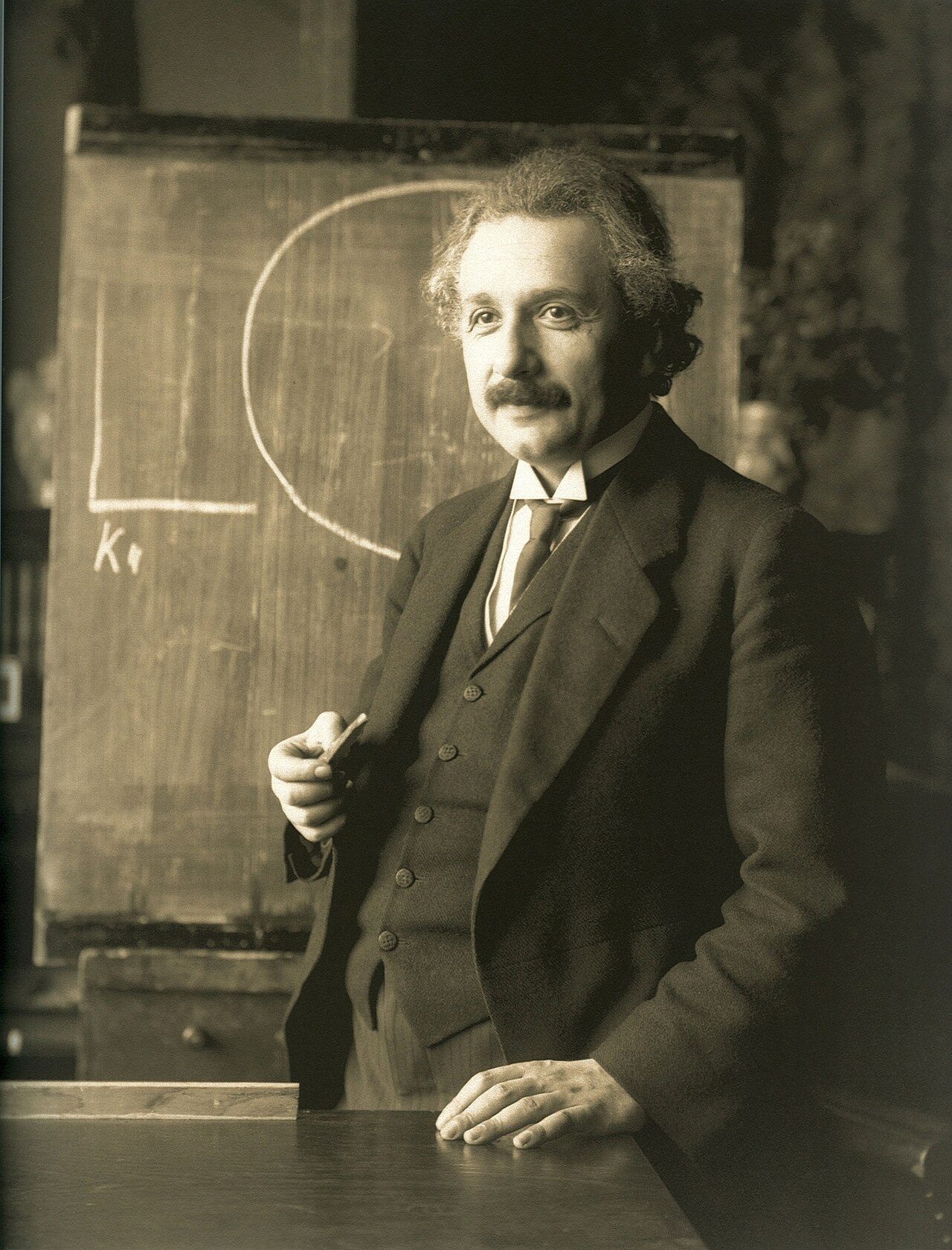
At a Glance
- Born
- 14 March 1879, Ulm, Germany
- Died
- 18 April 1955, Princeton, New Jersey, United States
- Miracle year
- 1905 — four landmark papers published while he worked at the Bern patent office
- Famous equation
- E = mc², from his papers on special relativity, 1905
- General relativity
- Proposed 1915; confirmed by eclipse observations of light bending in 1919
- Nobel Prize
- Physics, 1921 — for the photoelectric effect, not for relativity
Introduction
Albert Einstein was a German-born physicist who developed the special and general theories of relativity and is generally considered the most influential physicist of the 20th century. Special relativity, published in 1905, recast space and time as a single fabric and produced the equation E = mc², which states that energy and mass are the same thing in different forms. General relativity, proposed in 1915, went further: gravity is not a force acting at a distance but a curving of space-time itself. He died at Princeton on 18 April 1955.
The route to those ideas was improbable. Einstein was not a professor when he made his greatest early breakthroughs but a technical expert at the patent office in Bern, assessing other people's inventions by day and rebuilding physics in his spare hours. When his fame spread, he toured the world lecturing, and his name became a byword for genius itself.
Background
At five he was mystified by a compass, whose needle was deflected by invisible forces; at twelve he devoured a book of geometry he called his sacred little geometry book. Schooling suited him less well: at the Luitpold Gymnasium in Munich he felt stifled by a system that punished originality. When his father's business failed and the family moved to Milan, he left school and followed them.
He recovered by applying to the Swiss Federal Polytechnic School in Zürich. His mathematics and physics marks won him a place once he had finished his schooling at Aarau, where he graduated in 1896. In Zürich he met Marcel Grossmann and Michele Besso, friends with whom he argued about space and time for years, and fellow physics student Mileva Marić, whom he married in 1903. At sixteen he had already posed the question that drove a decade of thinking: what would a light beam look like if you could run alongside it?
1905: The Miracle Year
The year 1905 — his annus mirabilis — produced four papers in Annalen der Physik, alongside his doctorate. The first proposed that light behaves as a stream of quanta and explained the photoelectric effect. The second explained Brownian motion, the jittering of pollen grains in water, as the visible effect of atoms — evidence, soon confirmed, that atoms are real. The third set out special relativity. A short fourth paper drew the consequence the world remembers: if a body emits energy, its mass diminishes — E = mc². The Einstein Papers Project at Caltech, which edits the Collected Papers, treats these papers as the foundation for much of Einstein's later work.
A decade of work followed on the harder problem: extending relativity to gravity. In November 1915, now a professor in Berlin, Einstein presented the field equations of general relativity. The theory predicted that the Sun's gravity should bend passing starlight by twice the Newtonian value — a prediction testable only during a total eclipse.
Timeline
- 1879
Born on 14 March in Ulm, Germany, to Hermann and Pauline Einstein.
- 1896
Graduates at Aarau, Switzerland, and enters the Swiss Federal Polytechnic School in Zürich.
- 1905
His miracle year: papers on the photoelectric effect, Brownian motion and special relativity appear, along with E = mc², and he completes his doctorate.
- 1915
Proposes the general theory of relativity, describing gravity as the curvature of space-time.
- 1919
Eclipse expeditions observe starlight bending near the Sun, confirming general relativity and making Einstein world-famous.
- 1921
Awarded the Nobel Prize in Physics for the photoelectric effect — not for relativity.
- 1926
Writes to Max Born that he is convinced the Old One does not play dice, rejecting a purely probabilistic quantum world.
- 1933
With the Nazis in power, Einstein leaves Germany for good and joins the Institute for Advanced Study in Princeton.
- 2 August 1939
Signs the letter drafted with Leo Szilárd warning President Roosevelt that uranium chain reactions could make powerful bombs possible.
- 1940
Becomes a citizen of the United States.
- 1955
Dies in Princeton, New Jersey, on 18 April, aged 76, after the rupture of an abdominal aortic aneurysm.
Fame, Exile and the Letter
The confirmation came on 29 May 1919, when expeditions to Príncipe and Sobral photographed stars near the eclipsed Sun; announced that November, the measured bending of their light matched Einstein's prediction, and he became world-famous almost overnight. The Nobel Prize followed, but precisely: the reserved 1921 prize, awarded in 1922, cited his discovery of the law of the photoelectric effect, not relativity, which the committee still treated cautiously.
In 1933, with Hitler in power, Einstein — Jewish, pacifist and internationally famous — did not return to Germany from a trip abroad. He settled in Princeton at the Institute for Advanced Study, and became an American citizen in 1940. There he spoke publicly for civil rights and disarmament. On 2 August 1939 he signed the letter Leo Szilárd had drafted, warning President Roosevelt that uranium could sustain a chain reaction and that extremely powerful bombs were conceivable. The Atomic Heritage Foundation notes both what followed — the uranium committee that led, in time, to the Manhattan Project — and what did not: Einstein played no role in the project and was denied a security clearance in 1940. He later said that had he known the Germans would not succeed in building a bomb, he would have done nothing.
Significance
Relativity shifted the understanding of space completely. Newton's picture of fixed space, fixed time and gravity as an instant force had stood for more than two hundred years; Einstein replaced it with a universe in which clocks run at different rates, mass bends the geometry around it, and the same laws predict gravitational waves, black holes and the expansion of the universe.
His 1905 paper on the photoelectric effect mattered just as much in a different direction. By treating light as both wave and stream of particles, Einstein supplied a foundation on which quantum mechanics was built — even though he spent much of his later life arguing against its probabilistic interpretation. Few scientists have founded one revolution and then become the most famous critic of the next.
Myths and disputes
Einstein failed mathematics at school. He did not. He laughed at the story when it appeared in a Ripley's Believe It or Not! column in the 1930s, replying that he had never failed in mathematics and had mastered calculus before he was fifteen. His records support him: at Aarau his mathematics and physics marks were at the top of the scale. The myth is usually traced to a grading-scale confusion — the Swiss school reversed the German convention, so 6, a failure in Munich, was the highest mark in Aarau — compounded by his genuine failure, at sixteen, of the Zürich Polytechnic entrance examination as a whole, in which his weak subjects were languages, not mathematics.
E = mc² made the atomic bomb is a half-truth. The equation states the equivalence of mass and energy; it is not a design for a weapon, and Einstein did no work on the bomb itself. What he did do, in August 1939, was sign Szilárd's letter alerting Roosevelt — a political act, taken for fear Germany would build one first, which he afterwards regretted. The bomb was built by a vast industrial project drawing on physics from many countries.
That he did not speak until he was four rests on family recollection repeated by his sister Maja and later biographers. It may be true — Einstein himself joked that his parents worried — but it is unverifiable: no contemporary record exists, and this page labels it family tradition, not fact.
Legacy
Einstein died at Princeton Hospital in the early hours of 18 April 1955, and was cremated the same day, as he wished. What happened next was stranger. The pathologist on duty, Thomas Harvey, removed Einstein's brain during the autopsy without permission, as Smithsonian Magazine documented sixty years later; Harvey later obtained the family's retrospective agreement to keep it for study, had it sectioned into blocks and slides, and kept pieces for decades. Studies of the slides produced claims later researchers treated with scepticism, and a box of them is now displayed at the Mütter Museum in Philadelphia — an afterlife Einstein would not have chosen.
The bending of light, the behaviour of clocks in motion and the gravitational waves his equations implied have all since been observed, and satellite navigation must correct for relativity every day.
Sources
- Encyclopaedia Britannica — Albert Einstein
- NobelPrize.org — The Nobel Prize in Physics 1921
- Einstein Papers Project, Caltech — Two-Volume Essential Einstein Collection is Now Available
- Atomic Heritage Foundation / National Museum of Nuclear Science & History — Albert Einstein
- American Physical Society — Cecilia Payne-Gaposchkin (on Eddington's 1919 eclipse expedition)
- Smithsonian Magazine — How Einstein's Brain Ended Up at the Mütter Museum in Philadelphia
The facts on this page were checked against these sources on 19 November 2026. The History Trail's permanent pages are researched and written for this site; the live profiles elsewhere on The History Trail are assembled automatically from Wikipedia and Wikidata.
About the Author
Researched and written by the The History Trail Editorial Team — the accountable editorial function behind this site's permanent story pages. The team works from the published sources cited on each page; it does not invent historians, reviewers or credentials, and it corrects errors openly.
Fact Check
Every load-bearing fact on this page traces to one of the sources listed above, and significant claims link to their source in the text. Our checking method is described on the methodology page; errors can be reported via the corrections page.
Sources & Citations
Cite this page as: The History Trail Editorial Team, The History Trail — this article's title, publication and update dates are shown beneath its headline. The full source list appears under Sources above; the site's source standards are on the sources page.