
People
Isaac Newton
Isaac Newton was the culminating figure of the Scientific Revolution. In one book, the Principia of 1687, he set out three laws of motion and a law of universal gravitation that explained everything from a falling apple to the orbit of the Moon with the same mathematics.
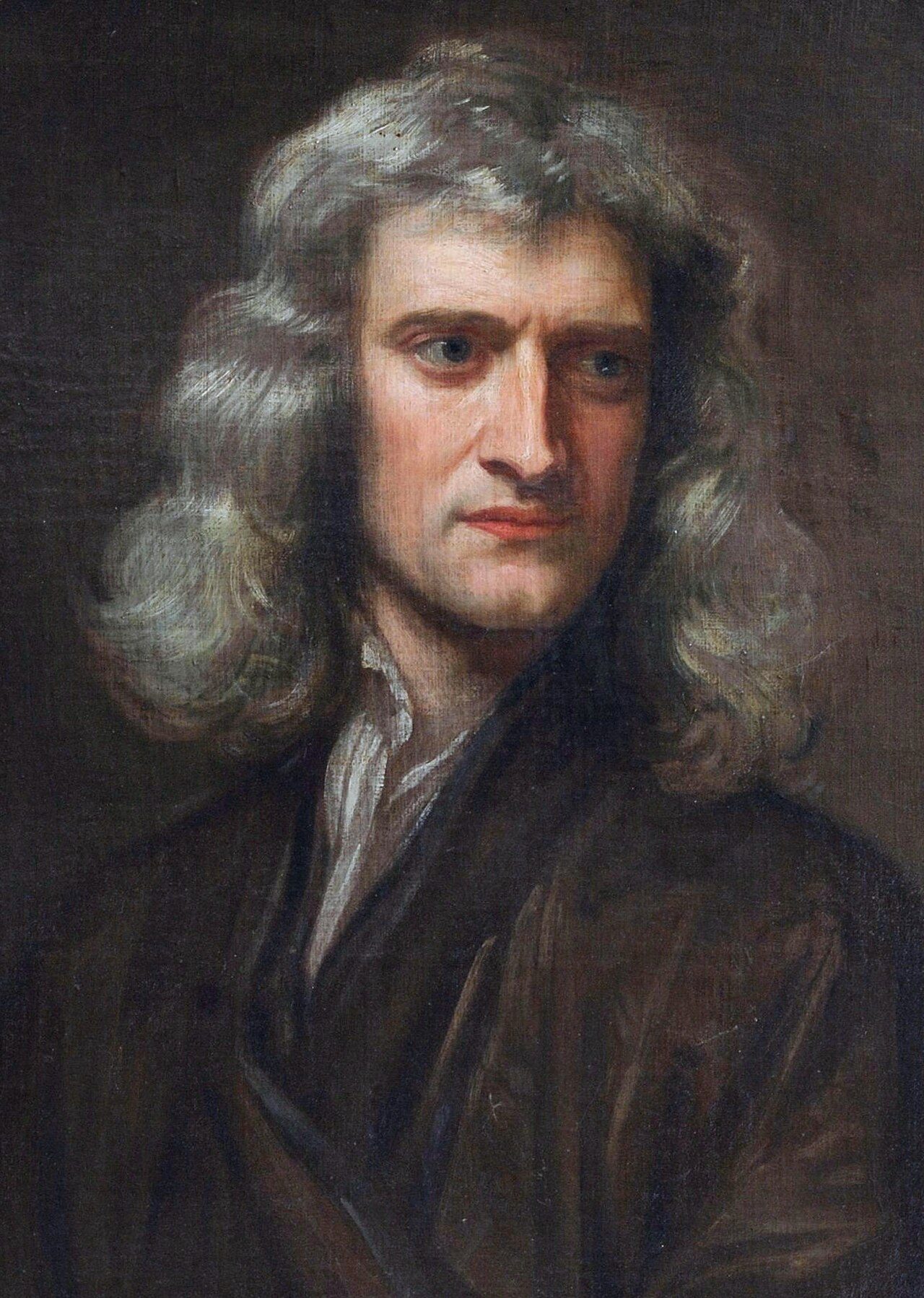
At a Glance
- Born
- 25 December 1642 (4 January 1643, New Style), Woolsthorpe, Lincolnshire, England
- Died
- 20 March 1727 (31 March, New Style), London
- Plague years
- 1665–66 — with Cambridge closed, he laid the foundations of calculus and his work on light and gravity at home
- Masterwork
- Philosophiae Naturalis Principia Mathematica (1687) — the three laws of motion and universal gravitation
- Optics
- Showed that white light is composed of colours; published in Opticks (1704)
- Public offices
- President of the Royal Society from 1703; Warden, then Master, of the Royal Mint; knighted in 1705
Introduction
Isaac Newton was an English physicist and mathematician who was the culminating figure of the Scientific Revolution of the seventeenth century. In optics, his discovery of the composition of white light integrated the phenomena of colours into the science of light and laid the foundation for modern physical optics. In mechanics, his three laws of motion — the basic principles of modern physics — resulted in the formulation of the law of universal gravitation. In mathematics, he was the original discoverer of the infinitesimal calculus.
His Philosophiae Naturalis Principia Mathematica — the Mathematical Principles of Natural Philosophy, published in 1687 — was one of the most important single works in the history of modern science. In it, the motions of visible bodies were given an exact quantitative description for the first time: one set of laws for the stone thrown on Earth and for the planets moving in the heavens.
Background
Newton was born in the hamlet of Woolsthorpe, the only son of a local yeoman who had died three months before his birth. A tiny and weak baby, he was not expected to survive his first day, much less 84 years. Within two years his mother remarried and moved away, leaving Isaac with his grandmother; for nine years, until his stepfather's death in 1653, he was effectively separated from her. Sent to manage the family property as a teenager, he proved a disaster — set to watch the cattle, he would curl up under a tree with a book — and was sent back to grammar school in Grantham to prepare for university.
He matriculated at Trinity College, Cambridge, in June 1661. The official curriculum was still Aristotelian, but Newton found the new philosophy on his own: Descartes, Gassendi, Boyle. A set of notes begun in 1664, his Quaestiones Quaedam Philosophicae, opens with the slogan that Plato is his friend and Aristotle is his friend, but his best friend is truth. Within little more than a year of serious mathematical study he had discovered the binomial theorem and developed the calculus — and told almost nobody.
Timeline
- 25 December 1642
Born at Woolsthorpe, Lincolnshire, three months after his father's death (4 January 1643 by the modern calendar).
- 1661
Matriculates at Trinity College, Cambridge.
- 1665
Receives his bachelor's degree in April; the plague then closes the university and he returns home to Woolsthorpe.
- 1665–66
The plague years: he lays the foundations of the calculus, extends his ideas on light and colours, and derives the inverse-square relation later crucial to universal gravitation.
- 1669
His tract De Analysi, summarising his mathematics, circulates in manuscript and makes his name known to a small circle.
- 1672
Sends a paper on light and colours to the Royal Society; Robert Hooke's critique helps drive him into virtual isolation.
- 1684
Edmond Halley receives Newton's short tract De Motu, 'On Motion' — the seed of the Principia.
- 1687
Publishes Philosophiae Naturalis Principia Mathematica, setting out the three laws of motion and the law of universal gravitation.
- 1703
Elected president of the Royal Society, a post he holds until his death.
- 1704
Publishes Opticks, summarising his research in light and colours.
- 20 March 1727
Dies in London, aged 84.
Significance
The Principia's achievement was unification. Newton compared the distance by which the Moon, in its orbit, is diverted from a straight path in one second with the distance a body at Earth's surface falls in one second — the Moon being about sixty times as far from Earth's centre as the apple at its surface — and showed that one inverse-square law of attraction accounts for both. The same mathematics yielded Kepler's laws of planetary motion, the tides, the trajectories of comets and the precession of the equinoxes, and ended serious doubt about the heliocentric system.
The three laws beneath it all are disarmingly simple: a body remains at rest or in uniform motion unless a force compels it to change; the change of motion is proportional to the force impressed; and to every action there is an equal and opposite reaction. From those statements, and the law of gravitation, the whole of classical mechanics followed — the physics that engineered the industrial age and that still designs bridges, engines and spacecraft trajectories today.
Legacy
Newton spent his last three decades in London as a public figure: Warden and then Master of the Royal Mint, where he pursued counterfeiters, president of the Royal Society from 1703, and knighted in 1705. His system stood essentially unchallenged for more than two hundred years, until Einstein's relativity showed where its edges lay — and even now, Newtonian mechanics remains the working physics of everyday scales. Galileo had died in the year Newton was born; between the two of them, the mathematical science of motion was begun and brought to completion.
Sources
- Encyclopaedia Britannica — Isaac Newton
- Encyclopaedia Britannica — Isaac Newton: The Principia
- Encyclopaedia Britannica — Life and works of Isaac Newton
The facts on this page were checked against these sources on 19 November 2026. The History Trail's permanent pages are researched and written for this site; the live profiles elsewhere on The History Trail are assembled automatically from Wikipedia and Wikidata.
About the Author
Researched and written by the The History Trail Editorial Team — the accountable editorial function behind this site's permanent story pages. The team works from the published sources cited on each page; it does not invent historians, reviewers or credentials, and it corrects errors openly.
Fact Check
Every load-bearing fact on this page traces to one of the sources listed above, and significant claims link to their source in the text. Our checking method is described on the methodology page; errors can be reported via the corrections page.
Sources & Citations
Cite this page as: The History Trail Editorial Team, The History Trail — this article's title, publication and update dates are shown beneath its headline. The full source list appears under Sources above; the site's source standards are on the sources page.