
Animals
Penguin
One family, found nowhere north of the Equator: penguins traded flight for the sea sixty million years ago and produced everything from a one-kilogram fairy penguin to the emperor — and, in between, giants taller than a man that are now long extinct.
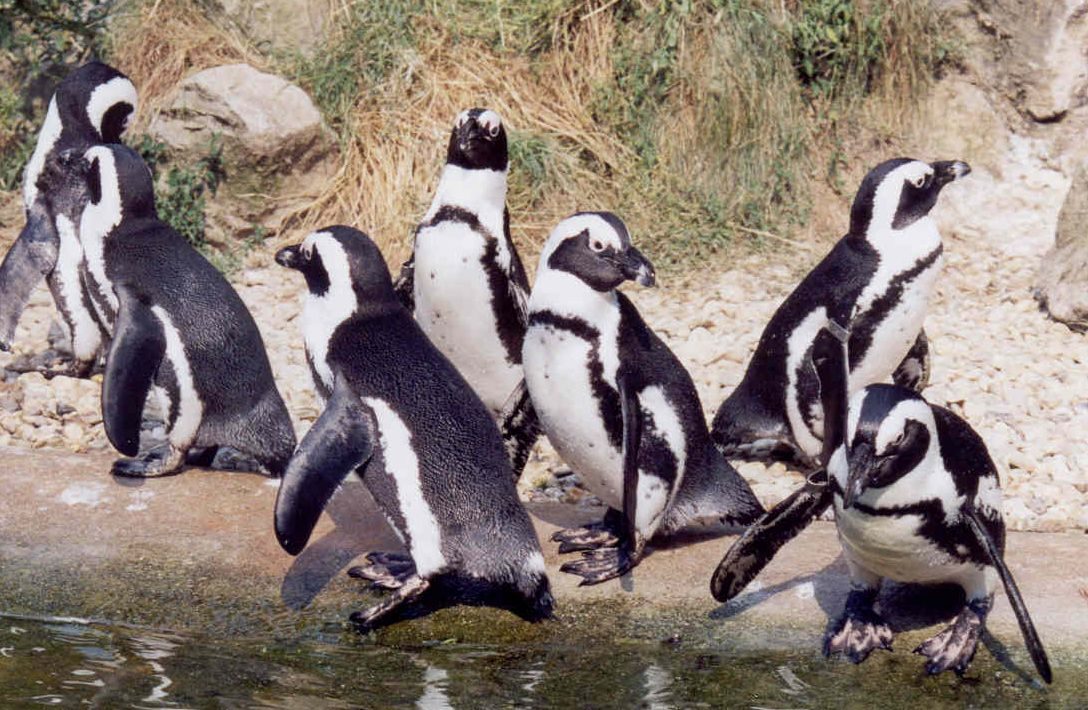
At a Glance
- Order
- Sphenisciformes — one family, Spheniscidae, in six genera
- Living species
- 18–21 species of flightless marine birds
- Range
- Only the Southern Hemisphere; most species breed between 45° and 60° S
- Northernmost
- The Galapagos penguin, living at the Equator
- Size range
- From the blue penguin (about 35 cm, 1 kg) to the emperor (up to 115 cm, 25–40 kg)
- Deepest diver
- The emperor penguin, Earth's deepest-diving bird at about 550 metres
- Diet
- Krill, fish and squid
- Origins
- Evolved from a flying ancestor about 60 million years ago
Introduction
Penguins are a family of flightless marine birds — the order Sphenisciformes, comprising eighteen to twenty-one living species in a single family, Spheniscidae, with six genera. They live only in the Southern Hemisphere. Despite their popular image, most penguins do not live in Antarctica at all: the majority of species breed on islands between latitudes 45° and 60° South, a few inhabit temperate coasts, and one, the Galapagos penguin, lives at the Equator. Only the emperor and Adélie penguins breed along the Antarctic coastline itself.
In size they span an extraordinary range for one family — from the blue, or fairy, penguin at about 35 centimetres tall and a kilogram in weight, to the emperor at up to 115 centimetres and 25 to 40 kilograms. What unites them is a body rebuilt for the sea: stocky, short-legged, upright on land, and driven underwater by wings transformed into paddles.
Background
The penguin's form is a catalogue of solutions to cold water. The feet sit far back on the body, producing the upright, plantigrade stance — penguins walk on the soles of their feet. The forelimb has become a stiff paddle, powered by flight muscles and a retained keel that now serve swimming instead of flight; webbed feet are used mainly for steering. Dense, short feathers over a layer of fat insulate against frigid seas, and a countercurrent heat-exchange system in the legs and feet keeps warmth in the body while the feet stand on ice. Most species are black above and white below, countershaded like the predators and prey around them, with colour confined to accents — the orange and yellow of emperor and king penguins, the yellow brow tufts of the crested penguins.
Penguins feed on krill, fish and squid, and some are astonishing divers: the emperor, Earth's deepest-diving bird, reaches depths of about 550 metres. They breed in colonies that can be immense — one royal penguin colony on Macquarie Island holds more than 500,000 breeding pairs — and most species share incubation and chick-rearing between both parents, the emperor being the famous exception. Populations of the smaller species run into the millions, yet penguins are highly vulnerable to changes in climate and ocean temperature and to depletion of local fish stocks.
Timeline
- About 60 million years ago
Fossil evidence indicates penguins evolved from a flying ancestor in the Southern Hemisphere, trading the air for the sea.
- About 50 million years ago
Penguins and the order Procellariiformes — albatrosses, shearwaters and petrels — are both represented by well-defined fossils, pointing to a common origin.
- 56–34 million years ago (Eocene)
Giant penguins flourish: Anthropornis stands about 1.8 metres tall, and Icadyptes about 1.5 metres — dwarfing every living species.
- About 8 million years ago
The lineage of living penguins begins — smaller, highly aquatic birds; the family's modern, modest size is a geologically recent development.
- 1800s
Nineteenth-century whalers and seal hunters raid colonies for meat and eggs, and a penguin oil industry takes large numbers of birds.
- Early 1900s
The exploitation becomes unprofitable and ends; most colonies are left alone or actively protected.
- Mid-1900s
Industrial whaling decimates Antarctic whales — the penguins' great competitors for krill — and some penguin species increase in numbers as a result.
- Today
Eighteen to twenty-one species persist, from the Equator to the Antarctic coast, but many face declining food supplies and a warming ocean.
Significance
Penguins are among the Southern Ocean's great consumers, and their colonies are nutrient engines: immense island rookeries concentrate the sea's production on land, and penguins themselves are a major food resource for seals and killer whales. Their scientific significance is just as large. The fossil record shows the family experimented early with gigantism and then, in the recent geological past, shrank — the small, hyper-aquatic modern penguin is the late product of a sixty-million-year history, not its starting point. Few bird families demonstrate so cleanly how a single trade — flight surrendered for swimming — can open an entire hemisphere's oceans.
Culturally, no other bird family commands the same affection. The stocky, upright, formally plumaged penguin has endeared itself to people worldwide, and that affection has practical value: penguins are flagship species for Southern Ocean conservation, and their sensitivity to ocean temperature and fish stocks makes them living instruments for measuring the health of the seas they patrol. When a penguin colony fails, it is usually the ocean reporting a problem first.
Legacy
The family's legacy is written in its survivors' spread: crested penguins on subantarctic islands, the banded penguins of South American, African and Galapagos coasts, the brush-tailed species of the Antarctic Peninsula, and the two great Aptenodytes — king and emperor — at the cold extreme. Each is a variation on the same Eocene decision to become a swimmer. Several species, such as the royal penguin, remain vulnerable precisely because their whole world population breeds in one small place, exposed to a single oil spill or storm season.
What the next chapter holds depends on the ocean itself. Penguins survived the end of the sealing era and profited, briefly, from the whalers' removal of their krill competitors; they are less equipped to out-adapt warming water and industrial fishing on their food supply. Sixty million years after a flying bird took to the southern seas, its descendants remain the Southern Hemisphere's signature birds — and its most sensitive witnesses.
Sources
- Encyclopaedia Britannica — Penguin
- Encyclopaedia Britannica — Penguin: Form and function
- Encyclopaedia Britannica — Antarctica: Animal life
- Australian Antarctic Program — Emperor penguin (family context and adaptations)
The facts on this page were checked against these sources on 19 November 2026. The History Trail's permanent pages are researched and written for this site; the live profiles elsewhere on The History Trail are assembled automatically from Wikipedia and Wikidata.
About the Author
Researched and written by the The History Trail Editorial Team — the accountable editorial function behind this site's permanent story pages. The team works from the published sources cited on each page; it does not invent historians, reviewers or credentials, and it corrects errors openly.
Fact Check
Every load-bearing fact on this page traces to one of the sources listed above, and significant claims link to their source in the text. Our checking method is described on the methodology page; errors can be reported via the corrections page.
Sources & Citations
Cite this page as: The History Trail Editorial Team, The History Trail — this article's title, publication and update dates are shown beneath its headline. The full source list appears under Sources above; the site's source standards are on the sources page.