
Animals
Bald eagle
The United States chose the bald eagle as its national symbol in 1782 and then spent a century and a half shooting it, clearing its nesting habitat and poisoning its food with DDT. Its rescue — from 417 nesting pairs to more than seventy thousand — is conservation's favourite proof that decline can be reversed.
At a Glance
- Scientific name
- Haliaeetus leucocephalus
- Range
- The only eagle solely native to North America — Alaska and Canada to northern Mexico
- Size
- Females up to 8 feet wingspan and 14 pounds; males smaller, up to 6 feet and 10 pounds
- Low point
- 417 known nesting pairs in the contiguous United States, 1963
- Recovery
- 316,700 individuals, including 71,467 breeding pairs, in the lower 48 states (2018–19 estimates)
- Lifespan
- Up to about 30 years in the wild, longer in captivity
- Status
- Removed from the endangered species list in 2007; still protected by the Migratory Bird Treaty Act and the Bald and Golden Eagle Protection Act
Introduction
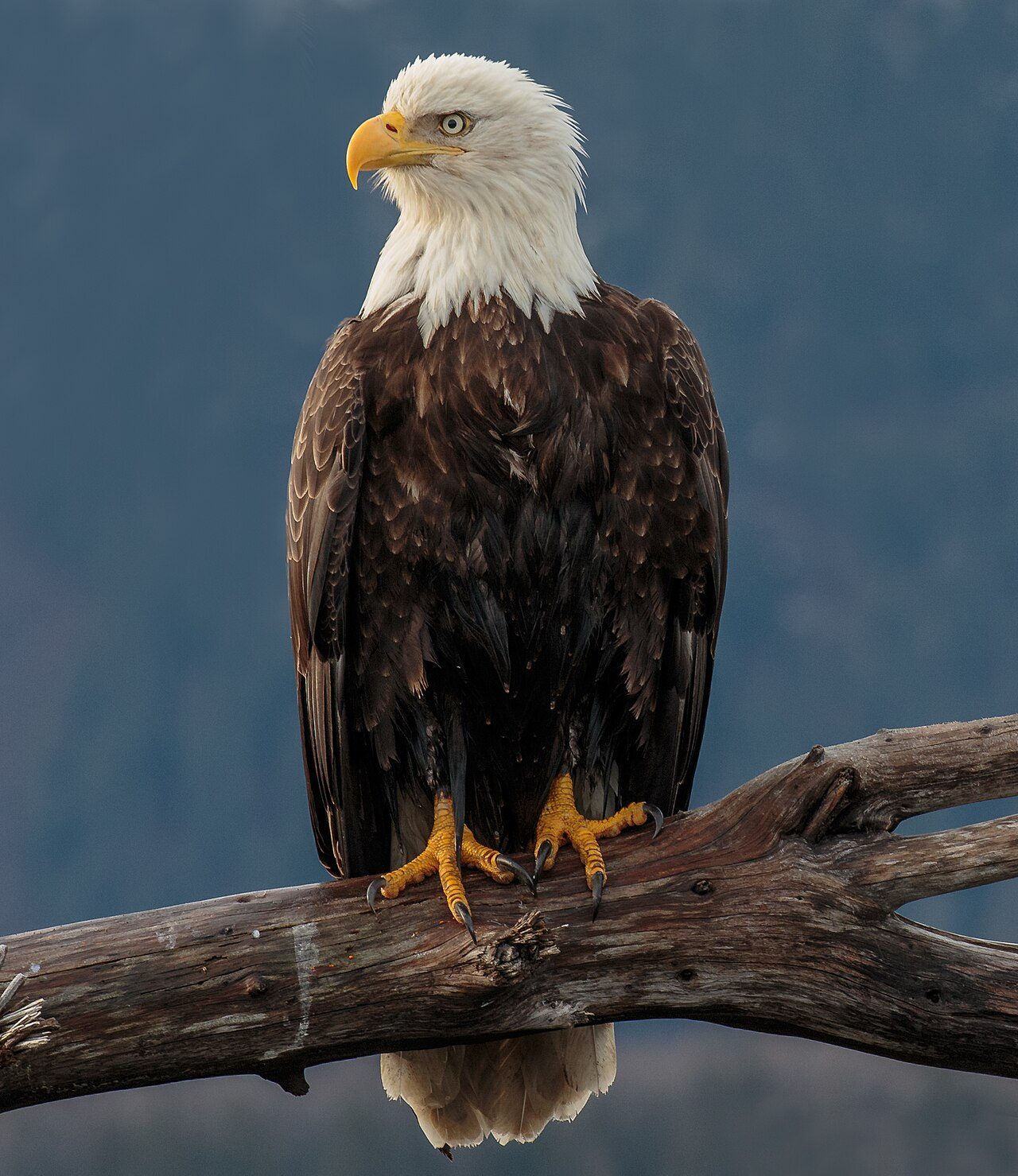
The bald eagle is a large, powerful bird of prey found only in North America — the only eagle solely native to the continent, ranging historically from Alaska and Canada across the contiguous United States to northern Mexico. The adult is unmistakable: a dark brown body set off by a white head and white tail, bright yellow bill and legs. But that plumage is earned slowly. Females are the larger sex, reaching a wingspan of up to eight feet and a weight of fourteen pounds, against the male's six feet and ten pounds; northern birds grow larger than southern ones, and Alaskan eagles have reached sixteen pounds.
Bald eagles are visual, opportunistic hunters. Fish is the staple food, taken by swooping from a conspicuous perch or soaring flight, but they also feed on waterfowl, shorebirds, turtles, rabbits, snakes, small animals and carrion — and they are notorious food thieves, stealing caught prey from other eagles, mammals and birds of prey.
Origins
When America adopted the bald eagle as its national symbol in 1782, anecdotal accounts suggested the country may have held as many as 100,000 nesting eagles. The first major decline probably began in the mid to late 1800s, coinciding with the decline of the waterfowl, shorebirds and other prey eagles depended on. Worse, eagles were widely considered marauders that preyed on chickens, lambs and livestock, and were shot in an effort to eliminate the perceived threat. Coupled with the loss of nesting habitat, the shooting drove populations down for a century.
Protection came just before the worst blow. Shortly after the Second World War, the insecticide DDT was hailed as a wonder pesticide. Its residues washed into waterways, were absorbed by aquatic plants and fish, and poisoned the eagles that ate the contaminated fish. DDT interfered with the birds' ability to produce strong eggshells; the shells became so thin they often broke during incubation or failed to hatch. By 1963 only 417 nesting pairs of bald eagles were known to exist in the contiguous United States, and the national symbol was in genuine danger of extinction.
Timeline
- 1782
The United States adopts the bald eagle as its national symbol; the country may hold as many as 100,000 nesting eagles.
- Mid–late 1800s
The first major decline begins, as prey species fall and eagles are shot as supposed predators of livestock.
- 1940
Congress passes the Bald Eagle Protection Act, prohibiting killing, selling or possessing the species.
- 1963
Only 417 nesting pairs are known in the contiguous United States; DDT-thinned eggs are failing across the range.
- 1967
The Secretary of the Interior lists bald eagles south of the 40th parallel under the Endangered Species Preservation Act.
- 1972
The Environmental Protection Agency bans DDT in the United States, spurred in large part by Rachel Carson's Silent Spring.
- 1978
Under the Endangered Species Act the bald eagle is listed as endangered across the lower 48 states, except five states where it is listed as threatened.
- July 1995
Recovered populations in the lower 48 are reclassified from endangered to the less critical category of threatened.
- 28 June 2007
With at least 9,789 nesting pairs in the contiguous United States, the bald eagle is removed from the threatened and endangered species list.
- 2018–2019
Population estimates for the lower 48 states reach 316,700 individual bald eagles, including 71,467 breeding pairs.
Significance
The recovery was engineered, not accidental. Listing gave the species a springboard: captive breeding programmes, reintroduction efforts, law enforcement and protection of nest sites during the breeding season accelerated the rebound, on top of habitat protection under the Endangered Species Act and the DDT ban. The numbers chart a classic conservation arc — 417 nesting pairs in 1963, at least 9,789 by 2007, and an estimated 71,467 breeding pairs among 316,700 individuals in the lower 48 states by 2018–19.
The bird's own biology rewarded the effort. Bald eagles mate for life, though a survivor accepts a new mate; pairs build nests four to five feet wide in the tallest trees, return to enlarge the same nest year after year, and produce structures that can reach ten feet across and weigh thousands of pounds — the largest recorded, at St. Petersburg, Florida, was nine and a half feet in diameter, twenty feet deep and weighed almost 6,000 pounds.
Legacy
Delisting in August 2007 did not leave the eagle unprotected: it remains covered by the Migratory Bird Treaty Act and the Bald and Golden Eagle Protection Act, which prohibit killing, selling or otherwise harming eagles, their nests or their eggs, and the import and export of eagles and their parts is prohibited by law. The Fish and Wildlife Service continues to work with state and federal agencies, tribes, non-governmental organisations and private landowners to keep the population flourishing.
The bald eagle's legacy is the template it proved. A species can be shot at, starved of habitat and poisoned through its food chain down to a few hundred pairs — and still come back, if the poison is banned, the nests are guarded and the law holds for decades.
Sources
- U.S. Fish & Wildlife Service — Bald Eagle (Haliaeetus leucocephalus)
- Smithsonian's National Zoo and Conservation Biology Institute — Bald eagle
- Cornell Lab of Ornithology — Bald Eagle Overview, All About Birds
The facts on this page were checked against these sources on 19 November 2026. The History Trail's permanent pages are researched and written for this site; the live profiles elsewhere on The History Trail are assembled automatically from Wikipedia and Wikidata.
About the Author
Researched and written by the The History Trail Editorial Team — the accountable editorial function behind this site's permanent story pages. The team works from the published sources cited on each page; it does not invent historians, reviewers or credentials, and it corrects errors openly.
Fact Check
Every load-bearing fact on this page traces to one of the sources listed above, and significant claims link to their source in the text. Our checking method is described on the methodology page; errors can be reported via the corrections page.
Sources & Citations
Cite this page as: The History Trail Editorial Team, The History Trail — this article's title, publication and update dates are shown beneath its headline. The full source list appears under Sources above; the site's source standards are on the sources page.