
Things
Avalanche
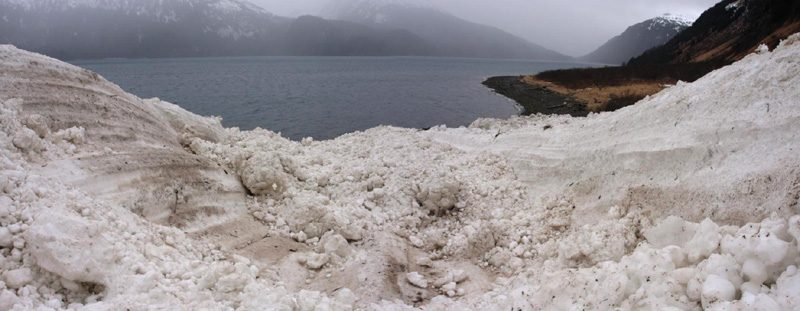
An avalanche is a mass of snow that breaks loose from a mountainside and moves rapidly downhill, growing as it goes. The deadliest kind, the slab avalanche, happens when a cohesive plate of snow collapses on a hidden weak layer and the whole slope releases at once - on gradients of 30 to 50 degrees, sometimes under the weight of a single skier. Alpine history, from White Friday in 1916 to Galtur in 1999, is the record of communities learning, disaster by disaster, to forecast and defend against the snow above them.
At a Glance
- What it is
- A mass of snow (also rock, ice or debris) moving rapidly down a slope; a large slab avalanche can reach 130 km/h (80 mph), according to Britannica
- The classic set-up
- A cohesive slab of snow resting on a weakened buried layer, on a slope of 30 to 50 degrees - loaded by snowfall, wind, warming or rain, then released by a trigger
- Who is at risk
- About 150 people a year die in avalanches in North America and Europe; most victims are backcountry travellers who trigger the slide themselves
- White Friday
- 13 December 1916: official Austrian sources give 1,300 deaths for 5-14 December on the Alpine front; claims of 10,000 are judged too high by the ECMWF-Bern reanalysis
- Galtur
- 23 February 1999: 31 people killed in Austria's worst single avalanche accident since 1954; it forced new national hazard-map criteria within months
- Protection
- Daily danger bulletins on a five-level scale, explosive control work, snow fences and dams, hazard zoning - and, for travellers, transceiver, shovel, probe and airbag pack
Introduction
Britannica defines an avalanche as a mass of material moving rapidly down a slope, typically triggered when the material breaks loose and then collects and carries still more material as it descends. Snow avalanches range from a small shift of loose snow, called sluffing, to enormous slabs that, Britannica records, can reach speeds of 130 km (80 miles) per hour and destroy forests and villages in their path. Avalanches kill about 150 people a year in North America and Europe, most of them skiers, climbers and snowmobilers who trigger the slide that buries them.
The avalanche is therefore a disaster with a peculiar structure: the danger is built quietly, layer by layer, all winter, and released in seconds - often by the weight of a single person. Its history is the history of mountain communities learning to read that hidden structure: villages that zoned their slopes, soldiers who died under snow in the First World War, and forecasters who now dig into the snowpack each morning.
The Snowpack: Layers, Weak Layers and Slabs
A snowpack is not one material but a stack of layers, each formed by a different snowfall under different weather. Once snow is on the ground, Britannica explains, its ice crystals keep changing, and the changes can weaken a buried layer beneath a cohesive slab of harder snow above it. That arrangement - a strong plate on a weak foundation - is the classic set-up for a slab avalanche, the deadliest kind. Slab avalanches typically occur on slopes of 30 to 50 degrees: on gentler slopes gravity cannot overcome friction, and on steeper ones snow sluffs off before a slab can build.
Weather loads the trap: heavy snowfall overloads old weaknesses, wind packs snow into slabs on lee slopes, and rapid warming or rain can weaken the structure within hours. Then a trigger - new snow, a falling cornice, an explosive charge, or most commonly a person - applies the final force.
White Friday, December 1916: The Alpine War's Deadliest Day
The worst avalanche disaster in European history was a by-product of the First World War. On the Austro-Hungarian and Italian front in the southeastern Alps, soldiers held summit positions where, a University of Bern and ECMWF reanalysis records, losses from avalanches and exposure rivalled those from enemy fire. The winter of 1916-17 was one of the snowiest of the century. After a week of abundant snowfall, on 13 December 1916 a warm, humid air mass brought intense precipitation and a rising snow level, and countless avalanches fell - the day remembered as White Friday.
The largest single incident struck the barracks at Gran Poz on Mount Marmolada, where, the reanalysis reports, between 270 and 332 men died. For the whole event this page uses the reanalysis's attributed figures: official Austrian sources give 1,300 deaths and 650 wounded for 5-14 December 1916, while later estimates give about 2,000 casualties for 12 and 13 December, with Italian losses thought similar. Dozens of civilians also died as slides reached settlements considered safe. The disaster passed almost unnoticed, censored in wartime - one reason its numbers are still argued over, as the myths section explains.
From the Winter of Terror to Galtur: Lessons Written in Zoning Maps
The Alps relearned the lesson in peacetime - the Winter of Terror of 1950-51 brought 235 avalanche fatalities in Austria and Switzerland alone, and the Blons avalanches of January 1954 killed 122 people in Vorarlberg by Holler's chronology - and hazard zoning, protection forests and forecasting followed. The system was tested again on 23 February 1999 at Galtur. After weeks of Atlantic storms, a huge dry-snow slab released above the village and its powder cloud crossed ground the hazard maps had treated as safe. Holler and Schaffhauser of Austria's Federal Forest Research Centre record 31 fatalities, the most serious single avalanche accident in Austria since 1954; the next day a second avalanche at Valzur killed seven more. Galtur led directly to new hazard-map criteria, in force from July 1999.
Timeline
- 1916
Austrian ski pioneer Mathias Zdarsky publishes his elements of avalanche awareness, identifying slope angle, friction, snow strength and snow weight as the key factors.
- 13 December 1916
White Friday: after a week of heavy snowfall and a sudden warm, wet air mass, countless avalanches strike the Alpine front; official Austrian sources give 1,300 deaths for 5-14 December.
- 1929
Zdarsky's fuller work opens with the dictum that the wind is the architect of most avalanches.
- Winter 1950-51
The Winter of Terror: extreme snowfall triggers hundreds of avalanches across the Alps, with 235 fatalities in Austria and Switzerland alone.
- January 1954
Avalanches devastate the Great Walser Valley around Blons in Vorarlberg, Austria; Holler's chronology lists 122 fatalities in Vorarlberg.
- 23 February 1999
The Galtur avalanche kills 31 people, Austria's most serious single avalanche accident since 1954, after snow reaches ground the hazard maps had zoned as safe.
- 24 February 1999
A second great avalanche strikes Valzur, a few kilometres from Galtur, killing seven people.
- July 1999
Austria's revised hazard-map design criteria, drawn from the Galtur and Valzur disasters, come into force.
Forecasting and Protection: Reading the Mountain Before It Moves
Modern avalanche forecasting is a daily judgement. Britannica describes the forecaster's craft: field work to gather snowpack information - digging snow pits, testing layers, examining crystals - combined with remotely accessed weather data, historical databases and models, to predict when and where avalanches are most likely. In Europe the results are published as bulletins on a five-level danger scale, from 1 (low) to 5 (very high), naming the day's avalanche problems, such as wind slab or a persistent buried weak layer.
Where people cannot simply stay away, the mountain is managed. Explosives release unstable slopes deliberately when nobody is exposed - standard practice at ski areas and along highways. Fences hold snow on the slope; dams and wedges deflect what comes down; hazard maps zone the ground below. For backcountry travellers the standard kit is a transceiver, shovel and probe; inflatable airbag packs, designed to help a caught person stay nearer the surface, add a further chance - a help, never a guarantee.
Significance
Avalanches wrote some of the earliest land-use law in the mountains. Hazard zoning - the maps that decide where an Alpine village may build - is avalanche science translated into planning, and Galtur's revision of the Austrian criteria in 1999 is the clearest case of a single disaster rewriting a country's rules. The science runs both ways: institutes such as Switzerland's WSL Institute for Snow and Avalanche Research study the snowpack systematically, and modern models can now reconstruct even the storm that caused White Friday in 1916.
Myths and disputes
Can a shout set off an avalanche? Britannica answers plainly: no. Yelling or yodelling will not trigger avalanches; only the loudest sonic booms, under the most sensitive conditions, might do so. What triggers slides is weight and stress on a weak layer - which is why the person most at risk is so often the person standing on the slab.
The White Friday death toll is genuinely disputed, and this page flags the spread rather than choosing a dramatic number. Popular accounts, and even Britannica's avalanche article, speak of more than 10,000 troops killed in a single day in December 1916, sometimes adding that the slides were triggered by artillery fire. The ECMWF and University of Bern reanalysis concludes that estimates of 10,000 are certainly too high: official Austrian sources give 1,300 deaths for 5-14 December, and its account of 13 December blames the weather rather than gunnery. The artillery story belongs to the wider Alpine war, in which Britannica notes avalanches were also triggered intentionally.
Legacy
The avalanche's legacy is measured in what now stands on Alpine slopes: protection forests guarded by law, snow fences and galleries over roads and railways, villages zoned by hazard maps, and a daily bulletin skiers check as routinely as a weather forecast. The disasters are commemorated where they happened, and the research institutes founded in response still set the world's standard for snow science.
Sources
- Encyclopaedia Britannica - Avalanche
- ECMWF Newsletter (Brugnara et al., University of Bern) - Reanalysis sheds light on 1916 avalanche disaster
- Federal Forest Research Centre, Austria (Holler and Schaffhauser) - The Avalanches of Galtur and Valzur in Feb. 1999
- Peter Holler, BFW Austria - About the Practical Knowledge to Understand Snow Avalanches: A Chronology
- EARTH Magazine - Benchmarks: February 23-24, 1999: Alpine Avalanches Sweep Through Austrian Towns
The facts on this page were checked against these sources on 19 November 2026. The History Trail's permanent pages are researched and written for this site; the live profiles elsewhere on The History Trail are assembled automatically from Wikipedia and Wikidata.
About the Author
Researched and written by the The History Trail Editorial Team — the accountable editorial function behind this site's permanent story pages. The team works from the published sources cited on each page; it does not invent historians, reviewers or credentials, and it corrects errors openly.
Fact Check
Every load-bearing fact on this page traces to one of the sources listed above, and significant claims link to their source in the text. Our checking method is described on the methodology page; errors can be reported via the corrections page.
Sources & Citations
Cite this page as: The History Trail Editorial Team, The History Trail — this article's title, publication and update dates are shown beneath its headline. The full source list appears under Sources above; the site's source standards are on the sources page.