
Things
Egypt
Egypt is one of the world's oldest continuous civilisations: a country created by the Nile, united under its first pharaohs around 3000 BCE, and ruled in turn by pharaonic dynasties, Persians, Greeks, Romans, Arabs, Mamluks, Ottomans and the British, before officers overthrew the monarchy in 1952 and proclaimed a republic. Its pyramids, its canal and its river explain almost everything about it.
At a Glance
- Official name
- Arab Republic of Egypt; capital Cairo; Arabic is the official language and the Egyptian pound the currency
- Population
- About 109,139,000 (2026 estimate, Britannica); virtually all Egyptians live in the Nile valley, the delta and scattered oases
- Area
- 384,790 sq mi (996,603 sq km), mostly arid western and eastern desert divided by the Nile River
- Unification
- Upper and Lower Egypt were united c. 3000 BCE, beginning nearly 3,000 years of native rulers across 31 dynasties, divided into the Old, Middle and New Kingdoms
- The pyramids
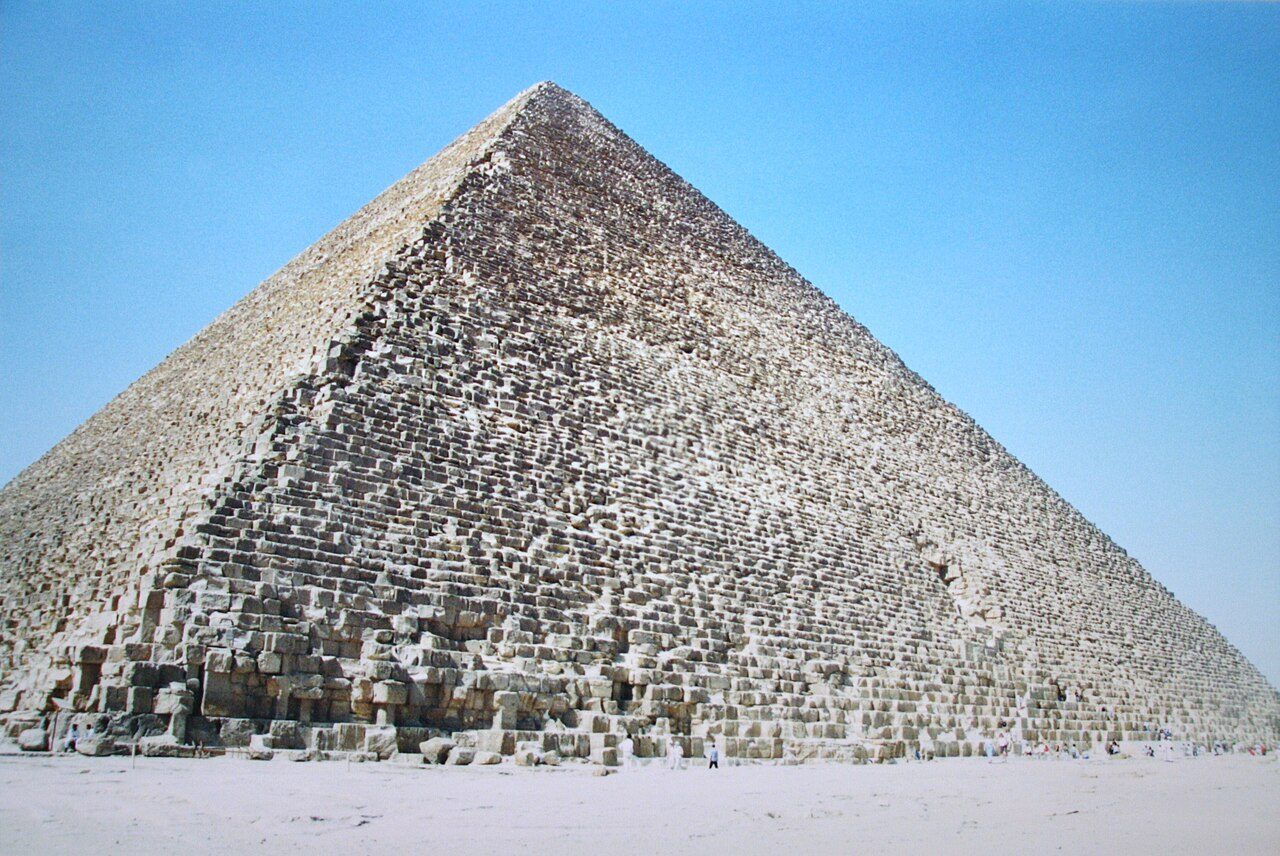
- Old Kingdom monuments; the Great Pyramid of Khufu at Giza is the only surviving wonder of the ancient world, among more than 38 pyramids in the Memphis necropolis
- Suez Canal
- Built 1859-1869 and officially opened on 17 November 1869; nationalised by President Nasser in 1956, precipitating the Suez Crisis
- The republic
- Army officers overthrew the monarchy in 1952 and a republic was proclaimed in 1953; a popular uprising forced President Mubarak to step down in 2011
Introduction
Egypt, officially the Arab Republic of Egypt, is a country at the crossroads of Africa, Europe and Asia, with a population estimated by Britannica at about 109 million in 2026 and its capital at Cairo. Most of its land is arid desert; its dominant feature is the Nile, whose valley, generally 5 to 10 miles (8 to 16 km) wide, fans out north of Cairo into the densely populated delta. The Nile valley and delta, along with scattered oases, support all of Egypt's agriculture and virtually all of its population.
Britannica calls Egypt one of the world's oldest continuous civilisations. Upper and Lower Egypt were united around 3000 BCE, beginning a line of native rulers that lasted nearly 3,000 years. What followed was the same river-made land ruled in succession by Persians, Greeks, Romans, Arab caliphs, Mamluks, Ottomans and the British, until Egyptian officers overthrew the monarchy in 1952 and a republic was proclaimed in 1953. This page follows that whole sweep, from the first pharaohs to the modern republic.
The Nile Kingdom: Pharaohs and Pyramids
Ancient Egypt can be thought of, in Britannica's phrase, as an oasis in the desert of northeastern Africa, dependent on the Nile's annual inundation. The flood deposited silt, the valley grew emmer wheat and barley with very high productivity from a single annual crop, and the surpluses that could be stored against failure formed the chief basis of Egyptian wealth. The Nile was also the country's sole transportation artery, linking Memphis and Thebes.
Historians divide pharaonic history into the Old, Middle and New Kingdoms, spanning 31 dynasties. The pyramids date from the Old Kingdom: UNESCO records more than 38 pyramids in the Memphis necropolis, among them the three pyramids of Giza, of which the Great Pyramid of Khufu is the only surviving wonder of the ancient world. At Saqqara stands the Pyramid of Djoser, the Step Pyramid - the first monumental stone building ever constructed and the first pyramid ever built. Memphis itself, traditionally believed founded in 3000 BC, commanded the entrance to the delta and served as the effective administrative capital through much of the country's history.
Crossroads of Empires: Persia, Alexander, Rome and Islam
An Assyrian invasion came in 671 BCE, and the Persian Achaemenids established a dynasty in 525 BCE, ending native rule. Then, in 332 BCE, Alexander the Great invaded, inaugurating the Ptolemaic period and the ascendancy of Alexandria as a centre of learning. The Romans held Egypt from 30 BCE to 395 CE; afterwards it was part of the Byzantine Empire, and a formal Egyptian, Coptic, church emerged.
Egypt came under Arab control in 642 CE and was ultimately transformed into an Arabic-speaking state with Islam as the dominant religion, though a Coptic Christian minority remained, as it does today. After Umayyad and Abbasid rule, Egypt in 969 became the centre of the Fatimid dynasty, whose rulers founded Cairo; the Mamluk state of 1250 lasted until 1517, when Egypt fell to the Ottoman Empire. Through every change of ruler, language and faith, the geography did not change: whoever held the Nile valley and its delta held Egypt.
Suez, Britain and the Road to a Republic
The modern turning point was a canal. In 1854 Ferdinand de Lesseps received a concession from Egypt's viceroy, Said Pasha, to cut a waterway; construction began in 1859, dug at first by hand by drafted Egyptian peasants, and the canal was officially opened on 17 November 1869. It also bound Egypt to European finance: in 1875 financial troubles compelled Said's successor, Ismail Pasha, to sell Egypt's holding in the Canal Company, which the British government bought at once. Egypt became a British protectorate in 1914 and received nominal independence in 1922, when a constitutional monarchy was established.
In 1952 a group of army officers led by Gamal Abdel Nasser overthrew that monarchy, and a republic followed in 1953. In 1956 President Nasser nationalised the Suez Canal, precipitating the Suez Crisis: Britain, France and Israel attacked Egypt, and only American, Soviet and United Nations pressure forced their withdrawal, leaving the canal in Egyptian hands under the Suez Canal Authority. The Nile itself was remade a decade later: the Aswan High Dam, built between 1960 and 1970, virtually eliminated the danger of floods downstream, generated about half of Egypt's electricity when completed, and required the relocation of nearly 100,000 residents and the moving of archaeological sites above the new Lake Nasser. Under Nasser's successor, Anwar el-Sadat, Egypt made peace with Israel in 1979, after three wars between them. Sadat was assassinated in 1981 and succeeded by Hosni Mubarak; a popular uprising in 2011 forced Mubarak out, and the military removed his elected successor, Mohammed Morsi, in 2013.
Timeline
- c. 3000 BCE
Upper and Lower Egypt are united, traditionally under Menes (Narmer); Memphis becomes the capital of a unified Egypt.
- c. 2543-c. 2436 BCE
The 4th dynasty builds the great pyramids - among them the Great Pyramid of Khufu at Giza.
- 332 BCE
Alexander the Great conquers Egypt; the Ptolemaic period begins and Alexandria rises as a centre of learning.
- 30 BCE
Egypt passes to Rome, which holds it until 395 CE; it later forms part of the Byzantine Empire.
- 642 CE
Egypt comes under Arab control and is transformed into an Arabic-speaking state with Islam as the dominant religion.
- 969
Egypt becomes the centre of the Fatimid dynasty; its rulers found Cairo.
- 17 November 1869
The Suez Canal is officially opened after ten years of construction, linking the Mediterranean and the Red Sea.
- 1922
After a British protectorate declared in 1914, Egypt receives nominal independence and a constitutional monarchy is established.
- 1952-1953
Army officers led by Gamal Abdel Nasser overthrow the monarchy in 1952; the Egyptian republic is proclaimed in 1953.
- 1956
Nasser nationalises the Suez Canal; Britain, France and Israel attack, then withdraw under American, Soviet and UN pressure.
- 1979
Egypt signs a peace treaty with Israel, the first between Israel and an Arab country, under President Anwar el-Sadat.
- 2011
A popular uprising forces President Hosni Mubarak to step down; the military assumes control.
Significance
Egypt's significance is continuity under change. The same river valley that fed the builders of Giza feeds more than a hundred million people today, and the same crossroads position that drew Alexander, the Arabs and the Ottomans made the Suez Canal, in Britannica's words, the shortest maritime route between Europe and the lands around the Indian and western Pacific oceans. Pharaonic Egypt also left the ancient world's most durable monuments and one of its earliest writing systems, hieroglyphs and the cursive hieratic script, both dating to around 3000 BCE.
Questions readers ask
Were the pyramids built by slaves? The popular image of vast slave gangs is not the picture in Britannica's account: slavery in ancient Egypt was never common, being restricted to captives and foreigners or to people forced by poverty or debt into service, and most who worked the land, though tied to it, were not enslaved. What the pyramids required was a centralised state able to mobilise a huge labour force, made available by exceptionally efficient agriculture - and even so, how they were constructed has yet to be fully explained.
Was Menes a real king? Britannica treats Menes as the legendary first king of unified Egypt: tradition credits him with joining Upper and Lower Egypt and founding Memphis, and he is identified with the king also called Narmer. The unification itself, around 3000 BCE, is the reference point historians use for Egypt's origin; the single founding king belongs to tradition, and UNESCO likewise calls Memphis only traditionally believed to have been founded in 3000 BC.
Legacy
Egypt's legacy stands in stone along the west bank of the Nile: the Memphis necropolis, its pyramid fields running from Giza to Dahshur with more than 9,000 rock-cut tombs, is a UNESCO World Heritage site preserving almost 80 percent of its ancient form and material. The living legacy is the country itself - Arabic-speaking, predominantly Muslim, ruled from Cairo, still organised around the river that made the pharaohs. The Aswan High Dam ended the annual inundation that had defined Egyptian farming for five millennia, but valley, delta and canal remain the whole basis of Egyptian life.
Sources
- Encyclopaedia Britannica - Egypt
- Encyclopaedia Britannica - Ancient Egypt
- UNESCO World Heritage Centre - Memphis and its Necropolis: the Pyramid Fields from Giza to Dahshur
- Encyclopaedia Britannica - Suez Canal: Construction, Expansion, Trade
- Office of the Historian, US Department of State - The Suez Crisis, 1956
- NASA Earth from Space - Aswan High Dam, Southern Egypt
The facts on this page were checked against these sources on 19 November 2026. The History Trail's permanent pages are researched and written for this site; the live profiles elsewhere on The History Trail are assembled automatically from Wikipedia and Wikidata.
About the Author
Researched and written by the The History Trail Editorial Team — the accountable editorial function behind this site's permanent story pages. The team works from the published sources cited on each page; it does not invent historians, reviewers or credentials, and it corrects errors openly.
Fact Check
Every load-bearing fact on this page traces to one of the sources listed above, and significant claims link to their source in the text. Our checking method is described on the methodology page; errors can be reported via the corrections page.
Sources & Citations
Cite this page as: The History Trail Editorial Team, The History Trail — this article's title, publication and update dates are shown beneath its headline. The full source list appears under Sources above; the site's source standards are on the sources page.