
Things
Unicorn
The unicorn is a mythical creature - a horse-like animal with a single horn that has never existed. Yet for two thousand years it was described as real by ancient writers, treasured by medieval kings, woven into great tapestries and chosen as the national animal of Scotland, which it remains today.
At a Glance
- What it is
- A mythical creature - a horse-like animal with a single spiralling horn. No such animal has ever existed
- First description
- Ctesias, a Greek physician at the Persian court, described a one-horned Indian wild ass around 400 BCE; his account probably reflects the Indian rhinoceros
- The horn
- Alicorn, said to detect and cure poison - in reality narwhal tusks and rhinoceros horn, traded at treasure prices
- The masterpiece
- The Unicorn Tapestries, seven hangings of 1495-1505, designed in Paris, woven in the southern Netherlands, now at The Cloisters, New York
- Scotland
- Scotland's national animal: on Scottish royal arms since the Middle Ages, on gold unicorn coins under James III, and still beside England's lion in the royal arms
- The unravelling
- In 1638 Ole Worm showed that prized unicorn horns were narwhal tusks; improving natural history then retired the animal to legend
Introduction
For most of that long belief, the unicorn was not a fairy-tale creature. Greek and Roman writers placed it in natural history, among real animals in distant India. Medieval Christians read it as a symbol of Christ and of purity. Kings paid fortunes for its horn, said to detect poison, and Scotland put the animal on its royal arms, where it remains. The unicorn's history is therefore not a history of an animal, but of an idea - and of the texts, artworks and emblems that kept it alive.
This page traces that documented history: the ancient reports, the medieval bestiaries, the great tapestries woven around 1500, the narwhal tusks sold as unicorn horn, and the slow scientific unravelling of the belief.
Ancient Reports: Ctesias and Pliny
The earliest description in Greek literature, Britannica records, is by the historian and physician Ctesias, writing around 400 BCE about India, which he knew through the Persian court rather than by travel. His Indian wild ass was the size of a horse, with a white body, a purple or dark red head and blue eyes, and on its forehead a cubit-long horn, red at the pointed tip, black in the middle and white at the base. Those who drank from the horn, he said, were protected from stomach trouble, epilepsy and poison. Britannica notes that the animal behind the description was probably the Indian rhinoceros.
Later classical writers repeated the account as natural history, not myth. In the first century CE, Pliny the Elder described the monoceros in his Natural History as a very fierce animal with the body of a horse, the head of a stag, the feet of an elephant and the tail of a boar, a deep lowing voice and a single black horn two cubits long - adding that it could not be taken alive. For Greek and Roman readers, the unicorn lived at the edge of the known world, exactly where unverifiable animals belonged.
Bestiaries, Virgins and the Meaning of the Hunt
The Bible helped carry the belief into Christian Europe. Hebrew passages speak of a strong horned animal called the re'em; many old translations rendered the word as unicorn, though modern translations prefer wild ox, the aurochs, which Britannica gives as the correct meaning. The Physiologus, an early Greek bestiary, taught that the unicorn is strong and fierce and can be caught only if a virgin maiden is placed before it: it leaps into her lap, and she leads it to the king's palace.
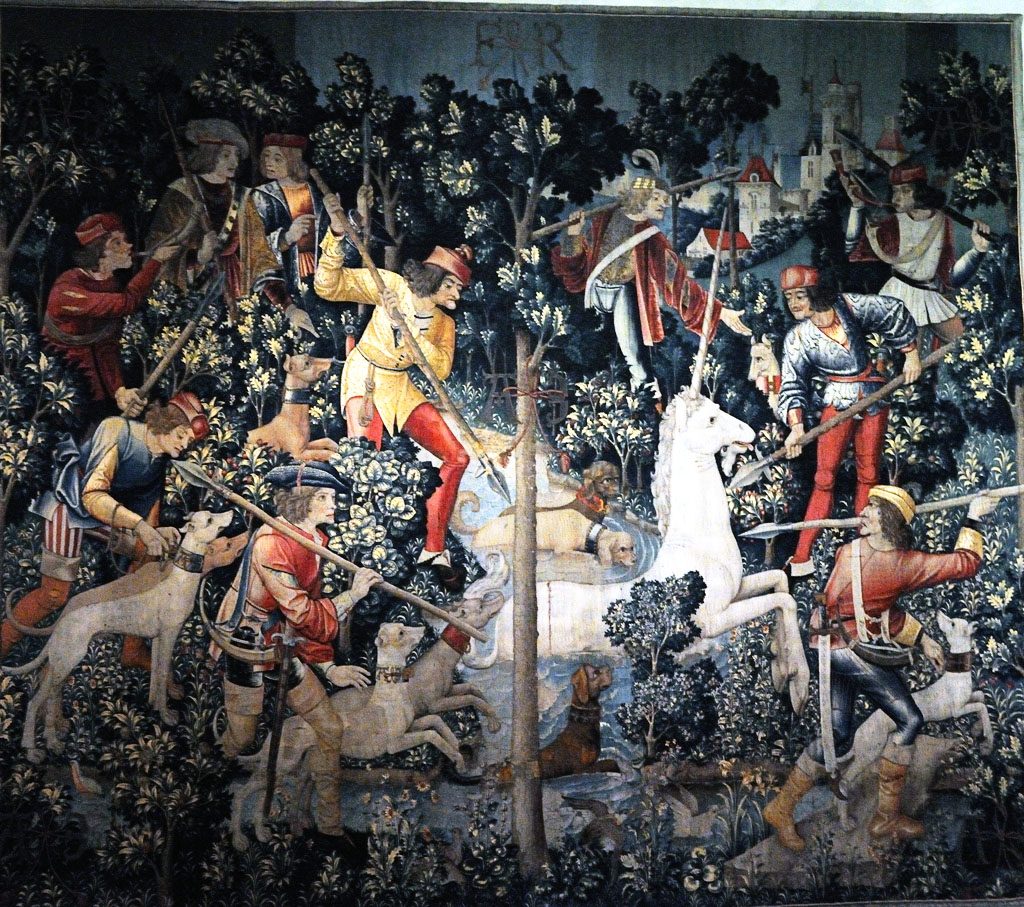
Medieval bestiaries - illustrated books of animals, real and imagined side by side - repeated the story for centuries, and medieval writers likened the unicorn to Christ, who raised up a horn of salvation and dwelt in the womb of the Virgin Mary. The hunt thus carried two meanings at once: purity and capture, and the Incarnation and Passion. Its supreme expression is the Unicorn Tapestries, seven hangings designed in Paris and woven in the southern Netherlands between 1495 and 1505, now at the Cloisters in New York, ending with the unicorn resting, tethered and content, in a flower-filled garden.
Alicorn: The Horn That Was a Whale's Tooth
Belief had a price, and the price was high. Cups said to be made of unicorn horn - alicorn - were treasured by kings, popes and nobles as protection against poisoned drink, and whole horns stood in royal treasuries. Britannica states the reality plainly: the cups were actually made of rhinoceros horn or narwhal tusk. The long, spiralling white tusks that reached Europe from the Arctic were, in the Metropolitan Museum's words, introduced in the late eleventh century and were soon believed to be unicorn horns. Northern traders who supplied them had every reason not to explain that the horn grew on a small Arctic whale.
The tusk fitted the legend too well to question: it was exactly the straight, twisted, ivory horn that art gave the unicorn, and its rarity kept prices at the level of treasure. In 1577 the English explorer Martin Frobisher found a dead narwhal in the Canadian Arctic and reported its two-yard horn as belonging to a sea unicorn.
Timeline
- c. 400 BCE
Ctesias describes a one-horned Indian wild ass whose horn protects drinkers from poison - the earliest Greek description.
- 1st century CE
Pliny the Elder describes the monoceros in his Natural History: horse's body, stag's head, elephant's feet, boar's tail and one black horn.
- Early centuries CE
The Physiologus teaches that the fierce unicorn can be captured only by a virgin, and reads the animal as a figure of Christ.
- 12th-13th centuries
Medieval bestiaries spread the unicorn across Europe; tradition links the animal to Scottish royal heraldry from the 12th century.
- c. 1484
Gold coins called unicorns and half-unicorns are issued in Scotland under James III, carrying the royal animal into everyday money.
- 1495-1505
The seven Unicorn Tapestries are designed in Paris and woven in the southern Netherlands; they are now at the Cloisters in New York.
- 1577
Martin Frobisher reports a horned fish in the Canadian Arctic - a narwhal, which he calls a sea unicorn.
- 1603
James VI of Scotland becomes James I of England; the royal arms of the united crowns set Scotland's unicorn beside England's lion.
- 1638
The Danish naturalist Ole Worm demonstrates publicly that prized alicorns are narwhal tusks, not unicorn horns.
- 1937-38
John D. Rockefeller Jr. gives the Unicorn Tapestries to the Metropolitan Museum of Art for the Cloisters.
Significance
The unicorn matters because it shows how knowledge worked before modern science. A belief could rest on respectable ancient authors, on scripture in translation, on allegory that made the animal theologically useful, and on physical horns that anyone could touch. The unicorn was not believed despite the evidence available; it was believed because of it. Its history is a lesson in how testimony, trade and symbolism can hold a false animal in place for two thousand years.
It also produced real art and real money. The tapestries at the Cloisters are among the most beautiful survivals of medieval art, the alicorn trade moved Arctic tusks across a continent at jewel prices, and in Scotland the animal became an emblem of purity and power: Scottish heraldic unicorns are shown chained, tradition says, because only a king was strong enough to hold so dangerous a beast.
Myths and disputes
Was there ever a real unicorn? No horse-like animal with a single forehead horn has ever been found, in life or in the fossil record, and this page presents none of the ancient reports as fact. Ctesias never visited India, and his animal is best explained as a traveller's composite in which the Indian rhinoceros looms largest, as Britannica suggests. Other sightings probably owe something to antelopes such as the oryx, seen in profile with its two horns lined up as one.
Did unicorn horn cure poison? No. Alicorn was narwhal ivory or rhinoceros horn, with no power to detect or neutralise poison; its reputation rested on the ancient claim, repeated from Ctesias onward, and on the confidence of the courts that paid for it. Even the Bible's unicorn is a translation effect: the Hebrew re'em is the wild ox.
When exactly did Scotland adopt the unicorn? Care is needed here too. Tradition credits William I in the 12th century, but no example from his reign survives; the oldest surviving royal arms with unicorn supporters are later, and the animal's prominence is firmly documented in the 15th century, on James III's coinage. The honest summary is that the association is medieval, royal and centuries old - and its precise first moment is lost.
Legacy
Science removed the unicorn from zoology and, in doing so, set it free. It became a pure symbol: of purity in heraldry, of Scotland on the royal arms of the United Kingdom, where the chained unicorn still stands opposite England's lion, and in modern culture of rarity itself - a valuable start-up is now called a unicorn because the creature stands for the almost impossibly rare.
The narwhal, meanwhile, inherited the romance under its own name, still widely called the unicorn of the sea. Few beliefs that turned out to be wrong have left so much beauty, or so honest a record of why people believed them.
Sources
- Encyclopaedia Britannica - Unicorn
- Encyclopaedia Britannica (1911) - Unicorn
- Metropolitan Museum of Art - The Unicorn Crosses a Stream (from the Unicorn Tapestries)
- Metropolitan Museum of Art - The Unicorn Rests in a Garden (from the Unicorn Tapestries)
- National Geographic - The Mystery of the Sea Unicorn
- Mental Floss - Why Is the Unicorn Scotland's National Animal?
The facts on this page were checked against these sources on 19 November 2026. The History Trail's permanent pages are researched and written for this site; the live profiles elsewhere on The History Trail are assembled automatically from Wikipedia and Wikidata.
About the Author
Researched and written by the The History Trail Editorial Team — the accountable editorial function behind this site's permanent story pages. The team works from the published sources cited on each page; it does not invent historians, reviewers or credentials, and it corrects errors openly.
Fact Check
Every load-bearing fact on this page traces to one of the sources listed above, and significant claims link to their source in the text. Our checking method is described on the methodology page; errors can be reported via the corrections page.
Sources & Citations
Cite this page as: The History Trail Editorial Team, The History Trail — this article's title, publication and update dates are shown beneath its headline. The full source list appears under Sources above; the site's source standards are on the sources page.